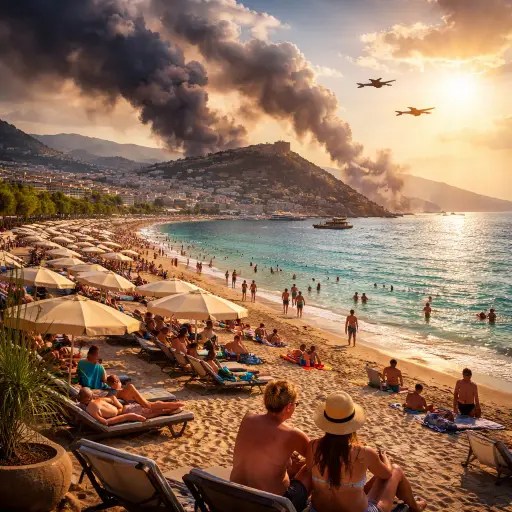
Regional tensions cloud summer outlook as travelers rethink destinations and industry braces for uncertainty
As the summer season approaches, Turkey’s vast tourism industry—long a pillar of the national economy—finds itself navigating an increasingly complex landscape shaped by nearby conflicts and shifting global perceptions of safety.
From the Mediterranean resorts of Antalya to the cultural corridors of Istanbul, early indicators suggest that while interest in travel to Turkey remains present, hesitation is growing. Industry insiders describe a cautious mood among international visitors, many of whom are weighing geopolitical risks more heavily than in previous years.
The country’s proximity to ongoing conflicts in neighboring regions has not resulted in direct disruptions to tourist areas. Yet perception, more than reality, is proving decisive. Travel agencies across Europe report a rise in last-minute booking delays, with customers seeking flexible options or redirecting plans toward destinations perceived as more distant from geopolitical tension.
“People are not necessarily canceling outright,” said one senior tour operator based in Western Europe. “But they are waiting longer to commit. That uncertainty is new, and it affects the entire booking cycle.”
Airlines and hotel groups are adapting quickly. Flexible cancellation policies, discounted early-bird offers, and targeted reassurance campaigns are being deployed to maintain demand. Turkish authorities have also intensified messaging around safety, emphasizing the stability of key tourist regions and the resilience of the country’s infrastructure.
Despite these efforts, the broader context remains difficult to ignore. War and instability in surrounding areas have reshaped global travel patterns, pushing tourists toward destinations perceived as insulated from geopolitical risk. Southern Europe, parts of Southeast Asia, and even domestic travel markets in major economies are benefiting from this shift.
For Turkey, the challenge is not only to retain its traditional visitor base but also to compete in an environment where risk perception can outweigh price and experience.
The economic implications are significant. Tourism accounts for a substantial share of Turkey’s foreign currency earnings, and any sustained slowdown could ripple through employment, local businesses, and national growth projections. Coastal regions, heavily reliant on seasonal visitors, are particularly vulnerable.
Hotel owners in resort areas describe a mixed picture. Some report steady bookings from repeat visitors who remain loyal to the destination, while others note a decline in first-time travelers. “Our regular guests still come,” said a hotel manager on the Aegean coast. “But new guests are more cautious. They ask more questions. They want guarantees.”
Meanwhile, luxury tourism appears somewhat insulated. High-end travelers, often less price-sensitive and more accustomed to curated travel experiences, continue to visit—albeit with increased demand for private transfers, security assurances, and personalized itineraries.
The Turkish government is working to diversify tourism flows, promoting cultural tourism, gastronomy, and off-season travel in an effort to reduce reliance on peak summer demand. There is also a growing focus on attracting visitors from alternative markets in the Middle East and Asia, where perceptions of regional proximity differ.
Still, industry leaders acknowledge that external factors remain beyond their control. “Tourism is always sensitive to global events,” said an industry association representative. “What is different now is the intensity and frequency of these events. Recovery windows are shorter, and uncertainty is more constant.”
At the same time, there are reasons for cautious optimism. Turkey’s tourism sector has demonstrated resilience in the past, rebounding from crises ranging from economic shocks to natural disasters. Its competitive pricing, diverse offerings, and well-developed infrastructure continue to make it an attractive destination.
Moreover, some analysts argue that travelers may gradually recalibrate their risk assessments. As conflicts persist without directly impacting tourist zones, confidence could stabilize, particularly if supported by consistent messaging and a trouble-free high season.
For now, however, the outlook remains finely balanced. The coming months will be critical in determining whether Turkey can sustain momentum or whether hesitation among travelers will translate into a tangible downturn.
What is clear is that the global tourism map is being redrawn—not by marketing campaigns or seasonal trends, but by the shifting contours of geopolitical reality. And for countries like Turkey, situated at the crossroads of continents and conflicts alike, the stakes have rarely been higher.
 The Tower Post