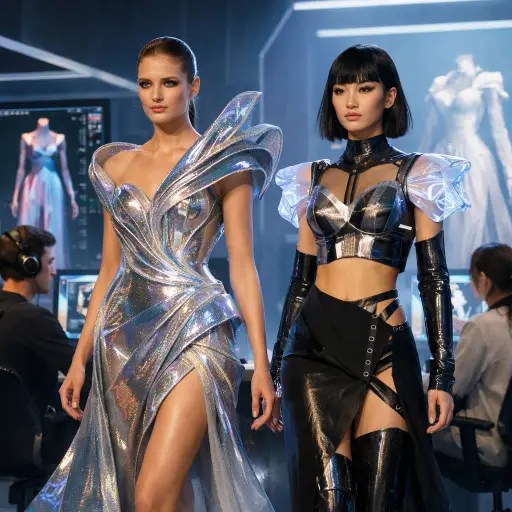
As artificial intelligence reshapes the design process, brands embrace digital-first collections while confronting new questions about authorship, originality, and the future of creativity.
The runway is no longer confined to fabric, thread, and the imagination of a single designer. Increasingly, it begins with data.
Across the fashion industry, artificial intelligence has moved from experimental tool to creative partner. Major brands and emerging labels alike are unveiling collections generated partially—or in some cases entirely—by AI systems trained on vast archives of silhouettes, textiles, cultural references, and historical trends. What once seemed like a novelty is now edging into the mainstream, reshaping not only how clothes are designed but also how creativity itself is defined.
In design studios from New York to Paris, algorithms are producing sketches in seconds, offering variations that would take human teams days to conceptualize. Designers describe the process less as replacement and more as acceleration. AI proposes; humans curate. The result is a hybrid workflow where intuition meets computation.
This shift is particularly visible in digital-first fashion—collections conceived initially for virtual spaces before being adapted, if at all, into physical garments. These designs often defy traditional constraints: gravity, material cost, and even wearability. Dresses shimmer with impossible textures, garments morph in real time, and silhouettes evolve dynamically on screen. What begins as pixels may later influence what appears on store racks, but the creative origin is increasingly intangible.
For brands, the appeal is clear. AI enables rapid prototyping, reduces production waste, and opens new avenues for personalization. A single design can be algorithmically adjusted to suit individual body types, preferences, or even moods. Consumers are no longer just buyers; they are participants in a feedback loop that informs the next iteration of design.
Yet the rise of AI-generated fashion also introduces a set of complex questions—ones that the industry is only beginning to grapple with.
Foremost among them is authorship. When a machine generates a design based on patterns learned from thousands of existing works, who owns the result? Is it the brand that deployed the technology, the engineers who built the model, or the countless designers whose creations were used to train it? Legal frameworks have yet to fully catch up, leaving a gray area that grows more pressing as AI-designed pieces reach commercial scale.
Creativity itself is also under scrutiny. Critics argue that AI, by its nature, recombines existing ideas rather than producing truly original ones. Supporters counter that all creativity builds on what came before—and that AI simply makes this process more visible. In this view, the role of the designer evolves rather than diminishes: from creator to editor, from originator to orchestrator.
There are cultural implications as well. Fashion has long been a reflection of identity, heritage, and human experience. As algorithms take on a greater role, concerns emerge about the potential homogenization of style. If AI systems are trained on dominant aesthetics, will they reinforce existing norms at the expense of diversity? Or can they be guided to amplify underrepresented voices in new and unexpected ways?
Some designers are already using AI as a tool for exploration rather than efficiency. By feeding models with niche or unconventional inputs, they are generating outputs that challenge traditional notions of beauty and form. In these cases, AI becomes less a shortcut and more a catalyst for experimentation.
Meanwhile, consumers are encountering AI fashion not only on runways but also in everyday digital environments. Virtual wardrobes, gaming platforms, and augmented reality experiences are introducing garments that exist purely in digital form. These items, often purchased and worn online, signal a broader shift in how fashion is consumed and valued. Ownership is no longer tied exclusively to physical possession.
Retailers are paying close attention. Digital garments offer high margins and zero material waste, aligning with both economic and sustainability goals. At the same time, they require a rethinking of what it means to “wear” fashion in an increasingly hybrid physical-digital world.
Despite the enthusiasm, the transition is not without friction. Traditional artisans worry about the erosion of craftsmanship, while younger designers navigate a landscape where technical literacy is becoming as important as aesthetic sensibility. Fashion schools are beginning to adapt, incorporating AI tools into their curricula and encouraging students to view technology as an extension of their creative toolkit.
The industry now stands at a crossroads. AI is not replacing designers, but it is undeniably changing the terms of their work. The question is no longer whether artificial intelligence belongs in fashion, but how it will be integrated—and who will shape its role.
As collections generated with the help of algorithms continue to appear on runways and in digital spaces, one thing is clear: the definition of fashion is expanding. It is no longer limited to what can be cut, sewn, and worn, but includes what can be imagined, rendered, and experienced.
In this evolving landscape, creativity remains at the center—but it is a creativity shared between human and machine, each influencing the other in ways that are only beginning to be understood.



 The Tower Post