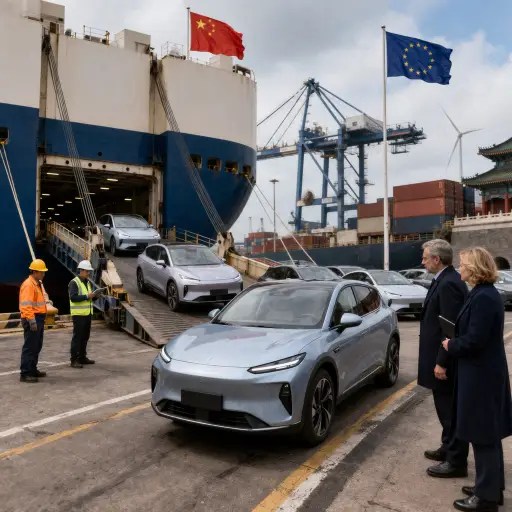
New pricing framework signals cautious détente as both sides seek balance between fair competition and green transition goals
The European Union and China have taken a significant new step toward easing tensions in their long-running dispute over electric vehicle subsidies, signaling a cautious shift from confrontation to negotiation at a critical moment for the global clean energy transition.
The latest development centers on a jointly acknowledged framework that allows Chinese electric vehicle manufacturers to propose minimum pricing commitments for cars exported to Europe. The mechanism, outlined in recent guidance from the European Commission and endorsed by Chinese authorities, offers a potential alternative to punitive tariffs that have strained trade relations since their introduction.
The dispute traces back to an EU anti-subsidy investigation launched amid concerns that Chinese EV producers were benefiting from extensive state support, enabling them to undercut European competitors. The inquiry ultimately led to the imposition of countervailing duties on Chinese-made battery electric vehicles, with rates reaching up to roughly a third of the vehicle’s value.
While Brussels has defended the measures as necessary to ensure fair competition, Beijing has consistently criticized them as protectionist, even escalating the issue to the World Trade Organization.
Now, however, both sides appear willing to explore compromise.
A shift from tariffs to pricing discipline
At the heart of the emerging solution is the concept of price undertakings. Under this approach, Chinese manufacturers can commit to selling their vehicles in Europe above a certain minimum price, effectively neutralizing the competitive advantage derived from state subsidies.
European officials have framed the mechanism as a pragmatic tool designed to preserve market openness while addressing concerns about distortion. Any proposed pricing commitments must be sufficient to remove the injurious effects of subsidization and will be assessed individually for each model.
For Chinese automakers, the framework offers a pathway to maintain access to one of the world’s most lucrative EV markets without facing the full burden of tariffs that, when combined with standard import duties, can approach nearly half the vehicle’s value.
Industry observers say the approach reflects a broader recalibration of trade policy, as governments attempt to reconcile industrial strategy with the urgency of climate goals.
Economic stakes and political sensitivities
The stakes are high on both sides.
Europe’s automotive sector, a cornerstone of its industrial base, has voiced alarm over the rapid influx of lower-cost Chinese EVs. Policymakers argue that unchecked imports could threaten domestic manufacturers already grappling with high energy costs and the expensive transition to electrification.
At the same time, China has emerged as a dominant force in the EV supply chain, with competitive pricing and scale that have accelerated global adoption of electric mobility. European consumers, facing inflationary pressures, have increasingly been drawn to more affordable imported models.
This tension has made the dispute as much about industrial sovereignty as it is about trade.
Recent months have also seen signs of retaliatory friction, including Chinese investigations into European agricultural exports, underscoring the broader geopolitical implications of the standoff.
A delicate balancing act
The new framework does not eliminate tariffs outright, but it introduces flexibility that could soften their impact. Manufacturers willing to meet pricing conditions and, in some cases, demonstrate investment plans within the EU may secure exemptions or reduced duties.
This case-by-case approach reflects the EU’s attempt to remain aligned with World Trade Organization rules while maintaining leverage in negotiations. Officials have emphasized that all proposals will be evaluated objectively and fairly, reinforcing the bloc’s commitment to a rules-based system.
For China, the willingness to engage on pricing commitments suggests a strategic calculation: preserving market access in Europe may outweigh the costs of adjusting export strategies.
Implications for the global EV race
Beyond bilateral relations, the evolving EU-China dynamic carries significant implications for the global EV market.
The dispute has already influenced corporate strategy, with some manufacturers reconsidering production locations, pricing models, and investment plans in Europe. Meanwhile, policymakers in other regions are closely watching the outcome as they develop their own responses to China’s growing dominance in green technologies.
Analysts note that a negotiated settlement, even a partial one, could help stabilize supply chains and reduce uncertainty at a time when the industry is scaling rapidly.
Yet challenges remain.
Differences within the EU itself, where member states have taken varying positions on tariffs, highlight the complexity of forging a unified approach. Meanwhile, the underlying question of how to address state subsidies in a globalized economy remains unresolved.
A cautious step forward
For now, the new guidance represents a tentative but meaningful step toward de-escalation.
Rather than deepening a trade conflict that risks spilling into other sectors, both Brussels and Beijing appear to be testing a more nuanced path, one that blends enforcement with negotiation.
Whether this approach will lead to a durable resolution remains uncertain. But as the global transition to electric mobility accelerates, the ability of major economies to manage competition without undermining cooperation may prove decisive.
In that sense, the latest move is less an endpoint than the beginning of a more complex phase in EU-China economic relations, one where compromise, however fragile, is becoming a necessity rather than an option.



 The Tower Post