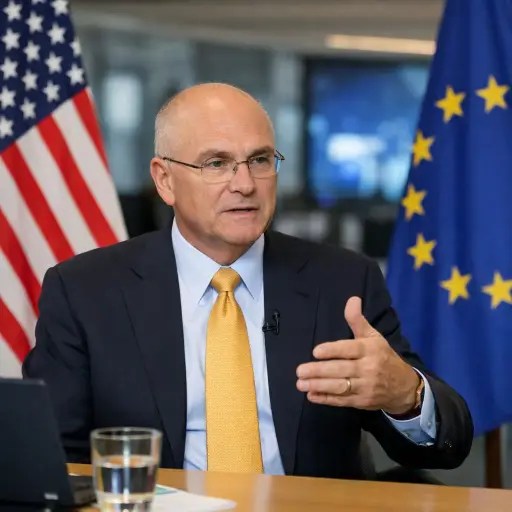
Ambassador Andrew Puzder warns that stricter oversight of American tech giants could sideline the European Union in the rapidly evolving artificial intelligence economy
As the global race to dominate artificial intelligence accelerates, tensions between regulatory caution and economic ambition are once again surfacing across the Atlantic. In a recent interview with CNBC, U.S. Ambassador to the European Union Andrew Puzder delivered a pointed message: if Europe wants to remain relevant in the AI-driven future, it may need to ease its regulatory stance toward major American technology firms.
Puzder’s remarks come at a critical juncture, as policymakers in Brussels continue to refine a sweeping framework governing digital markets, competition, and artificial intelligence. While European officials argue that robust rules are essential to protect consumers, privacy, and fair competition, critics—including the U.S. envoy—warn that excessive oversight risks stifling innovation and discouraging investment.
“The AI economy is moving quickly, and capital follows opportunity,” Puzder said, emphasizing that regulatory burdens could drive leading firms—and their cutting-edge research—elsewhere. His comments reflect growing concern in Washington that Europe’s regulatory approach may inadvertently weaken its own position in one of the most transformative technological shifts in decades.
At the heart of the debate lies a fundamental question: can Europe strike a balance between safeguarding public interests and fostering a competitive environment for innovation?
The European Union has long positioned itself as a global standard-setter in digital governance. From landmark privacy rules to antitrust actions targeting dominant platforms, Brussels has taken a proactive—and often assertive—role in shaping the behavior of large technology companies. More recently, its focus has expanded to artificial intelligence, with policymakers aiming to establish guardrails around high-risk applications while encouraging trustworthy development.
However, industry leaders and some policymakers argue that the cumulative effect of these measures may be counterproductive. They contend that compliance costs, legal uncertainty, and slower approval processes could deter both domestic startups and international tech giants from investing heavily in Europe’s AI ecosystem.
Puzder’s critique echoes these concerns. By singling out U.S. “big tech” firms, he highlighted the central role American companies continue to play in advancing AI capabilities—from foundational models to cloud infrastructure. Restricting their operations too aggressively, he suggested, could limit Europe’s access to the very tools and partnerships needed to compete globally.
Yet European officials remain cautious. Many argue that the risks associated with AI—ranging from misinformation to algorithmic bias and labor displacement—require a strong regulatory response. They point out that unchecked technological expansion could erode public trust and create long-term societal costs that outweigh short-term economic gains.
Moreover, some policymakers reject the notion that regulation and innovation are inherently at odds. Instead, they see well-designed rules as a means of creating a stable and predictable environment in which businesses can thrive. By setting clear standards, Europe hopes to build a model of “trustworthy AI” that could become a competitive advantage in its own right.
Still, the urgency of the moment is hard to ignore. The United States and China are investing heavily in AI development, with both public and private sectors pouring resources into research, infrastructure, and talent acquisition. In this context, even a slight delay or disadvantage could have significant implications for Europe’s long-term economic position.
Analysts note that Europe’s challenge is not only regulatory but structural. The region has historically lagged behind in scaling technology companies to the level of its American and Chinese counterparts. Fragmented markets, limited access to venture capital, and slower commercialization processes have all contributed to this gap. Stricter regulations, critics argue, could exacerbate these existing challenges.
At the same time, there are signs that Europe is seeking to recalibrate. Recent discussions among policymakers suggest a growing awareness of the need to support innovation alongside regulation. Initiatives aimed at boosting AI research, fostering cross-border collaboration, and attracting investment are gaining traction, even as the regulatory framework continues to evolve.
Puzder’s comments may therefore serve as both a warning and an opportunity. By highlighting the potential trade-offs of its current approach, he has added momentum to an ongoing debate within Europe about how best to position itself in the AI era.
For businesses operating on both sides of the Atlantic, the outcome of this debate will be closely watched. A more flexible regulatory environment could encourage deeper collaboration between European institutions and American tech firms, accelerating the development and deployment of AI technologies. Conversely, a more restrictive approach could lead to greater fragmentation, with companies adapting their strategies to navigate diverging regulatory landscapes.
Ultimately, the question is not whether Europe should regulate artificial intelligence, but how it can do so in a way that preserves both its values and its competitiveness. As the AI economy continues to expand, the decisions made in Brussels will shape not only the region’s future but also the global trajectory of one of the most powerful technologies of our time.
For now, Puzder’s message is clear: in a world where innovation moves at unprecedented speed, hesitation—or overregulation—may come at a cost Europe can ill afford.



 The Tower Post