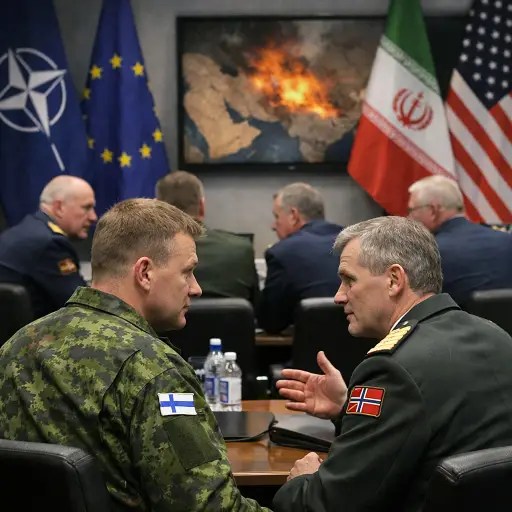
Finland and Norway reject framing of Iran war as alliance issue, while Europe prioritizes Ukraine and internal defense—revealing widening cracks in transatlantic coordination.
As tensions surrounding the escalating conflict involving Iran continue to reverberate across global security circles, European governments are increasingly signaling a clear strategic distance. Rather than rallying behind a unified Western response, several key European actors are reframing the situation as peripheral to their immediate security concerns—marking a notable shift in alliance dynamics and exposing fractures within NATO.
At the forefront of this repositioning are Finland and Norway, two northern European states whose recent integration into NATO had been widely interpreted as strengthening the alliance’s cohesion. Yet both countries have taken a cautious stance, emphasizing that the Iran conflict does not fall within NATO’s core mandate.
Officials from Helsinki and Oslo have underscored that NATO’s primary obligation remains collective defense within the Euro-Atlantic area. In their view, the unfolding situation in the Middle East, while serious, does not trigger alliance mechanisms nor justify direct military involvement. This perspective reflects a broader recalibration underway across Europe, where strategic bandwidth is increasingly dominated by concerns closer to home.
A Shift in Strategic Priorities
Europe’s security focus remains overwhelmingly centered on the ongoing war in Ukraine. Military planning, budget allocations, and political messaging across the continent continue to prioritize deterrence against Russia and the stabilization of Eastern Europe.
For many policymakers, the Ukraine conflict represents an existential challenge to European security architecture. By contrast, the Iran war is seen as geographically and strategically distinct—complex, volatile, but not immediately threatening to European territory.
This prioritization is also reflected in defense spending patterns. Several European governments are channeling resources into reinforcing their own armed forces, expanding ammunition stockpiles, and modernizing infrastructure. The emphasis is on readiness and resilience within Europe itself, rather than expeditionary operations in distant theaters.
Behind closed doors, diplomats acknowledge a growing fatigue with prolonged external engagements. The lessons of past interventions continue to weigh heavily, reinforcing a cautious approach toward new military commitments outside the continent.
Diverging Views Within the Alliance
The divergence between European and American perspectives is becoming increasingly visible. While Washington appears more inclined to frame the Iran conflict within a broader security narrative, many European capitals are resisting that framing.
This difference is not necessarily a rupture, but it highlights a subtle yet important evolution in transatlantic relations. European leaders are asserting a greater degree of strategic autonomy, carefully delineating where alliance solidarity applies—and where it does not.
Within NATO discussions, this has translated into nuanced language and carefully calibrated statements. There is support for diplomatic efforts, concern over regional stability, and acknowledgment of risks to global energy markets. However, there is little appetite for invoking collective defense principles or expanding NATO’s operational scope.
Finland and Norway’s position is particularly significant because it comes from countries traditionally aligned with strong transatlantic cooperation. Their stance suggests that even among NATO’s most committed members, there is a growing consensus about the limits of alliance engagement.
Internal Pressures and Political Realities
Domestic political considerations are also shaping Europe’s response. Governments across the continent are navigating complex public opinion landscapes, where voters are increasingly wary of foreign entanglements.
Economic pressures, energy transitions, and social challenges are competing for attention and resources. In this context, committing to another external conflict—especially one perceived as distant—carries significant political risks.
There is also an underlying concern about overstretch. European militaries, already heavily engaged in supporting Ukraine, face logistical and operational constraints. Opening a new front, even indirectly, could strain capabilities at a time when readiness is paramount.
As a result, European leaders are adopting a measured tone, emphasizing diplomacy, de-escalation, and regional solutions rather than military intervention.
Implications for Transatlantic Coordination
The emerging gap in priorities is raising questions about the future of transatlantic coordination. While NATO remains a cornerstone of European security, its role in addressing conflicts beyond its traditional area of responsibility is increasingly contested.
Analysts note that this moment reflects a broader trend: the gradual redefinition of alliance boundaries in a multipolar world. As threats diversify and regional dynamics evolve, NATO members are reassessing how and where the alliance should act.
For the United States, this could mean navigating a more complex partnership, where European support is not automatic across all theaters. For Europe, it represents an opportunity—and a challenge—to articulate a more independent strategic identity.
A Delicate Balancing Act
Despite these differences, European leaders are careful to avoid signaling disunity. Public messaging continues to emphasize solidarity, shared values, and the importance of maintaining strong transatlantic ties.
The challenge lies in balancing this unity with divergent strategic priorities. Europe’s approach to the Iran conflict illustrates this tension: supportive in principle, cautious in practice, and firmly anchored in its own security calculus.
As the situation evolves, the extent of these divisions—and their impact on alliance cohesion—will become clearer. For now, what is evident is a Europe increasingly focused inward, determined to safeguard its own stability while navigating a complex and uncertain global landscape.
In this context, the Iran war is not being ignored. But it is being placed firmly outside the immediate scope of European—and NATO—action. And in that distinction lies a quiet but consequential shift in how the alliance understands its role in the world.



 The Tower Post