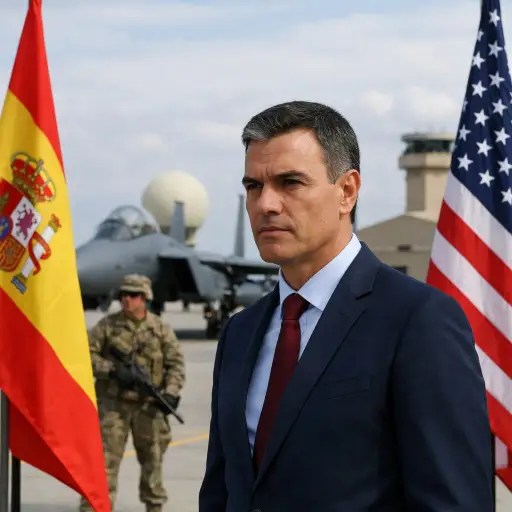
Pedro Sánchez rejects U.S. access to Spanish bases, reshaping Europe’s anti-war stance and exposing deep divisions within the West
In a move that has reverberated across diplomatic corridors on both sides of the Atlantic, Spanish Prime Minister Pedro Sánchez has refused to grant the United States military expanded access to key Spanish bases amid escalating tensions surrounding a potential conflict with Iran. The decision places Spain at the forefront of European resistance to military escalation and marks one of the most significant transatlantic disagreements in recent years.
The refusal directly challenges pressure from Donald Trump, whose administration has sought broader logistical support from European allies in anticipation of possible military operations in the Middle East. Spain’s strategic bases—long considered essential nodes for U.S. operations—have historically symbolized close cooperation between Spain and the United States. Sánchez’s decision disrupts that tradition.
A calculated break from Washington
Government officials in Madrid describe the move not as an act of defiance, but as a principled stand rooted in international law and domestic political consensus. Sánchez has framed his position as a rejection of preemptive military logic, emphasizing diplomacy and multilateralism over force.
Behind the scenes, however, the decision reflects a broader recalibration of Spain’s foreign policy. Sánchez has steadily sought to position himself as Europe’s most vocal advocate for de-escalation, aligning with public opinion that remains deeply skeptical of another Middle Eastern conflict.
The stakes are high. U.S. access to Spanish installations—particularly naval and air bases—has long been integral to rapid deployment capabilities. By limiting that access, Spain complicates operational planning at a critical moment.
Europe divided
Sánchez’s stance has not been universally embraced within the European Union. While some southern and western European governments quietly sympathize with Spain’s caution, others—particularly in eastern Europe—have expressed concern that the move undermines collective security and transatlantic unity.
France and Germany have responded with measured language, calling for restraint while avoiding direct endorsement of Spain’s position. Meanwhile, several NATO-aligned governments have privately questioned whether Sánchez’s approach risks emboldening adversaries by signaling division among Western allies.
The result is a fragmented European response at a moment when cohesion is typically paramount. Analysts note that Sánchez has effectively forced a debate that many leaders had hoped to avoid: whether Europe should automatically align with Washington in times of crisis, or assert a more independent strategic posture.
Domestic politics and public sentiment
At home, Sánchez’s decision appears to resonate strongly with the Spanish public. Polling and political discourse suggest widespread fatigue with foreign military engagements and a preference for diplomatic solutions.
Opposition parties have criticized the move as potentially damaging to Spain’s international standing, warning that it could strain long-standing defense agreements. Yet even critics have been cautious, aware that public opinion heavily favors avoiding entanglement in another war.
For Sánchez, the political calculus is clear. By adopting a firm anti-war stance, he not only reinforces his domestic legitimacy but also distinguishes himself within a crowded European leadership landscape.
A test for NATO and transatlantic ties
The implications extend far beyond Spain. The dispute raises broader questions about the future of NATO cooperation and the durability of transatlantic alliances under strain.
For decades, the relationship between Europe and the United States has been anchored in shared security commitments. Spain’s refusal introduces a new variable: the possibility that individual allies may selectively disengage from U.S.-led operations based on political or legal considerations.
Washington has responded with visible frustration, though officials have stopped short of open confrontation. Diplomatic channels remain active, and both sides appear eager to avoid a full rupture. Still, the episode underscores a growing divergence in strategic priorities.
Sánchez’s emerging role
Within this shifting landscape, Sánchez has emerged as a prominent—if controversial—voice. His approach blends traditional European skepticism toward military intervention with a more assertive willingness to challenge U.S. policy directly.
Supporters argue that this marks a necessary evolution in Europe’s global role. By asserting independence, they say, leaders like Sánchez can help rebalance a relationship long dominated by Washington.
Critics counter that such moves risk weakening collective deterrence and sending mixed signals at a critical juncture. They warn that unity, even if imperfect, remains the cornerstone of Western influence.
Uncertain consequences
As tensions continue to unfold, the full impact of Spain’s decision remains uncertain. Much will depend on whether diplomatic efforts succeed in defusing the situation with Iran, and whether other European nations follow Sánchez’s lead or distance themselves from his stance.
What is clear is that the episode has already reshaped the conversation. Spain is no longer merely a participant in transatlantic policy—it is a driver of debate.
For Sánchez, the gamble is both political and historical. By refusing to align automatically with Washington, he has positioned himself as a defining figure in Europe’s ongoing struggle to reconcile alliance commitments with strategic autonomy.
Whether that position ultimately strengthens or fractures the Western alliance is a question that remains unanswered—but no longer avoidable.



 The Tower Post