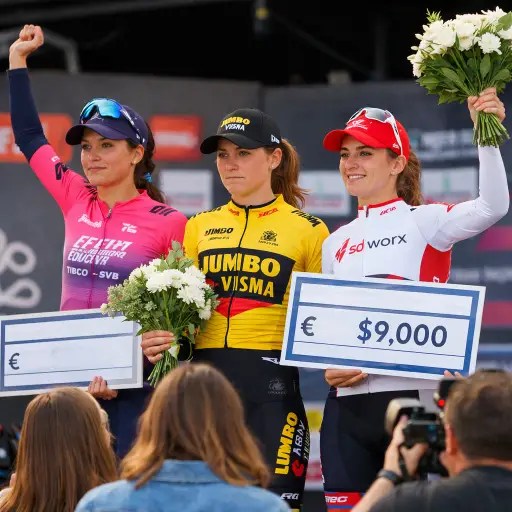
Professional riders push for equal pay as sponsors and organizers face growing scrutiny across Europe
As the European cycling calendar builds momentum toward the summer season, a renewed debate over prize money in women’s professional cycling is gaining urgency. Riders, teams, and advocates are calling for tangible action, arguing that progress in visibility and professionalism has not yet been matched by financial equality.
The issue has come sharply into focus following a series of high-profile European races where disparities in prize purses between men’s and women’s events were once again laid bare. While organizers have made strides in elevating women’s races—through improved broadcasting, expanded race calendars, and increased sponsorship—the financial rewards remain uneven.
For many riders, the discrepancy is no longer acceptable.
“We’re racing the same roads, attracting growing audiences, and delivering high-level performances,” said one professional cyclist competing on the WorldTour circuit. “The sport has evolved, but the prize structures haven’t kept pace.”
In recent seasons, women’s cycling has experienced a surge in popularity. Landmark races now draw global viewership, and teams benefit from more structured contracts and minimum salary requirements. Yet, despite these advances, prize money continues to reflect a legacy gap that riders say undermines the sport’s credibility.
The pressure is increasingly directed at race organizers and sponsors, who are seen as key agents of change. Several major brands have expanded their investment in women’s cycling, aligning with broader commitments to gender equality in sport. However, critics argue that sponsorship growth must translate into equitable financial rewards at the competition level.
“There’s a clear mismatch between the commercial narrative and the financial reality,” noted a team manager familiar with ongoing negotiations. “If the sport is being marketed as equal, then prize money needs to follow that message.”
Some race organizers have begun to respond. A handful of events have announced plans to narrow the prize gap or align payouts more closely between men’s and women’s competitions. These moves, while welcomed, are viewed by many as incremental rather than transformative.
Advocacy groups within cycling are now calling for standardized prize structures across major races, suggesting that governing bodies could play a stronger role in enforcing parity. While regulations around minimum salaries have been introduced in recent years, prize money remains largely at the discretion of individual event organizers.
The debate is also resonating beyond the peloton. Fans and commentators have increasingly taken to social media to highlight disparities, amplifying pressure on stakeholders. Broadcasters, too, are seen as influential players, as increased coverage of women’s races continues to boost the sport’s commercial appeal.
Importantly, the conversation is no longer confined to equality as a principle—it is now framed as a question of sustainability. Many riders depend on prize money as a meaningful component of their income, particularly outside the top tier of the sport. Unequal payouts, they argue, can directly impact career longevity and competitive balance.
With the summer racing season approaching, expectations are rising that organizers will take more decisive action. Several upcoming events are already under scrutiny, with riders and teams signaling that they will continue to speak out if disparities persist.
“There’s a real sense that this is a turning point,” said another rider. “We’ve seen how quickly the sport can grow when there’s investment and belief. Now it’s about making sure that growth is fair.”
As women’s cycling continues its upward trajectory, the prize money debate is emerging as a defining issue. Whether the coming months bring meaningful change may depend on how willing the sport’s key stakeholders are to match ambition with action.



 The Tower Post