Behind closed doors, quiet diplomacy, and a youth-focused message shape a surprise papal trip that caught even seasoned observers off guard
The announcement came quietly, almost discreetly, and yet its impact rippled quickly across ecclesiastical and diplomatic circles. In a move that surprised both Vatican watchers and French bishops alike, Pope Leo XIV chose to visit the Principality of Monaco for a tightly scheduled and largely understated day of encounters.
The decision, according to sources close to the Holy See, had been in preparation for some time, though intentionally kept under wraps. Unlike grand apostolic journeys often marked by extensive public programming and global media anticipation, this visit unfolded with a different tone: measured, focused, and deliberately restrained.
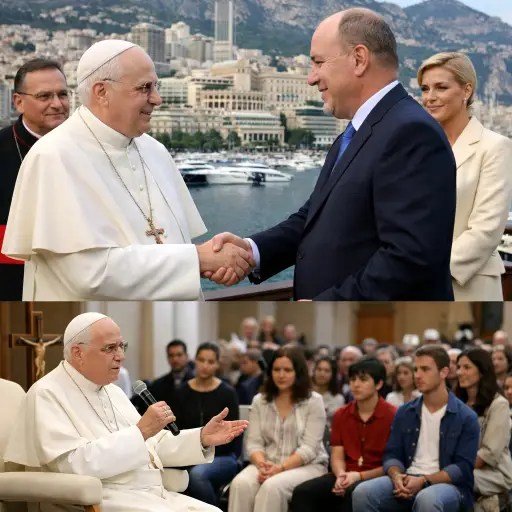
At the heart of the visit lies a private meeting with Prince Albert II, a conversation that, while not officially detailed, is understood to center on shared concerns about environmental stewardship, migration across the Mediterranean, and the role of small states in global diplomacy. Monaco, with its unique geopolitical position and longstanding ties to Catholic tradition, offers a symbolic stage for discussions that extend far beyond its borders.
Observers note that Pope Leo XIV has shown a growing interest in engaging with smaller nations and microstates, viewing them as laboratories of governance and moral responsibility in an increasingly fragmented world. The meeting with the Monegasque sovereign, therefore, is less ceremonial than strategic, reflecting a broader vision of dialogue between moral authority and political leadership.
Yet the visit is not confined to diplomatic exchanges. In what many see as the most telling aspect of the trip, the Pope is dedicating significant time to young people and catechumens. The encounter, expected to be intimate and conversational, aligns with a pastoral priority that has defined his pontificate: rebuilding a direct relationship between the Church and younger generations.
Participants describe the gathering as an opportunity for open dialogue rather than formal catechesis. Questions of faith, identity, and belonging are expected to take center stage, particularly among those preparing for baptism or rediscovering their spiritual path. For Pope Leo XIV, these encounters are not peripheral but central to his mission, offering a glimpse into the future of a Church seeking renewal from within.
The culmination of the day will take place at the Stade Louis-II, where the Pope will celebrate Mass before a diverse assembly of the faithful. The choice of venue, more commonly associated with sporting events than liturgical celebrations, carries its own significance. It reflects an effort to bring the Church into spaces of everyday life, bridging the gap between sacred tradition and contemporary experience.
Behind the scenes, the logistics of the visit have been carefully orchestrated to balance security with accessibility. Local authorities, in coordination with Vatican officials, have opted for a streamlined approach, avoiding excessive spectacle while ensuring that the essential moments of the visit remain open to the public.
For French bishops, some of whom expressed quiet surprise at the destination and timing, the visit raises questions about shifting pastoral priorities within the region. Monaco, though geographically small, occupies a distinct ecclesial position, and its selection underscores a willingness by the Pope to move beyond traditional centers of influence.
There is also a symbolic dimension to the timing. Without anchoring the visit to a specific commemorative date, the Pope appears to favor a more fluid approach to his agenda, one that allows for responsiveness rather than rigid planning. This flexibility, insiders suggest, is becoming a hallmark of his leadership style.
Ultimately, the significance of the visit may lie less in its immediate outcomes than in its underlying message. By choosing Monaco, by prioritizing youth engagement, and by conducting much of the visit away from the spotlight, Pope Leo XIV is signaling a shift toward a quieter, more relational form of papal presence.
In a world accustomed to grand gestures and sweeping declarations, this discreet journey offers a different kind of narrative: one of listening, encounter, and carefully calibrated influence. Whether in private conversation with a head of state or in dialogue with young seekers, the Pope’s message appears consistent—change begins not with spectacle, but with attention.
As the day unfolds along the Mediterranean coast, what remains most striking is not the scale of the visit, but its intention. In its simplicity, it reveals a pontificate that is still defining itself, one step at a time, often where few expect it.


 The Tower Post