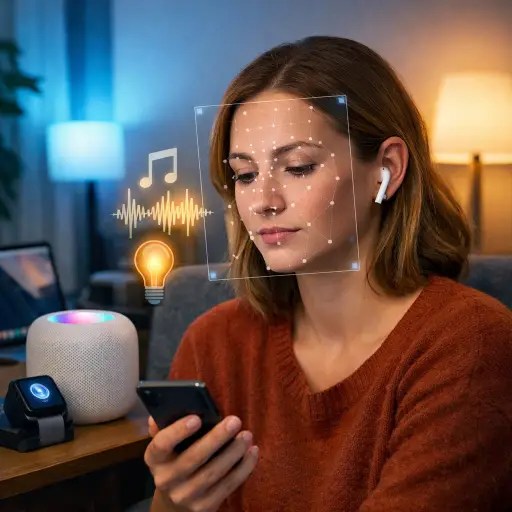
As devices begin to sense how we feel, the line between helpful innovation and intrusive surveillance grows increasingly thin
In the early days of March, whispers began circulating across the technology sector: Apple may be testing a new generation of devices capable of detecting human emotions. According to multiple industry sources familiar with early-stage prototypes, the company is exploring ways for its hardware to interpret facial expressions, vocal tone, and behavioral patterns—subtly reshaping how devices respond to users in real time.
If confirmed, the move would mark one of the most significant shifts in consumer technology since the introduction of voice assistants. But unlike earlier innovations, emotion-aware systems venture into deeply personal territory, raising urgent questions about privacy, consent, and the future relationship between humans and machines.
At the core of this development is a convergence of existing technologies. Apple devices already incorporate advanced cameras, microphones, and machine learning capabilities. What appears to be new is how these inputs are being combined. Engineers are reportedly training models to recognize micro-expressions—fleeting facial cues that signal emotional states—as well as variations in speech patterns, such as hesitation, pitch, and rhythm.
The potential applications are both subtle and expansive. A device might detect signs of stress in a user’s voice and automatically silence non-essential notifications. Music playback could shift toward calmer or more uplifting tracks depending on perceived mood. Lighting systems integrated with smart home ecosystems might dim or warm in response to emotional cues, creating environments designed to soothe or energize.
On paper, the concept aligns with Apple’s long-standing focus on seamless user experience. Technology that adapts intuitively, without explicit commands, represents the next logical step in interface design. Instead of tapping, swiping, or speaking, users would simply exist—and devices would respond.
Yet this vision carries a deeper implication: devices would need to continuously observe and interpret human behavior. Even if processing remains on-device, as Apple has historically emphasized, the act of emotional inference introduces a new layer of intimacy between user and machine.
Privacy advocates have been quick to highlight the risks. Emotional data, unlike location or browsing history, reveals internal states—how a person feels in a given moment. Such information could be extraordinarily valuable, not only for improving user experience but also for targeted advertising, behavioral prediction, or even manipulation.
Apple’s reputation for prioritizing privacy may offer some reassurance. The company has consistently positioned itself as a counterweight to data-driven business models that rely on extensive cloud tracking. Industry analysts suggest that if emotion-aware features are introduced, they will likely emphasize local processing and user control, potentially allowing individuals to opt in or out of specific functions.
Still, skepticism remains. Even with safeguards in place, the normalization of emotion-tracking technology could set broader precedents. Competitors may adopt similar features with fewer restrictions, accelerating a shift toward pervasive emotional surveillance across the digital ecosystem.
There is also the question of accuracy. Human emotions are complex, culturally nuanced, and often ambiguous. A smile does not always indicate happiness; silence does not always signal calm. Misinterpretations could lead to frustrating or even harmful interactions, particularly in sensitive contexts such as mental health or personal communication.
Experts in human-computer interaction caution that overreliance on inferred emotions may oversimplify human experience. Devices that attempt to “understand” users risk reinforcing narrow definitions of emotional states, potentially shaping behavior in subtle ways. For example, if a system consistently responds to perceived sadness by promoting certain types of content, it may inadvertently guide users toward specific emotional patterns.
Despite these concerns, the momentum behind emotion-aware computing appears difficult to ignore. Advances in artificial intelligence have made it increasingly feasible to analyze complex human signals in real time. What was once confined to research labs is now edging closer to everyday products.
For Apple, the stakes are particularly high. The company’s ecosystem—spanning phones, watches, earbuds, and home devices—positions it uniquely to integrate emotional awareness across multiple touchpoints. A user’s mood detected through a wearable could influence interactions on a phone or even a home environment, creating a cohesive, responsive digital experience.
Whether this future will be embraced or resisted remains uncertain. Much will depend on how transparently the technology is introduced, how much control users retain, and how effectively privacy concerns are addressed.
What is clear is that the next phase of personal technology is no longer just about what devices can do, but how they understand us. As machines begin to interpret not only our actions but our emotions, the definition of “personal” technology is being rewritten.
In that shift lies both promise and unease—a delicate balance between convenience and intrusion that will shape the trajectory of innovation in the years ahead.



 The Tower Post