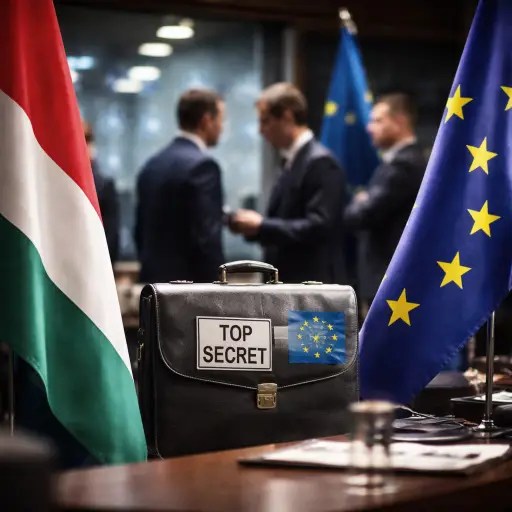
Allegations of leaked European Union secrets to Russia deepen divisions and raise urgent questions about trust and security within the bloc
A growing political storm is sweeping across Europe as Hungary faces mounting scrutiny over allegations that sensitive European Union information may have been leaked to Russia. The controversy, still unfolding, has reignited long-standing tensions between Budapest and several EU member states, while exposing deeper concerns about internal cohesion, intelligence-sharing, and mutual trust within the bloc.
At the center of the dispute are claims, reported by multiple European officials and security sources, that individuals linked to Hungarian institutions may have facilitated the transfer of confidential EU material to actors associated with Russian intelligence. While the details remain partly classified, the implications are already reverberating through diplomatic and political channels across Europe.
Hungarian authorities have firmly denied any wrongdoing, dismissing the accusations as politically motivated and lacking substantiated evidence. Government representatives have argued that Hungary remains a committed member of the European Union and a reliable partner in matters of security and cooperation. Yet, for many in Brussels and other European capitals, the issue is less about legal conclusions at this stage and more about perception, risk, and the fragility of trust.
The scandal comes at a particularly sensitive moment for the European Union, which has sought to maintain a unified front in response to geopolitical pressures, especially those involving Russia. Since the escalation of tensions between Moscow and Western institutions in recent years, intelligence-sharing and coordinated policy responses have become central to the EU’s strategic posture. Any suggestion that internal leaks could compromise these efforts is therefore treated with utmost seriousness.
Diplomats from several member states have expressed concern that the allegations, whether ultimately proven or not, could undermine the confidence necessary for effective cooperation. Intelligence collaboration within the EU relies heavily on trust, often informal and built over years of close coordination. If that trust is perceived to be at risk, even temporarily, it may lead to more cautious information exchanges or the tightening of internal safeguards.
There are also broader political ramifications. Hungary has frequently found itself at odds with EU institutions on issues ranging from rule of law concerns to foreign policy alignment. The current controversy risks deepening those divides, potentially isolating Budapest further within the bloc. Some officials have hinted that the situation could influence ongoing discussions about funding mechanisms, voting dynamics, and institutional reforms.
At the same time, voices within the EU are urging caution against premature conclusions. Several analysts note that intelligence-related allegations are inherently complex and often difficult to verify in the public domain. They stress the importance of allowing investigative processes to unfold without politicization, warning that overreaction could itself damage the cohesion the EU seeks to protect.
Security experts, however, emphasize that the episode highlights a structural vulnerability within the European framework. Unlike a centralized state, the EU operates through a network of sovereign nations, each with its own intelligence apparatus, legal system, and political priorities. This diversity, while a strength in many respects, can also create gaps in coordination and oversight, particularly when sensitive information is shared across borders.
The situation has prompted renewed calls for stronger mechanisms to safeguard classified information within EU institutions. Proposals being discussed include enhanced vetting procedures, more robust cybersecurity protocols, and clearer accountability frameworks for handling sensitive material. Some policymakers are also advocating for deeper integration in intelligence cooperation, though such measures often face resistance from member states keen to preserve national sovereignty.
Public reaction across Europe has been mixed. In some countries, the allegations have fueled skepticism about the reliability of certain partners within the union. In others, there is concern that the issue could be exploited for political gain, both domestically and internationally. The narrative surrounding the scandal is still evolving, shaped by ongoing reporting, official statements, and behind-the-scenes diplomatic engagement.
For Hungary, the stakes are significant. Beyond the immediate reputational impact, the controversy could influence its standing within the EU at a time when unity is increasingly seen as essential in navigating global challenges. The government in Budapest has signaled its willingness to engage in dialogue and address concerns, but it remains to be seen whether this will be sufficient to restore confidence among its partners.
For the European Union as a whole, the episode serves as a reminder of the delicate balance between cooperation and sovereignty. It underscores the reality that trust, once questioned, requires careful and sustained effort to rebuild. As investigations continue and political discussions intensify, the bloc faces a critical test of its ability to manage internal اختلافات while maintaining a coherent and resilient external posture.
The coming weeks are likely to be decisive. Whether the allegations lead to concrete findings or fade amid competing priorities, their impact on the dynamics within the European Union is already evident. What remains uncertain is how lasting that impact will be, and whether it will ultimately strengthen or strain the foundations of European unity.



 The Tower Post