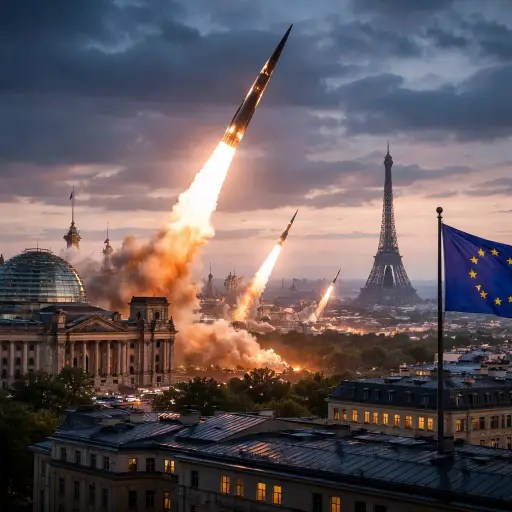
Israeli warnings and shifting threat assessments push NATO governments to confront a new security reality
A growing sense of urgency is taking hold across European capitals as concerns mount over Iran’s expanding missile capabilities and their potential reach into the heart of the continent. What was once viewed as a regional security issue confined largely to the Middle East is now being reassessed as a direct strategic challenge to Europe itself.
Israeli officials have intensified their warnings in recent weeks, arguing that advancements in Iran’s ballistic missile program could place major European cities within striking distance. These assessments, echoed by several Western intelligence services, suggest that the evolution of long-range delivery systems is no longer theoretical, but an emerging operational reality.
The implications of such a shift are profound. European policymakers, long focused on threats emanating from Russia’s eastern flank or instability in neighboring regions, now face the prospect of a new axis of vulnerability from the southeast. Defense analysts note that Iran’s steady progress in missile technology, including improved range, payload capacity, and precision, has altered the strategic balance in ways that demand urgent attention.
Within NATO, discussions have intensified around missile defense readiness and the adequacy of existing deterrence frameworks. While the alliance has previously monitored Iran’s capabilities, the tone of internal deliberations has shifted markedly, reflecting a heightened perception of immediacy. Officials familiar with the discussions describe a growing consensus that Europe can no longer treat the issue as a distant concern.
This recalibration comes at a time of already elevated geopolitical tension. The war in Ukraine continues to strain European security resources, while instability across the Middle East adds further complexity. Against this backdrop, the prospect of Iranian missiles capable of reaching cities such as Berlin, Paris, or Rome introduces an additional layer of strategic uncertainty.
Diplomatic channels remain active, but increasingly strained. Efforts to revive or reshape agreements aimed at limiting Iran’s nuclear and missile activities have yielded little tangible progress. European governments, traditionally supportive of negotiated solutions, are now grappling with the limits of diplomacy in the face of rapid technological advancement.
Public messaging from European leaders has begun to reflect this shift. Calls for de-escalation remain consistent, but they are now coupled with clearer acknowledgments of the risks involved. Several governments have urged renewed international engagement to prevent further escalation, emphasizing that the consequences of miscalculation could extend far beyond the region.
At the same time, there is a cautious effort to avoid inflaming tensions further. Officials are keenly aware that rhetoric alone can contribute to escalation, particularly in a volatile security environment. As a result, statements are being carefully calibrated to balance deterrence with diplomacy.
Military planners are also reassessing defensive postures. Investments in missile defense systems, early warning capabilities, and intelligence sharing are being reviewed with renewed urgency. Some countries are exploring deeper coordination within NATO frameworks, while others are considering national-level enhancements to their defensive infrastructure.
Experts point out that Europe’s vulnerability is not solely a function of missile range, but also of preparedness. The effectiveness of response systems, the resilience of critical infrastructure, and the clarity of command structures will all play a role in shaping outcomes should a crisis emerge.
Despite the rising concerns, there remains a strong preference among European leaders to pursue de-escalation. The emphasis is on preventing a scenario in which military confrontation becomes unavoidable. Diplomatic initiatives, though challenged, are still viewed as essential tools in managing the risk.
The current moment reflects a broader transformation in the global security landscape. Technological proliferation, shifting alliances, and regional conflicts are converging in ways that blur traditional boundaries of threat. For Europe, the challenge lies in adapting to this evolving environment without losing sight of long-standing commitments to stability and cooperation.
As discussions continue within NATO and across European institutions, one point is increasingly clear: the question is no longer whether Iran’s missile capabilities matter for Europe, but how Europe chooses to respond. The coming period will test the continent’s ability to navigate a complex and rapidly changing security reality, where distance no longer guarantees safety and where strategic foresight has become more critical than ever.


 The Tower Post