Kaori Sakamoto delivers a breathtaking farewell in Prague, capturing a fourth world title and a rare, perfect ending in elite sport
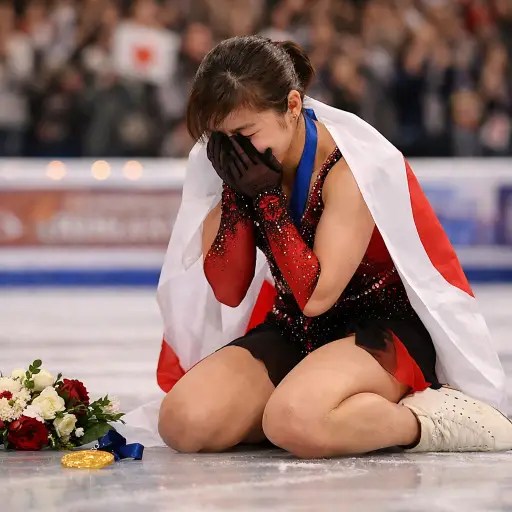
The ice had barely settled when the weight of the moment finally broke through.
Kaori Sakamoto stood motionless at center rink, her chest rising sharply, her hands trembling as the final notes of her music faded into a stunned silence. For a heartbeat, the arena seemed suspended in time. Then came the roar — a wave of sound that confirmed what everyone watching already knew: they had just witnessed something extraordinary.
In Prague, under the bright lights of the World Championships, Sakamoto delivered the performance of her life. It was powerful, precise, and deeply human — a routine that blended athletic command with raw emotion. When the final score flashed, confirming her fourth world title, she dropped to the ice, overcome. Tears followed instantly, not of relief alone, but of completion.
This was not just another victory. This was the end.
Sakamoto had arrived at the championships carrying the quiet knowledge that this would be her final competitive appearance. She had said little publicly in the lead-up, choosing instead to let her skating speak. And when it did, it told a story far bigger than medals or rankings.
Her program built slowly, deliberately. The opening movements were controlled, almost restrained, as if she were holding something back. Then came the acceleration — a sequence of jumps executed with trademark power, each landing firm and unmistakable. The transitions were seamless, her edges deep and confident. But what set the performance apart was not technical perfection alone. It was the sense of narrative, of a skater aware that every second mattered.
By the time she reached the closing section, the energy inside the arena had shifted. Spectators leaned forward, some already on their feet, sensing what was coming. Her final combination was clean. Her final spin, centered and unwavering. And then, as the music swelled to its conclusion, she extended her arms and held the final pose just a fraction longer than usual — as if reluctant to let go.
When she did, everything changed.
The composed competitor dissolved into a wave of emotion. She covered her face, her shoulders shaking as years of pressure, discipline, and expectation gave way in an instant. Coaches rushed to the boards, visibly moved. Fellow skaters watched from the tunnel, many applauding, some in tears themselves.
In a sport defined by relentless cycles — new talents rising, veterans fading — moments like this are almost unheard of. Champions rarely get to script their own ending. Injuries intervene, form dips, or younger rivals take over. The exit is often quiet, sometimes abrupt. But Sakamoto’s farewell felt different. It felt earned.
Fans quickly began calling it a “perfect ending,” a phrase often overused but, in this case, difficult to dispute. She did not just win — she delivered a performance that encapsulated everything she had become: resilient, expressive, and unmistakably herself.
Her career has been marked by consistency at the highest level, a rarity in modern figure skating. Known for her explosive jumps and commanding presence, she evolved over time into an artist capable of conveying complex emotion without sacrificing technical strength. That balance was on full display in Prague.
Off the ice, Sakamoto has long been regarded as a grounded and thoughtful presence within the sport. She navigated the pressures of global competition with a quiet determination, rarely seeking attention but consistently earning respect. Her decision to step away now, at the height of her abilities, reflects that same clarity.
There is a certain courage in leaving when there is nothing left to prove.
As the medal ceremony concluded, she stood atop the podium one last time, gold draped around her neck, her expression calmer now but still touched by disbelief. The crowd remained on its feet, applause lingering well beyond protocol. It was less a celebration of a single victory than a tribute to an entire era.
In the mixed zone afterward, words came slowly. She smiled, paused often, and spoke with the kind of honesty that defined her skating. There was gratitude — for her team, for the fans, for the journey itself. There was also a sense of peace.
“I gave everything,” she said softly.
And she had.
In a sport where perfection is pursued but rarely achieved, Sakamoto came as close as anyone could hope. Not because every element was flawless, but because the moment itself was complete. The performance, the result, the emotion — all aligned in a way that felt almost cinematic.
As the lights dimmed and the arena began to empty, one image remained: a champion kneeling on the ice, overcome not by defeat, but by fulfillment.
For those who were there, and for those watching around the world, it was more than a farewell. It was a reminder of why sport matters — not just for the records and results, but for the rare, fleeting moments when everything comes together.
Moments like this do not come often.
When they do, they stay.


 The Tower Post