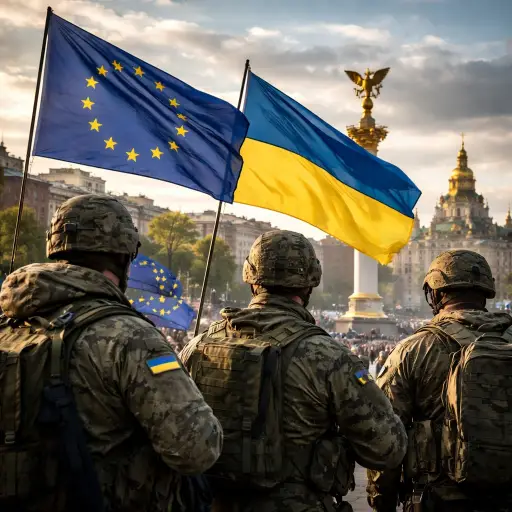
Europe Pressed to Lead as U.S. Attention Shifts and Internal Divisions Stall Critical Aid

As the war grinds on with no decisive breakthrough, Ukraine is entering a pivotal phase marked not only by battlefield realities but by shifting political winds among its allies. With Washington increasingly focused on escalating tensions in the Middle East, Kyiv is confronting a sobering question: can Europe fill the gap quickly and decisively enough to sustain Ukraine’s resistance?
For much of the conflict, U.S. military and financial backing has been the cornerstone of Ukraine’s defense. That support, while not absent, is no longer as politically assured or strategically central as it once was. The recalibration of American priorities has left European leaders facing intensified pressure to assume a larger share of responsibility—both in material aid and long-term security commitments.
Yet Europe’s response remains uneven.
A major setback has emerged from within the European Union itself, where Hungary’s veto has blocked a proposed €90 billion loan package intended to provide macro-financial stability and sustain Ukraine’s war effort. The impasse has exposed deep fractures within the bloc, raising concerns about whether political unity can be maintained at a moment when speed and cohesion are critical.
Diplomats across Europe acknowledge that the stakes extend far beyond Ukraine’s borders. The conflict has become a defining test of the European project’s capacity to act collectively in the face of sustained geopolitical pressure. But internal disagreements—over funding mechanisms, burden-sharing, and the broader trajectory of EU enlargement—are complicating what many leaders describe as an urgent strategic necessity.
For Ukraine, the implications are immediate and existential.
Officials in Kyiv have issued increasingly stark warnings that delays in aid are already affecting operational capabilities. Ammunition shortages, infrastructure vulnerabilities, and mounting economic strain are placing the country under growing pressure. While Ukrainian forces continue to demonstrate resilience, the margin for sustaining prolonged defense without consistent external support is narrowing.
European governments have stepped up in some areas, expanding bilateral assistance and accelerating joint procurement initiatives. However, these efforts have yet to match the scale or coordination previously driven by U.S. leadership. Analysts warn that fragmented contributions risk creating inefficiencies at a time when Ukraine requires predictable, large-scale support.
The political dimension is equally significant. Public opinion across Europe remains broadly sympathetic to Ukraine, but signs of fatigue are becoming more visible. Economic pressures at home, combined with competing global crises, are testing the willingness of governments to maintain high levels of engagement indefinitely.
At the same time, Ukraine’s leadership is framing the moment as a decisive crossroads not just for the country, but for Europe itself. The argument is clear: Ukraine’s survival is inseparable from the credibility of European unity and the broader security architecture that has defined the continent for decades.
In private discussions, European officials concede that the current situation demands a shift from reactive measures to a more strategic, long-term approach. This includes not only financial aid, but also defense industrial coordination, training programs, and clearer pathways toward integration with European institutions.
The challenge lies in translating political declarations into actionable consensus.
Hungary’s veto has underscored how a single member state can stall collective action, prompting renewed debate over decision-making rules within the EU. Some leaders are exploring alternative mechanisms to bypass blockages, including intergovernmental agreements outside formal EU structures. However, such approaches carry their own risks, potentially undermining institutional cohesion.
Meanwhile, the battlefield continues to evolve, with neither side achieving decisive gains. This stalemate reinforces the importance of sustained external support, as the conflict increasingly becomes one of endurance rather than rapid maneuver.
Ukraine’s message to its partners is becoming more urgent: time is not a neutral factor. Delays in assistance do not simply postpone outcomes—they shape them.
As Europe weighs its next steps, the coming period is likely to prove critical in determining whether it can rise to the challenge of leadership in a shifting geopolitical landscape. The decisions made now will not only influence the trajectory of the war, but also define Europe’s role in an increasingly uncertain world.
For Ukraine, the equation is stark. Its capacity to continue resisting depends not only on the courage of its forces, but on the unity and resolve of those who have pledged to stand behind it.