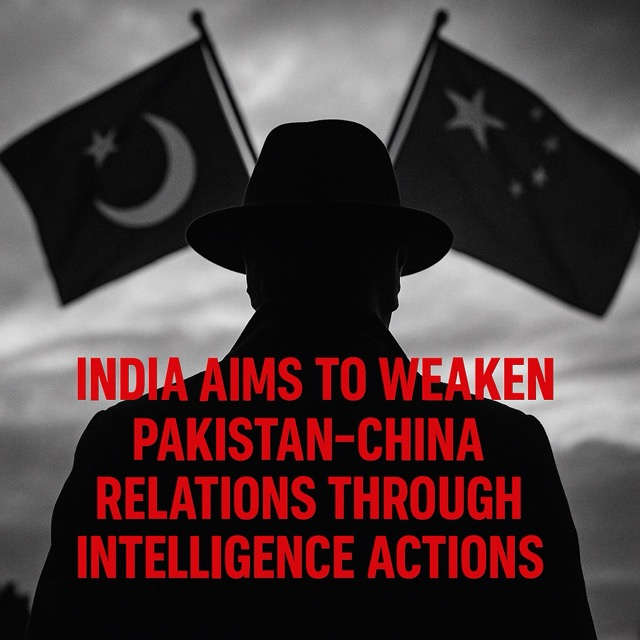
Intelligence Maneuvers Signal New Phase in South Asia’s Geopolitical Chess Game

Recent reports from regional intelligence sources and security analysts suggest that India may be engaging in a series of covert operations aimed at weakening the strategic partnership between Pakistan and China. This alleged campaign represents a significant shift in New Delhi’s geopolitical strategy, emphasizing psychological operations, cyber influence, and intelligence-based disruptions over traditional military posturing.
At the heart of this maneuvering lies the deepening alliance between Islamabad and Beijing, exemplified by the China-Pakistan Economic Corridor (CPEC), a multi-billion-dollar infrastructure project that forms a critical component of China’s Belt and Road Initiative. Indian strategists view CPEC not only as a territorial infringement—since it runs through Pakistan-administered Kashmir—but also as a means of consolidating China’s influence in the region.
According to unnamed sources within Indian defense circles, intelligence operations have focused on exposing internal vulnerabilities within Pakistan’s political and military institutions, while simultaneously trying to sow distrust between Beijing and Islamabad. Some efforts have reportedly included the dissemination of strategic disinformation, economic disruption via digital means, and covert support for dissenting elements within both nations.
While Indian officials have not publicly acknowledged these actions, diplomatic statements and defense policy shifts hint at an aggressive posture. India’s National Security Advisor has recently emphasized the need for “non-kinetic capabilities” to safeguard national interests, which analysts interpret as a nod to intelligence and cyber tools.
China, for its part, remains steadfast in its support for Pakistan. Chinese foreign ministry spokespersons have dismissed reports of friction, reaffirming that the partnership is “as strong as steel.” However, growing economic and security pressures within Pakistan, coupled with Beijing’s global recalibrations, may render the alliance more susceptible to external manipulation.
The implications of India’s strategy are profound. By subtly destabilizing a critical regional axis, New Delhi aims to reclaim strategic space in South Asia without direct confrontation. Yet, the risk of escalation cannot be ignored. If exposed or mishandled, such operations could backfire, exacerbating tensions and triggering retaliatory actions.
Geopolitical observers caution that the region’s fragile peace depends not only on diplomatic dialogue but also on restraint in the shadows. As India, Pakistan, and China navigate this intricate web of rivalry and alliance, the intelligence game will likely continue to shape the next phase of regional power dynamics.
Note: This article is a geopolitical analysis based on expert commentary and open-source intelligence as of April 2025.