Rising Violence, Deepening Divisions, and an Uncertain Future for the Palestinian Territories
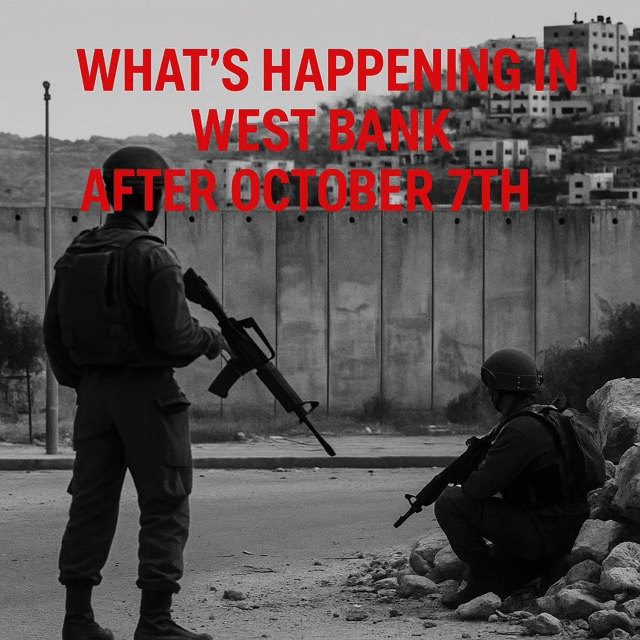
Since the devastating events of October 7th, when conflict erupted between Hamas and Israel, the West Bank has experienced a significant and alarming escalation in violence, political unrest, and humanitarian crises. Although the initial flashpoint was in Gaza, the West Bank, already a region of simmering tensions, has rapidly descended into chaos, becoming a parallel front of instability.
In the immediate aftermath of October 7th, Israeli military operations intensified across the West Bank, targeting alleged militant cells, weapons caches, and suspected Hamas operatives. Raids have become a daily occurrence in cities such as Jenin, Nablus, and Hebron. According to human rights groups, these operations have resulted in a sharp increase in casualties, including among civilians, further inflaming local resentment.
Palestinian factions in the West Bank, traditionally dominated by Fatah rather than Hamas, have found themselves under growing pressure. Youth movements and militant splinter groups have gained traction, viewing the violence as a rallying call against both the Israeli occupation and the perceived ineffectiveness of the Palestinian Authority. In many towns, protests have erupted not just against Israel but also against PA leadership, which is seen by many as disconnected and unable to protect its people.
Meanwhile, Israeli settler violence against Palestinian villages has surged, often under the cover of military operations. Numerous reports have surfaced detailing attacks on homes, farms, and residents, forcing some Palestinian families to flee their lands. The Israeli government has faced international criticism for not curbing settler violence, further isolating it diplomatically.
The economic situation has worsened dramatically. Checkpoints and closures have choked movement, crippling commerce and preventing thousands from reaching their workplaces. Agricultural exports, a lifeline for many West Bank communities, have been severely disrupted. Aid organizations warn of a mounting humanitarian crisis, with food insecurity, medical shortages, and displacement on the rise.
Diplomatically, the West Bank finds itself in a precarious position. Efforts by the United Nations and regional actors to de-escalate tensions have yielded limited success. Some Arab countries have called for renewed peace talks, but the political will on the ground appears scant. Instead, the region seems trapped in a cycle of retaliation and repression.
As the conflict drags on, the prospects for a two-state solution, already remote before October 7th, grow dimmer. Young Palestinians in the West Bank increasingly express disillusionment with political solutions, gravitating instead toward resistance movements. Analysts warn that without urgent intervention, the West Bank could face a prolonged period of insurgency and instability.
In summary, the West Bank after October 7th stands at a dangerous crossroads. With violence escalating, governance deteriorating, and despair rising, the region’s future hangs in a precarious balance. Without a coordinated and sincere effort from both local leaders and the international community, the spiral of conflict threatens to deepen, with devastating consequences for generations to come.



 The Tower Post