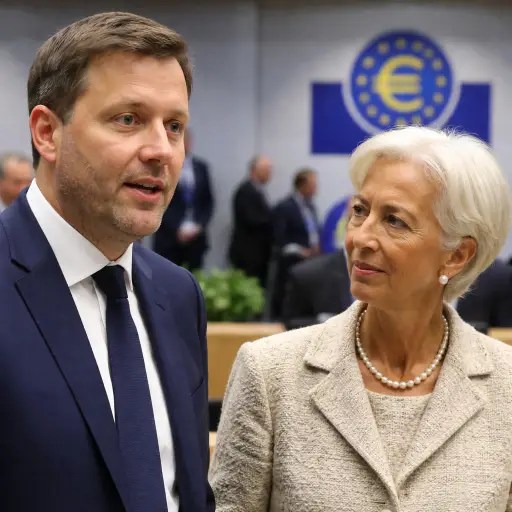
German finance minister dismisses talk of Christine Lagarde’s successor as premature while signaling that Europe’s largest economy will weigh in when the moment arrives

Germany’s finance minister has moved decisively to quell a growing wave of speculation over the eventual succession to European Central Bank President Christine Lagarde, describing the chatter as premature while making clear that Berlin will assert its influence when the formal process begins.
In remarks that set the tone for the political debate, Finance Minister Lars Klingbeil said discussion about who might follow Lagarde amounted to little more than conjecture, urging markets and policymakers alike to concentrate on the ECB’s present mandate rather than hypothetical future appointments.
“There is a president in office carrying out her responsibilities,” Klingbeil told reporters in Berlin, stressing that the independence and stability of the Frankfurt-based institution must not be overshadowed by what he called “pure speculation.”
Lagarde, who has led the ECB through pandemic disruption, an inflation surge and one of the most aggressive tightening cycles in the euro era, remains firmly at the helm as policymakers navigate a delicate shift toward more neutral monetary conditions amid easing price pressures.
Though no official succession timetable has been triggered, conversations in Brussels and across euro area capitals have intensified as economic conditions enter a new phase, prompting investors to look ahead even as central bankers counsel patience.
Klingbeil’s intervention appeared designed to dampen any impression of an emerging power vacuum, a perception that could unsettle bond markets already sensitive to signals about the future direction of interest rates.
Germany, as the euro area’s largest economy and traditional guardian of price stability, holds considerable weight in discussions over top European appointments, and the finance minister did not deny that Berlin will engage actively when negotiations formally commence.
“As Europe’s largest economy we naturally take part in European decisions,” Klingbeil said, adding that Germany would work constructively with partners when the appropriate moment arrives.
Analysts say the remarks reflect a careful balancing act between defending the ECB’s independence and acknowledging the political realities that shape leadership choices within the European Union’s institutional framework.
The ECB presidency, one of the bloc’s most influential posts, carries authority over monetary policy, banking supervision and crisis management tools that have become central to safeguarding the euro’s credibility in turbulent times.
Market reaction to Klingbeil’s comments was muted, suggesting investors interpreted the statement less as a signal of imminent change and more as an attempt to steady expectations during a period of economic recalibration.
Inflation across the euro area has retreated from its highs, yet policymakers continue to warn that underlying pressures require vigilance, reinforcing the argument that continuity at the top of the ECB remains paramount.
Germany’s own economy has faced industrial headwinds and fiscal constraints, sharpening Berlin’s interest in ensuring that the central bank retains both credibility and flexibility as Europe confronts geopolitical uncertainty and the costly transition toward greener energy systems.
Historically, leadership selections at the ECB have emerged from complex negotiations among member states, often intertwined with broader agreements over senior roles within the European Commission and other EU bodies.
In that context, Klingbeil’s message can be read as both a cooling gesture and a reminder that Germany intends to be an active participant when consensus-building begins.
For now, Lagarde continues to steer monetary policy as the euro area searches for a durable equilibrium between growth and price stability, and official debate over her successor remains on hold despite persistent market curiosity.
By firmly characterizing the succession talk as speculative, Berlin has sought to draw a clear line between legitimate long-term planning and premature jockeying that could distract from the ECB’s immediate mission.
As Europe approaches a pivotal stretch in its economic recovery, the finance minister’s comments underscore a broader political calculation: stability first, deliberation later, and when the time finally comes, Germany will ensure its voice is heard.