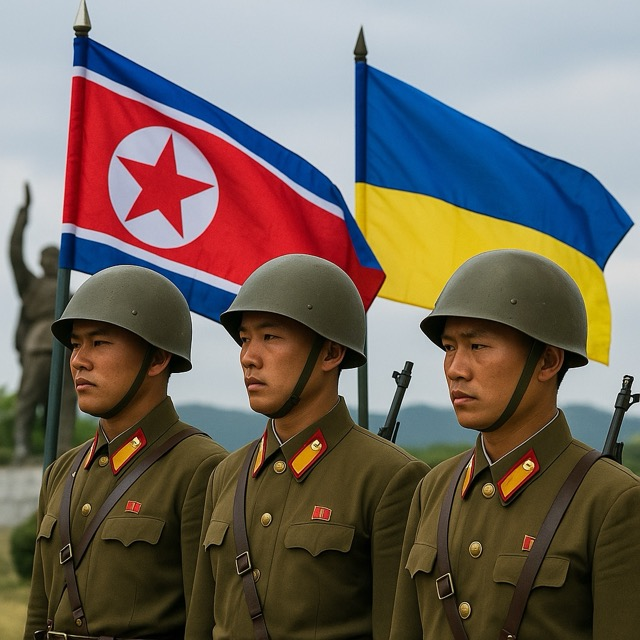
As North Korean troops reportedly join Russia’s war in Ukraine, analysts warn that Kim Jong-un may soon extend support to China in any conflict over Taiwan.

The recent deployment of North Korean soldiers to assist Russian forces in Ukraine has sent shockwaves through Western capitals, sparking fears that Pyongyang’s growing military adventurism could extend beyond Europe — potentially into the Taiwan Strait.
While North Korea has long been aligned with both Moscow and Beijing, the dispatch of combat personnel to an active warzone marks a significant and provocative escalation. According to multiple intelligence reports and confirmed by Ukrainian defense officials, a limited number of North Korean troops are now engaged in logistical and paramilitary support roles in eastern Ukraine, under the Russian command structure.
“What we’re witnessing is not just symbolic support,” said Rachel Connors, a senior analyst at the Center for Strategic Asia. “It’s a test run — an operational experiment with deep implications.”
Western analysts and Taiwanese officials are increasingly concerned that this precedent could pave the way for North Korean involvement in a future Chinese campaign against Taiwan. While Beijing has not signaled any official military coordination with Pyongyang regarding Taiwan, experts say the alliance is becoming increasingly cohesive, especially as all three regimes face mounting pressure from Washington and its allies.
“North Korea’s soldiers in Ukraine today could become China’s auxiliaries in Taiwan tomorrow,” warned General Robert Hastings, a retired U.S. Indo-Pacific Command official. “It would be a low-cost, high-impact show of loyalty — and a nightmare for allied defense planners.”
The strategic calculus for Kim Jong-un appears straightforward: align more deeply with China and Russia to ensure regime survival, gain political leverage, and extract economic concessions in return for military manpower. For China, which seeks to avoid the reputational and operational cost of unilateral action, North Korean assistance could offer a buffer or a plausible deniability mechanism.
Taiwanese officials have reacted with alarm. “We are not only preparing for a Chinese threat — we must now consider a North Korean one as well,” said a spokesperson for Taiwan’s Ministry of National Defense. The island has stepped up intelligence coordination with Japan and the United States following the revelations.
In Washington, the development has prompted urgent briefings on Capitol Hill, where bipartisan concern is mounting over what some lawmakers are calling an “axis of aggression.” Sanctions and diplomatic warnings are already being drafted in response to Pyongyang’s Ukraine deployment.
Still, questions remain about the scope and sustainability of North Korea’s overseas military ambitions. The regime is chronically under-resourced, its armed forces outdated, and its troops often poorly trained. But its willingness to take risks — and its value as a political signal — cannot be underestimated.
“The battlefield is changing,” said Dr. Min-seok Yoon, a Seoul-based military historian. “North Korea is no longer confined to its peninsula. And that should worry everyone.”
As geopolitical alliances harden and flashpoints multiply, the line between regional and global conflicts continues to blur. Pyongyang’s march from Donbas to the Taiwan Strait may not be imminent — but it is no longer unthinkable.