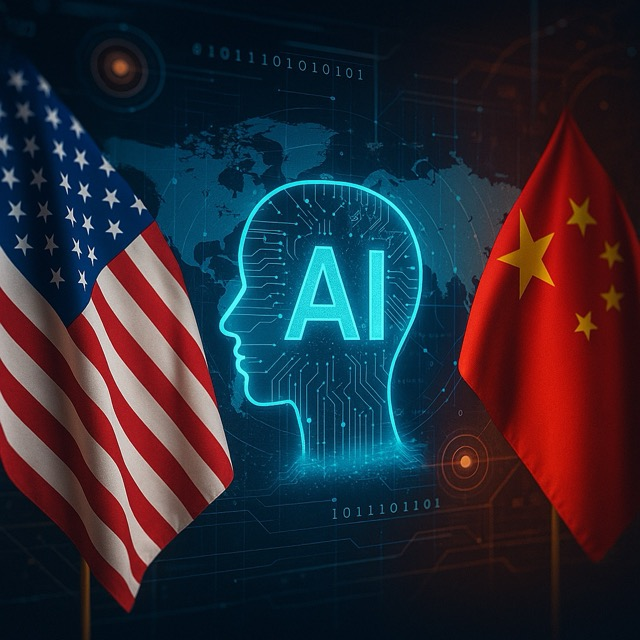
Tensions mount between the world’s leading powers as artificial intelligence becomes the new battleground for economic dominance, ethical standards, and digital control.

As artificial intelligence moves from the research lab to the front lines of economic and geopolitical power, tensions between the United States and China are intensifying over how the technology should be governed, controlled, and deployed. The two superpowers, already locked in strategic rivalry across trade, semiconductors, and cybersecurity, are now clashing over AI regulation and tech sovereignty—raising the stakes for the rest of the world.
At the heart of the dispute is a growing divergence in approach. The United States, with its sprawling tech giants and emphasis on innovation, is promoting a regulatory framework focused on light-touch oversight, transparency, and market-led ethics. China, by contrast, is tightening its grip on algorithm development and data use through centralized, state-driven rules designed to reinforce political control and national priorities.
Earlier this year, Beijing rolled out a new set of AI guidelines requiring companies to register their models with authorities and ensure outputs align with “core socialist values.” Meanwhile, Washington has signaled that it supports AI safety and ethics initiatives but is wary of overregulation that could stifle private-sector growth.
“This is not just a tech rivalry—it’s a values clash,” said Dr. Alicia Grant, a technology policy expert at the Atlantic Institute. “What we’re seeing is a struggle to define the global norms around artificial intelligence. Whoever leads on standards may also lead on influence.”
The stakes are massive. AI technologies—ranging from generative tools and surveillance systems to autonomous weapons—are reshaping defense strategies, labor markets, and public governance. Nations worldwide are watching closely, concerned that a bifurcated global AI system could force them to choose between competing technological ecosystems.
The U.S. has moved to restrict China’s access to advanced semiconductors essential for training AI models, citing national security risks. Export bans on cutting-edge chips and manufacturing tools have slowed Beijing’s ambitions, prompting China to invest billions in homegrown alternatives. At the same time, Chinese firms like Baidu, Huawei, and SenseTime are ramping up development of AI models designed for domestic use and regional export.
Diplomatically, the divide is widening. Recent talks between American and Chinese tech diplomats failed to yield a shared framework for global AI governance, with each side accusing the other of pursuing dominance under the guise of safety.
“The U.S. sees China’s AI controls as authoritarian. China views American sanctions as technological containment,” said Mei Zhang, a former Chinese trade official. “Neither side trusts the other’s motives.”
In Brussels, European regulators are working on a middle path. The EU’s AI Act—set to be the first major comprehensive legislation on artificial intelligence—seeks to balance innovation with strict rules on biometric surveillance, discrimination, and risk management. Yet critics warn that unless the U.S. and China cooperate, even the most well-intentioned frameworks could be rendered toothless in a divided digital world.
The global business community is also caught in the crossfire. Multinationals operating across both U.S. and Chinese markets are facing difficult decisions about data flows, cloud infrastructure, and AI partnerships. Some fear a new era of “AI nationalism,” where data and algorithms are confined within borders, curbing global scalability.
For now, the AI arms race shows no signs of slowing. Both Washington and Beijing are increasing funding for AI research, military applications, and talent acquisition. As each side seeks to secure its position at the forefront of the next technological revolution, the broader world may be left navigating the turbulent intersection of innovation and ideology.