Kremlin downplays Trump’s order of two nuclear submarines, emphasizing routine operations in Russian waters

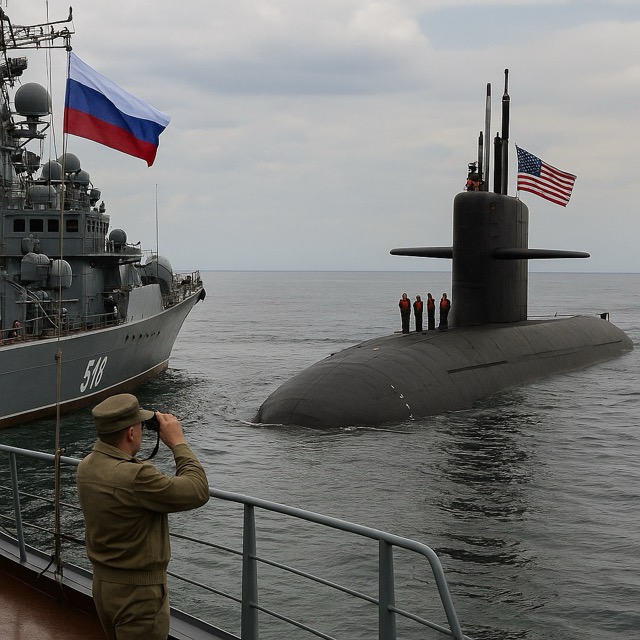
The Kremlin has dismissed as non-threatening the recent U.S. deployment of two nuclear submarines near Russian territorial waters, Russian state news agency TASS reported, quelling concerns that President Donald Trump’s order signals an escalation of hostilities. Kremlin spokesman Dmitry Peskov told reporters that Moscow has been “fully aware” of such maneuvers, which he described as routine for American naval forces and not a departure from established patterns of deployment.
President Trump announced last week via his social media platform that he had directed the repositioning of two U.S. Navy submarines to “appropriate regions” in response to what he branded “highly provocative” statements from former Russian President Dmitry Medvedev. Trump’s move, intended as a strategic signal to Moscow, coincided with fresh sanctions threats unless Russia agreed to a ceasefire in Ukraine within a tight deadline.
Yet Peskov emphasized that U.S. submarines routinely patrol international waters, including areas proximate to Russian shores. “We do not see these submarines as a new military threat. They are part of normal U.S. naval operations,” he said at his weekly briefing in Moscow. “Russia is tracking their movements and remains vigilant, but there is no cause for alarm.”
The Russian defense apparatus, too, appears unperturbed. A senior officer at the Northern Fleet, speaking anonymously, confirmed that Russian maritime reconnaissance units have observed the U.S. submarines but noted no unusual behavior or armament beyond their standard strategic, deterrent role. “These vessels operate under strict rules of engagement. Our forces maintain readiness, but there is no immediate danger to national security,” the officer said.
Analysts view the Kremlin’s public stance as an attempt to defuse rising tensions without appearing weak. By characterizing the submarine repositioning as business-as-usual, Moscow avoids elevating Trump’s announcement into a diplomatic crisis. “Peskov’s comments are calibrated to reassure domestic audiences and NATO observers that Russia remains in control,” said Dr. Olga Smirnova, a security analyst at the Moscow State Institute of International Relations. “It also sends a message to Washington that scare tactics will not alter Russian strategic calculations.”
In Washington, the Pentagon offered limited comment, referring queries to the White House. National Security Council spokesman John Kirby stated that U.S. forces deploy submarines around the globe “to ensure strategic stability and deter aggression,” refraining from specifying patrol locations or missions.
Meanwhile, geopolitical dynamics remain fraught. Trump’s submarine directive was part of a broader effort to pressure Moscow back to the negotiating table over Ukraine. Trump set a deadline for Russia to halt hostilities or face further punitive measures. Moscow, however, has continued its military campaign, and its leadership has signaled no willingness to capitulate to external timelines.
In addition to naval operations, both sides have ramped up rhetoric over potential nuclear contingencies. Medvedev, now Russia’s deputy security council head, warned that threats could spiral into unintended consequences if mishandled. Yet Peskov urged both capitals to exercise caution in their public statements to avoid misinterpretation.
European allies, closely monitoring the exchanges, have maintained calls for de-escalation. NATO Secretary-General Jens Stoltenberg reiterated that the alliance respects Russia’s sovereignty while cautioning against aggressive posturing. “We are committed to defensive preparedness, but diplomacy must lead,” Stoltenberg said at a press conference in Brussels.
As U.S. submarines continue their silent patrols and Russian detection systems remain on alert, the incident underscores the delicate balance of power at sea. The Kremlin’s downplaying of the threat may temper immediate alarm, but the underlying strategic competition persists. Both Moscow and Washington face the challenge of deterring each other without triggering unintended clashes.
Looking ahead, experts caution that routine maneuvers could become flashpoints if misread. “Submarine deployments are inherently covert, raising the risk of miscalculation,” noted Captain Yuri Antonov, a retired Russian Navy officer. “Clear communication channels and established protocols are essential to prevent incidents at sea.”
Despite the ease of modern naval warfare, the human element remains crucial. Operators on both sides must interpret signals accurately to avoid escalation. For now, Moscow’s message is one of calm—affirming its awareness and control. Yet in an era where a tweet can trigger seismic shifts in international relations, even routine deployments carry potent symbolic weight.