China says the visit breached political commitments; Prague calls it a private trip as trade ties and ‘One‑China’ sensitivities loom.
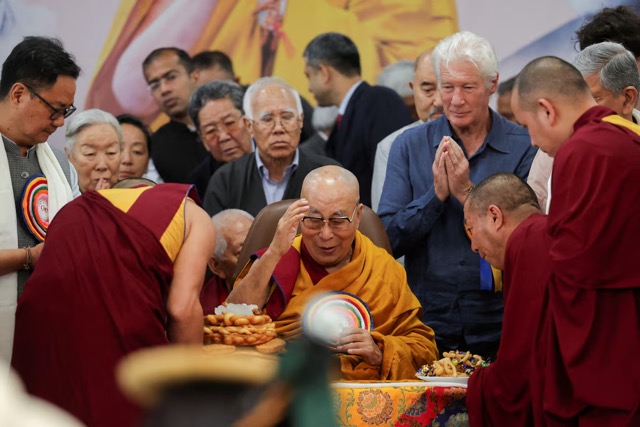
PRAGUE / BEIJING – China has announced it is cutting off contact with Czech President Petr Pavel after he met the Dalai Lama in India on July 27, a move that underscores how quickly Beijing is prepared to escalate when it perceives challenges to its sovereignty.
The decision was delivered on Tuesday, August 12, by Foreign Ministry spokesperson Lin Jian at a regular press briefing. He said Pavel acted “in disregard of China’s repeated protests and strong opposition,” and that the meeting “seriously contravenes the political commitment made by the Czech government to the Chinese government.” Lin added that, given “the severity of Pavel’s provocative action,” Beijing will “cease all engagement with him.”
The encounter took place in Leh, Ladakh, during the Tibetan spiritual leader’s 90th birthday month. Pavel congratulated the Dalai Lama in person and voiced support for the Tibetan cause—gestures celebrated by Tibetan representatives who have long cultivated ties with Czech figures dating back to former president Václav Havel.
Prague has emphasized that the India stopover was a private trip made as the president returned from Japan, and that the meeting did not signal any change in Czechia’s official policy. Foreign Minister Jan Lipavský urged Beijing to treat it as such, reiterating that the government adheres to its One‑China policy and does not support Taiwan’s independence.
Notably, Beijing’s penalty is tailored to Pavel personally: Chinese officials say they are suspending engagement with the president himself, not severing ties with the Czech government as a whole. The presidential office did not immediately respond to the announcement, but Prague’s line has been consistent—this was a personal gesture during a private visit.
The episode caps months of friction. In February, Chinese Foreign Minister Wang Yi met Lipavský on the sidelines of the Munich Security Conference and called on Prague to engage in “earnest self‑reflection,” respect China’s “core interests,” and take “concrete actions to rebuild trust.” For his part, Lipavský publicly stressed that Czechia follows its One‑China policy and does not back Taiwanese independence—language meant to reassure Beijing even as Prague deepens practical contacts with Taipei.
China’s red lines extend to Tibet as well as Taiwan. Beijing regards the Dalai Lama as a separatist and frames any official or semi‑official reception as interference in its internal affairs. For European leaders, the optics are tricky: heads of state rarely have truly “private” meetings, and gestures that read domestically as moral solidarity can register in Beijing as a direct affront to sovereignty.
Beyond symbolism, the stakes are economic. China is Czechia’s second‑largest trading partner and second‑largest source of imports, while ranking only 17th among export markets—reflecting a chronic imbalance. In 2024, Czech imports from China totaled roughly €36.7 billion against €3.0 billion in exports, leaving a deficit of about €33.7 billion, according to the Czech embassy in Beijing. Any deterioration in political ties risks further complicating supply chains for Czech manufacturers and the prospects for expanding exports to China.
Beijing’s calibrated move—isolating the president while keeping a channel open to the cabinet—suggests China aims to signal resolve without shutting the door on pragmatic cooperation. Similar tactics have appeared elsewhere in Europe in recent years, where Beijing has targeted individual officials or institutions rather than imposing sweeping, nationwide sanctions. Whether that restraint holds will depend on what happens next in Prague.
At home, Pavel’s approach dovetails with a Czech tradition of support for dissidents and Tibetans that predates EU accession. But the government also faces pressure to protect the country’s economic interests and to avoid a diplomatic freeze that could spill into trade or investment. For now, officials argue the India stopover was personal—and that Beijing should treat it that way.
As the Dalai Lama’s succession planning re‑enters the headlines and Europe recalibrates relations with China, Prague’s tightrope act will continue. The immediate test is short‑term: whether Beijing’s boycott of Pavel remains symbolic, or evolves into measures with material bite. Either way, the episode is a reminder that in 2025, a single photo‑op can redraw weeks—if not years—of quiet diplomacy.
 The Tower Post