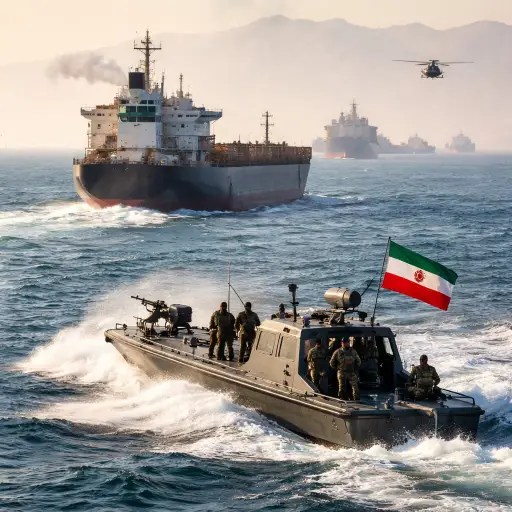
Tehran cites security concerns amid indirect talks with Washington, disrupting energy flows and raising fears of wider regional escalation

The government of Iran announced a temporary closure of the Strait of Hormuz, one of the world’s most critical maritime chokepoints, citing heightened security concerns amid ongoing indirect negotiations with the United States. The move, disclosed through state media and reinforced by visible naval deployments in the Gulf, immediately unsettled global energy and shipping markets.
The Strait of Hormuz serves as the primary maritime artery for a significant share of global oil and liquefied natural gas exports. Tankers departing from major Gulf producers must pass through its narrow lanes to access open seas, making the waterway indispensable to the stability of international trade and energy supply chains.
Iranian authorities described the measure as temporary and defensive, emphasizing that it was designed to safeguard national security during what officials characterized as a sensitive diplomatic phase. While the government stopped short of calling the action a blockade, it confirmed that commercial transit would face restrictions pending enhanced inspections and security procedures.
Energy markets reacted swiftly to the announcement, with benchmark crude prices rising sharply in early trading across Asia and Europe. Shipping companies began assessing alternative routes, while maritime insurers warned that risk premiums could increase for vessels operating near the Gulf, compounding pressure on global freight costs.
Diplomatic sources familiar with the indirect talks between Tehran and Washington suggested the closure may be intended as strategic leverage rather than a prelude to open confrontation. Negotiations, conducted through regional intermediaries, have focused on sanctions relief, nuclear oversight mechanisms, and broader maritime security guarantees.
The United States responded with caution, urging restraint and reaffirming its commitment to freedom of navigation under international law. American naval forces in the region were placed on heightened alert, though officials underscored that communication channels with regional actors remained active and that diplomatic efforts were continuing.
European governments echoed calls for de-escalation, warning that prolonged disruption would have far-reaching consequences beyond the Middle East. Energy-importing nations in Asia also expressed concern, noting their heavy dependence on uninterrupted flows through the Strait and signaling readiness to draw on strategic reserves if necessary.
Regional Gulf states, whose economies depend heavily on maritime exports, moved quickly to reassure global buyers. Some activated contingency measures involving alternative pipeline routes that bypass the Strait, though analysts caution that these routes cannot fully compensate for sustained maritime restrictions.
Security experts observe that Iran has periodically threatened to limit passage through the Strait during moments of geopolitical tension, yet actual closures remain rare and typically short-lived. The economic costs of extended disruption would likely affect Iran as well, given its reliance on maritime trade despite existing sanctions.
Financial markets are now factoring in elevated geopolitical risk, with investors closely monitoring developments in both the Gulf and the diplomatic backchannel between Tehran and Washington. Analysts warn that miscalculation in the confined waters of the Strait could rapidly escalate tensions in an already volatile region.
As indirect negotiations continue behind closed doors, the world’s attention remains fixed on the narrow corridor that links the energy-rich Gulf to global markets. Whether the current closure proves to be a brief tactical maneuver or the opening phase of a broader standoff will depend on the pace of diplomacy and the restraint of all parties involved.