Economic pragmatism, EU trade headwinds, and Macau’s Lusophone link drive a high‑stakes first trip

Portugal’s Prime Minister Luís Montenegro begins a three-day official visit to China today, his first as head of government, with a tightly scripted program in Beijing and a stop in Macau before continuing to Japan. The trip, scheduled for September 8–10 at the invitation of Premier Li Qiang, comes as Europe and China spar over trade and technology, and as Lisbon tries to turn a recent wave of Asian investment into jobs at home.
At the political level, the choreography signals priority treatment. Montenegro is due to lay a wreath at the Monument to the People’s Heroes in Tiananmen Square, meet National People’s Congress chairman Zhao Leji, hold talks with Premier Li, and—crucially—be received by President Xi Jinping. A signing ceremony for bilateral instruments is penciled in after the Li meeting, with memoranda of understanding expected in agri‑food market access and other trade‑facilitation areas, according to people briefed on the agenda.
The economic backdrop explains the timing. China is one of Portugal’s most consequential non‑EU partners: Chinese state‑owned China Three Gorges (CTG) has been the largest shareholder in Energias de Portugal (EDP) since 2011, anchoring a long‑running energy partnership, while Chinese battery maker CALB this year confirmed a €2 billion gigafactory project in Sines slated to begin deliveries before decade’s end. Montenegro’s cabinet sees both as beachheads in a broader push to plug Portuguese industry into electric‑mobility supply chains and to attract export‑oriented investment.
But the trip is also a test of equilibrium. In Brussels, Portugal has sought to preserve room for engagement with Beijing—remaining a signatory to the Belt and Road memorandum—while aligning with EU policy on security‑sensitive infrastructure. Lisbon’s restrictions on so‑called ‘high‑risk’ 5G vendors remain in place, and the government has signaled it won’t reverse course. Montenegro’s interlocutors know these are not easily squared circles: Lisbon wants Chinese capital and market access, but not at the cost of European unity on security.
Trade frictions form the other half of the picture. The European Union’s hefty countervailing duties on Chinese‑made electric vehicles, in force since late 2024 and sharpened this summer, have triggered retaliatory measures from Beijing—including tariffs on EU pork and probes touching a swath of European goods. Portugal’s car‑parts exporters and agribusiness firms are watching closely. A senior official in Lisbon says the prime minister will advocate for ‘predictable frameworks’ and pragmatic fixes, while carefully avoiding any appearance of freelancing against EU policy.
For Beijing, Montenegro’s arrival offers a chance to stabilize ties with a mid‑sized EU economy known for its Atlantic openness. Portugal abstained on the EV‑tariff vote last year and has cast itself as a bridge between Europe, the transatlantic community and the Portuguese‑speaking world. Chinese officials—fresh from a week of high‑profile commemorations in Beijing—are likely to cast the visit as a vote of confidence in China–EU economic resilience despite disagreements.
Macau is a hinge of the mission. The city, a former Portuguese-administered territory, hosts Forum Macao, a platform that connects China with nine Portuguese‑speaking countries from Brazil to Timor‑Leste. Montenegro is expected to meet Macau’s Chief Executive Sam Hou Fai, visit the Portuguese School and greet the local community before heading to Tokyo. The message is triple‑layered: Portugal values its historic link to Macau; it sees commercial opportunity in the Lusophone network; and it wants to keep people‑to‑people ties front‑and‑center even as geopolitics hardens.
Business deliverables will be the measure of success. Agri‑food producers are pushing for faster approvals on items ranging from dairy to specialty meats; tech and telecoms firms want clarity on standards and compliance; and the energy sector is keen to deepen joint ventures in renewables and storage. Officials on both sides say any announcements this week will be incremental rather than headline‑grabbing—removing bureaucratic splinters that slow trade, mapping pilot projects, and reaffirming investment timelines for projects already in the pipeline.
Politically, Montenegro also has reasons to show momentum abroad. Barely three months into a fresh mandate, he faces a fragmented parliament and a slowing European economy. A visible win on exports, or tangible progress on a factory that turns shovels in Portuguese soil, would reinforce his government’s economic case. That calculus explains the Asia swing: courting investors in China and then Japan, where Portugal hopes to draw more capital into precision manufacturing and green technologies.
Still, pitfalls abound. Any hint of divergence from EU policy—on EV tariffs, for instance—would be seized upon at home and in Brussels. Conversely, if talks get bogged down in long‑running disagreements over 5G, data governance or human‑rights language, the visit could end with boilerplate communiqués and little else. Montenegro’s team argues the way through is to be concrete: unlock permits, speed up customs channels, and give investors in both directions clearer timelines.
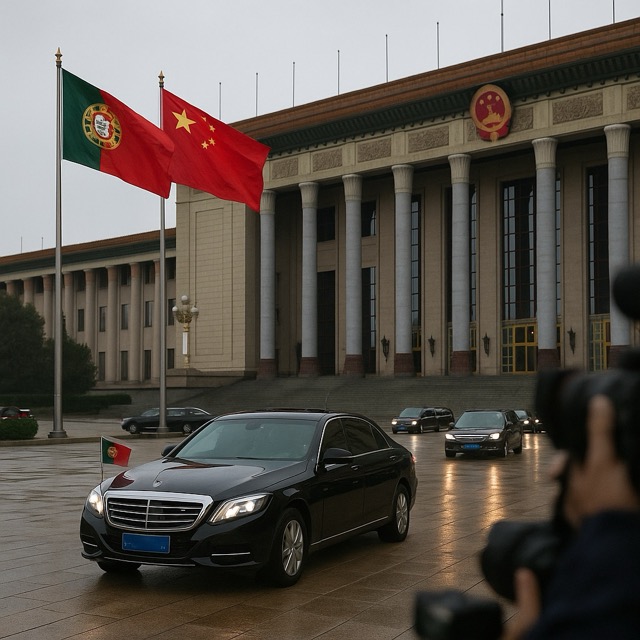
The optics will matter as much as the paperwork. Images of a Portuguese leader in the Great Hall of the People, and in the narrow streets of Macau’s historic center, speak to a diplomatic tradition that predates today’s trade rows. But this is not nostalgia; it is transactional diplomacy with guardrails. Lisbon is betting it can keep the door open to Chinese capital and consumers while buttressing European standards and security commitments. Beijing, for its part, is betting that pragmatic partners like Portugal can help lower the political temperature with Europe.
By Friday, the headlines will show whether the bet paid off. If agri‑food access nudges forward, if the Sines battery project timeline looks firmer, and if working groups on customs, standards and market access are tasked with concrete deadlines, Lisbon will call the trip a success. And if Montenegro can do that while keeping Brussels onside and avoiding the minefields of great‑power rivalry, Portugal’s wager on balance over bluster will look just a little wiser.
SOURCES (selected):
– Chinese MFA announcement: official visit Sept. 8–10, 2025.
– Xinhua/State Council: confirmation of first visit as PM.
– Plataforma Media/Lusa: detailed Beijing program, signing ceremony; Macau leg; onward to Japan.
– Macau Post Daily (GCS/TDM): Macau schedule and community events.
– Reuters (Mar. 24, 2025): Portugal’s abstention on EU EV tariffs; 5G restrictions; Chinese FDI; CALB €2bn plant.
– Reuters & industry releases (Feb. 21–25, 2025): CALB €2bn Sines gigafactory (≈15 GWh).
– Reuters & EU notices (Oct. 2024–Sept. 2025): definitive EU tariffs on Chinese EVs; Chinese measures incl. pork duties.
– Reuters & company filings (2011–2024): CTG as EDP’s largest shareholder (~21%).
– Forum Macao background materials.