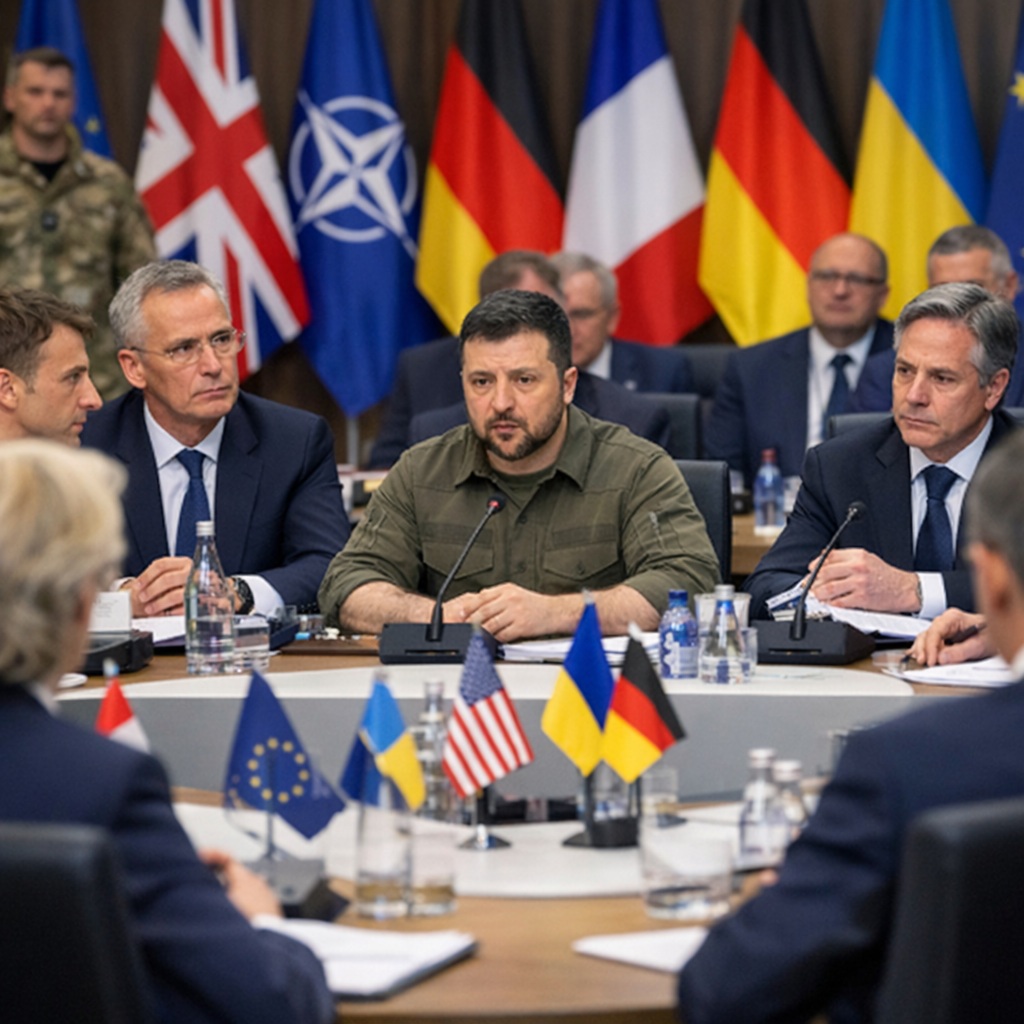
Kyiv and allied leaders plan an early-January meeting to align strategy and sustain pressure on Moscow, underscoring a renewed diplomatic push as the conflict enters another year.

As the year turns, Ukraine’s leadership is preparing to convene what President Volodymyr Zelenskiy has described as a meeting of a “coalition of the willing,” a gathering of allied governments ready to maintain political, military, and economic backing for Kyiv. The talks, expected in the opening days of the new year, are designed to synchronize strategy among partners at a moment when the war has settled into a grinding, high-stakes stalemate.
Ukrainian officials say the meeting will focus on sustaining momentum—on the battlefield, in diplomacy, and across international institutions—at a time when attention risks drifting and domestic pressures are rising in several partner countries. The initiative reflects Kyiv’s recognition that unity among its supporters remains as critical as weaponry, and that signaling resolve early in the year can help shape the months ahead.
The phrase “coalition of the willing” is deliberately chosen. It points to a core group of states prepared to move decisively, even as broader international consensus can be slow and uneven. While officials have not publicly detailed the guest list, the framing suggests participation by key European partners, transatlantic allies, and other governments that have consistently backed Ukraine with arms, training, and financial assistance.
According to people familiar with the preparations, the agenda will include coordination on military aid deliveries, longer-term defense industrial cooperation, and the management of sanctions pressure on Russia. Discussions are also expected to touch on Ukraine’s air defense needs through the winter period, as well as planning for sustained support should the conflict extend further into the year.
Diplomatically, the meeting aims to reinforce a shared narrative: that the cost of fatigue or division would be higher than the cost of continued support. Ukrainian officials have repeatedly warned that wavering commitment could embolden Moscow and undermine the rules-based international order. By convening allies at the very start of the year, Kyiv is seeking to lock in political commitments before electoral cycles and budget debates complicate decision-making in partner capitals.
For European governments, the talks come against a backdrop of economic strain and public concern about energy prices and defense spending. Yet many leaders argue that predictability and coordination are precisely what markets and voters need. A clear, collective plan for Ukraine can reduce uncertainty and demonstrate that support is being managed strategically rather than reactively.
The meeting also reflects a broader evolution in how Ukraine and its partners conduct wartime diplomacy. Rather than relying solely on large, formal summits, Kyiv has increasingly favored focused formats that bring together decision-makers capable of acting quickly. This approach has helped accelerate aid packages and streamline training programs, even as the overall conflict remains complex and fluid.
Russia, for its part, has consistently criticized such initiatives, portraying them as evidence of Western interference. Ukrainian officials counter that the coalition is defensive by nature, aimed at restoring sovereignty and deterring further aggression. The early-year timing, they say, is meant to emphasize continuity: support for Ukraine is not a seasonal or symbolic gesture, but a sustained policy.
As the new year begins, expectations remain measured. No single meeting will alter the strategic balance overnight. But in Kyiv’s view, maintaining alignment among committed partners is a prerequisite for any future progress—whether on the battlefield or at the negotiating table.
In that sense, the planned gathering is as much about messaging as mechanics. It sends a signal to allies, adversaries, and Ukrainians themselves that, despite the passage of time and the accumulation of costs, the coalition backing Ukraine intends to start the year as it means to continue: coordinated, deliberate, and resolute.