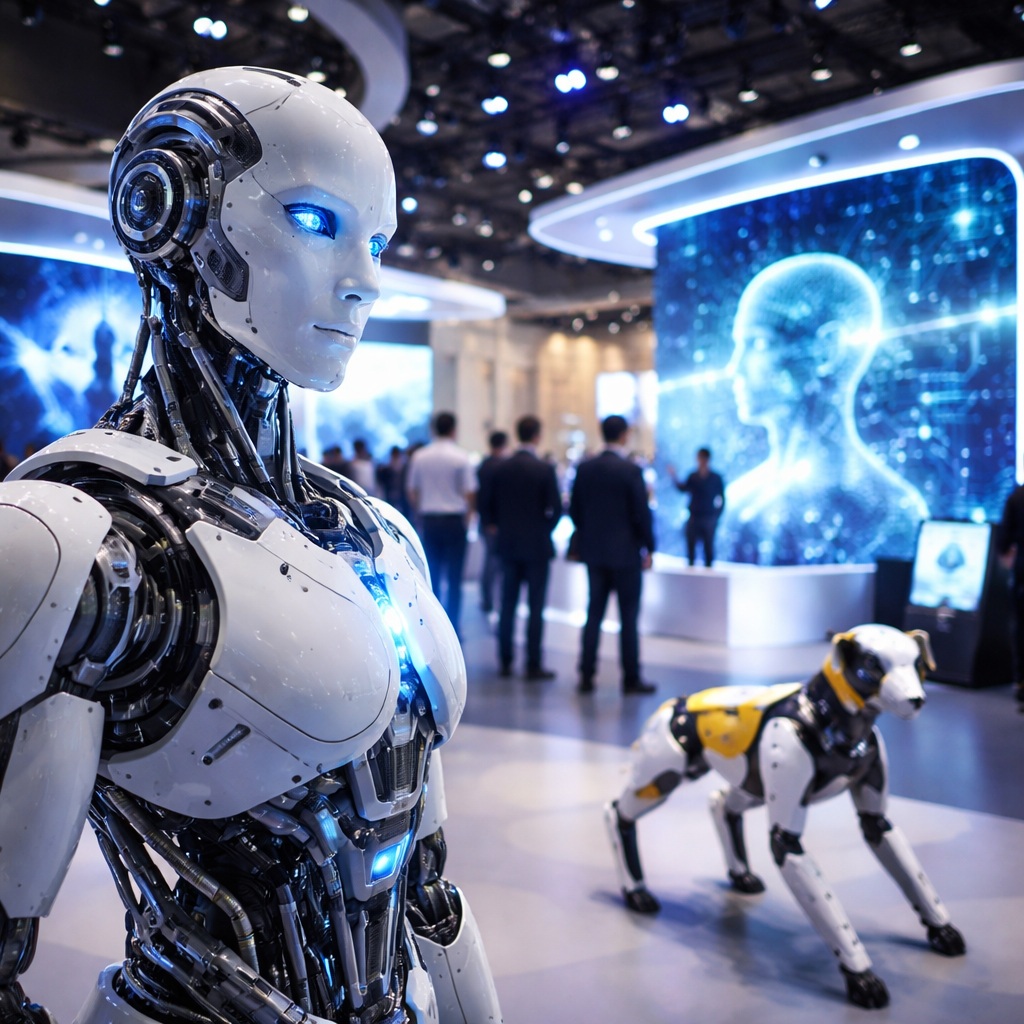
As the world’s biggest tech show opens its doors, industry leaders from Nvidia to emerging startups are framing artificial intelligence and robotics as the engines of a new technological era.
The global technology industry enters the new year with its attention fixed on Las Vegas, where the Consumer Electronics Show is poised to underline a decisive shift in innovation. As CES 2026 gets underway, artificial intelligence and robotics are no longer side attractions. They are the central narrative, presented as the foundations of the next economic and industrial cycle.
In the days leading up to the show, executives and analysts have converged on a shared message: AI is moving beyond software alone and into the physical world. Generative systems that once lived primarily in the cloud are now being embedded into machines, vehicles, factories, and homes. The result is what many industry leaders describe as a new phase of “physical AI,” where algorithms perceive, reason, and act in real environments.
Nvidia, whose hardware has become synonymous with the AI boom, is expected to play a defining role in shaping that conversation. The company has spent the past year expanding its focus from data centers to robotics platforms, simulation tools, and AI-driven digital twins. Its positioning ahead of CES reflects a broader industry trend: intelligence is becoming a core layer of every product category, not an optional feature.
Robotics, long promised but slow to mature, appears ready for renewed momentum. Advances in AI perception, reinforcement learning, and simulation are enabling machines to operate with greater autonomy and adaptability. At CES, this progress is expected to be visible in service robots, warehouse automation, healthcare assistants, and humanoid prototypes designed to work safely alongside people.
Generative AI remains a second pillar of the show’s narrative. While consumer chatbots captured public imagination in recent years, companies are now emphasizing practical deployment. Expect announcements focused on on-device AI, personalized assistants that respect privacy, and generative systems integrated directly into consumer electronics, from vehicles to smart appliances. The emphasis has shifted from novelty to reliability, efficiency, and trust.
The convergence of AI and robotics also reflects deeper economic pressures. Labor shortages, supply chain volatility, and rising costs are pushing companies to automate more intelligently rather than simply faster. CES exhibitors are likely to frame their technologies as tools for resilience, promising systems that can learn from disruption and adapt in real time.
For startups, the show offers a rare chance to compete for attention alongside established giants. Many young companies are expected to showcase niche AI models, specialized robotics platforms, and software designed to bridge the gap between research and deployment. Venture investors attending CES are increasingly focused on such applied innovation, seeking evidence that AI can deliver measurable productivity gains.
Yet alongside the optimism, caution remains part of the conversation. Regulators, ethicists, and industry leaders continue to debate how autonomous systems should be governed, particularly as robots move into public and private spaces. Security, safety, and transparency are expected to feature prominently in panel discussions and keynote addresses.
CES 2026 thus opens with a clear signal: the technology industry sees artificial intelligence and robotics not as separate trends, but as intertwined forces shaping a new era. The show’s message is less about distant futures and more about imminent change. As products unveiled this week move from prototypes to production, they point toward a world where intelligent machines are no longer experimental, but essential.




 The Tower Post