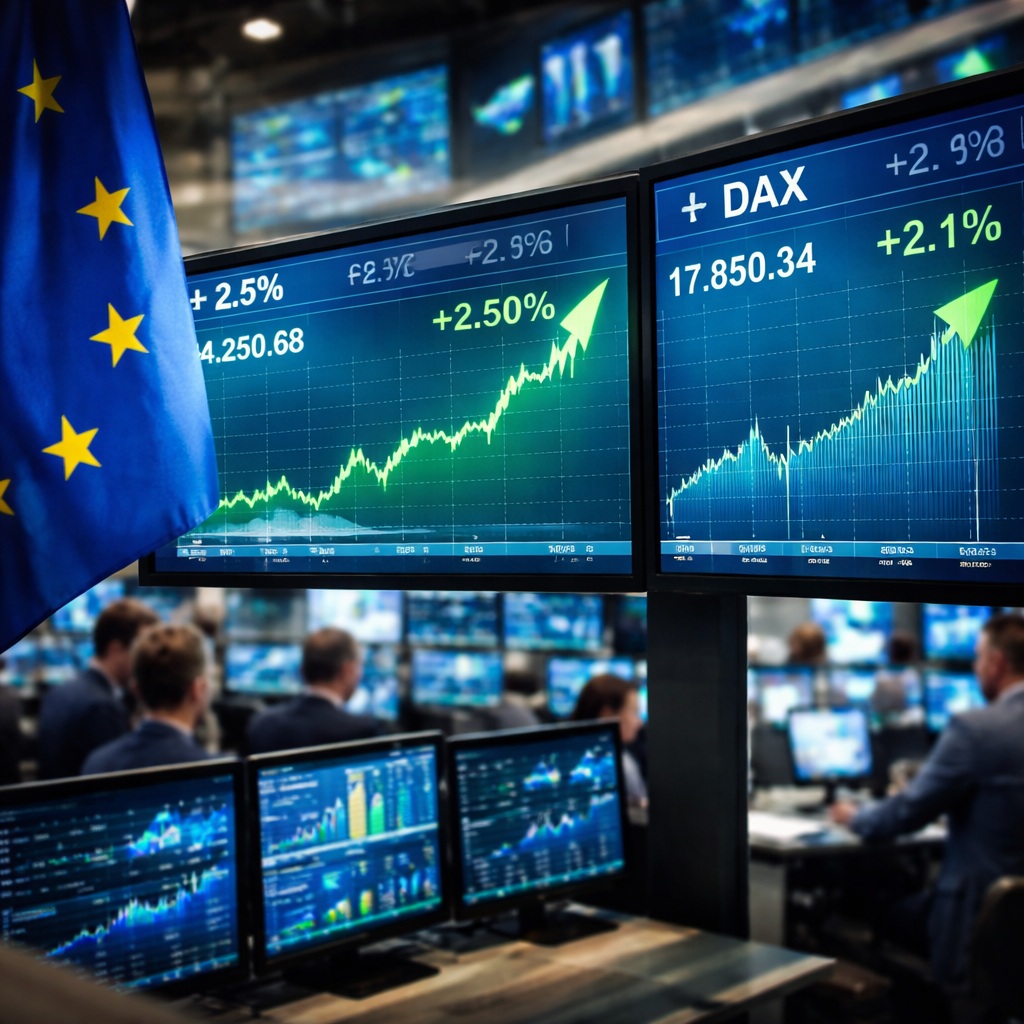
Markets across the continent extend late-2025 momentum as fiscal spending plans and a rotation into defence stocks outweigh weak factory data.
European equity markets have opened the new year with a decisive show of confidence, extending the rally that closed out last year and pushing key indices to fresh record territory. From Frankfurt to Paris, investors have embraced a risk-on mood that reflects growing optimism around government spending, industrial policy, and Europe’s strategic repositioning in a more fragmented global economy.
The broad-based STOXX 600 index has continued to grind higher, supported by gains across industrials, financials, and defence-related stocks. Germany’s DAX, long seen as a barometer of Europe’s export-driven economy, has also advanced, underlining the market’s willingness to look beyond short-term economic softness.
At the heart of this momentum lies a renewed focus on fiscal stimulus. Several European governments have entered the year signalling a readiness to loosen the purse strings, particularly in areas linked to defence, infrastructure, and energy security. For investors, this marks a notable shift from the austerity-heavy narratives that dominated much of the previous decade.
Defence stocks have emerged as one of the most powerful drivers of the rally. Heightened geopolitical tensions and long-term commitments to higher military spending have prompted portfolio managers to rotate into companies seen as direct beneficiaries of sustained public investment. This rotation has helped offset weakness in more cyclical sectors tied closely to consumer demand.
Economic data, meanwhile, has offered a more cautious picture. Recent surveys show that factory activity across parts of the euro zone remains in contraction, reflecting subdued global demand and lingering supply-chain adjustments. Ordinarily, such figures might have dampened market enthusiasm. This time, however, investors have largely shrugged them off.
The disconnect between soft manufacturing data and buoyant equity prices highlights a broader shift in market psychology. Rather than focusing narrowly on current output, investors appear more interested in medium-term policy support and structural change. Expectations that fiscal measures will cushion the slowdown — and eventually reignite growth — have taken precedence.
Central banks remain part of the backdrop, though they are no longer the sole focus. With inflation pressures easing compared with recent peaks, monetary policy is seen as less of a headwind than in previous years. This has allowed fiscal policy and sector-specific narratives to reclaim centre stage in shaping market direction.
The early-year rally has also been characterised by relatively calm trading conditions. Volatility has remained contained, suggesting that the advance is being driven more by steady asset allocation shifts than by speculative bursts. Analysts note that international investors, who had previously underweighted European equities, are gradually rebuilding exposure.
Still, some caution persists beneath the surface. Valuations in certain segments have become stretched, and the resilience of the rally will ultimately depend on whether promised spending translates into tangible economic activity. A prolonged manufacturing downturn or renewed external shocks could yet test investor confidence.
For now, though, European shares have entered the new year with clear momentum. As markets digest the interplay between soft data and strong policy signals, the opening days of 2026 have set a tone of guarded optimism — one in which Europe’s equity story is once again commanding global attention.


 The Tower Post