Authorities say progress in a maritime investigation underscores growing European concern over the security of undersea communications infrastructure.

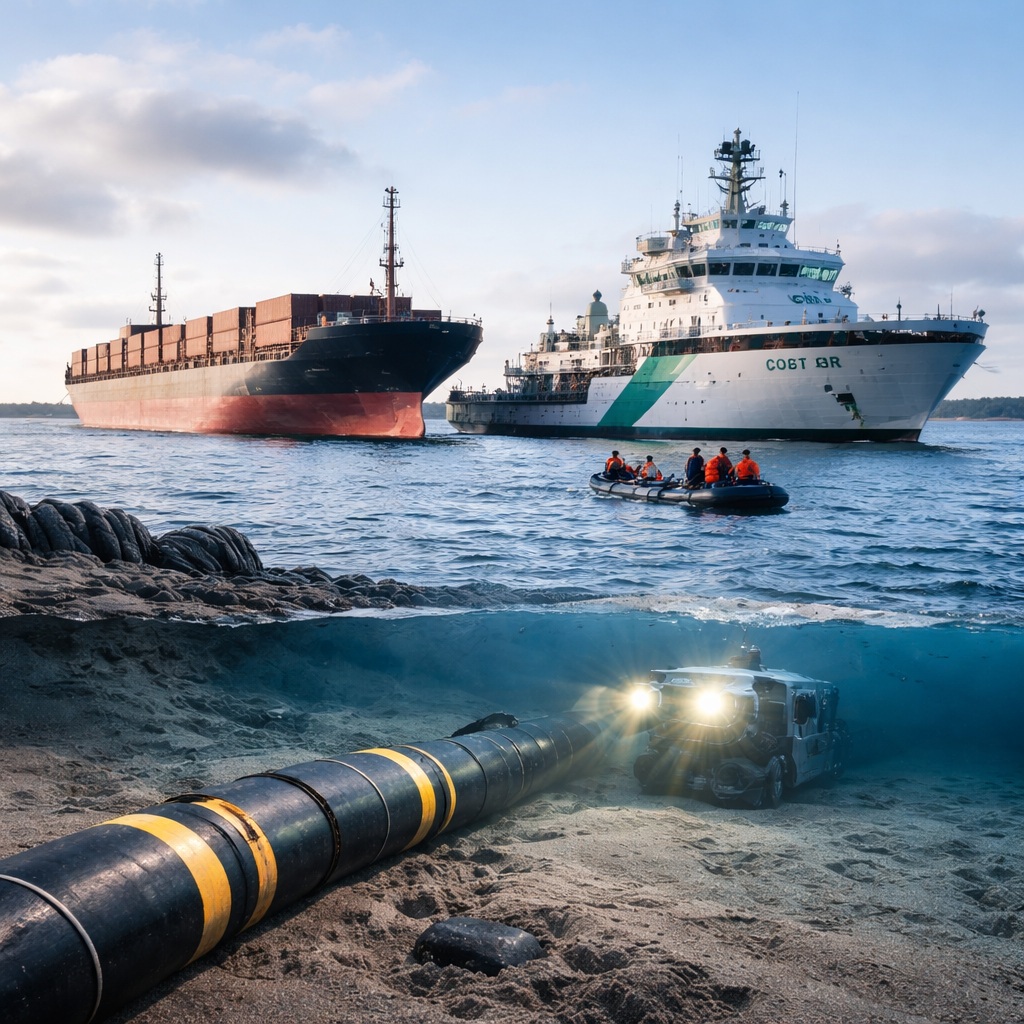
Finland has taken a decisive step forward in its investigation into a suspected breach of critical maritime infrastructure, as police confirmed that a cargo vessel believed to be linked to damage to an undersea cable has been seized. The move signals a more assertive posture by Nordic authorities amid rising concern across Europe about the vulnerability of the networks that carry data, energy, and communications beneath regional seas.
The incident, which involves a subsea cable running through strategically sensitive waters, has drawn attention well beyond Finland’s borders. Undersea cables are the silent arteries of the digital economy, enabling everything from mobile communications and financial transactions to government coordination and emergency services. Any disruption, even localized, can ripple across multiple countries.
Finnish investigators have remained cautious in their public statements, emphasizing that the inquiry is ongoing and that conclusions will be based on technical and forensic evidence. Still, officials have acknowledged that the seizure of a commercial vessel marks a turning point in the probe. Authorities are now examining whether the ship’s movements, equipment, or crew activities coincide with the moment the cable was damaged.
According to sources familiar with the investigation, maritime tracking data and seabed inspections played a key role in narrowing the focus to the vessel. Modern cable monitoring systems can detect anomalies almost instantly, but identifying the cause—whether accidental, negligent, or deliberate—requires painstaking reconstruction of events beneath the surface.
The case has reignited debate about how exposed Europe’s critical infrastructure remains. The Baltic Sea, in particular, has become a focal point for security planners. It is shallow, crowded with commercial traffic, and crisscrossed by a dense web of data cables, power links, and pipelines connecting multiple nations. While this interconnectedness underpins economic resilience, it also creates points of vulnerability.
Security analysts note that damage to subsea infrastructure does not automatically imply hostile intent. Anchors dragged along the seabed, fishing equipment, or mechanical failures have historically caused many cable breaks worldwide. Yet the current geopolitical climate has heightened sensitivity to any incident affecting strategic assets, especially in northern Europe.
Finnish officials have stressed that cooperation with international partners is central to the investigation. Information sharing with neighboring states and European agencies has intensified, reflecting a broader push toward collective awareness of maritime risks. In recent years, several European governments have invested in joint monitoring initiatives, naval patrols, and satellite surveillance aimed at protecting undersea infrastructure.
The seizure of the vessel also raises complex legal and diplomatic questions. Maritime law allows coastal states to investigate incidents within their jurisdiction, but commercial shipping is inherently international. Any determination of responsibility must balance national security concerns with due process and international conventions governing navigation and trade.
Industry representatives are watching the case closely. Telecommunications operators and energy companies have long warned that subsea cables are both essential and difficult to defend. Repairs can take weeks and require specialized ships, during which time traffic must be rerouted or capacity reduced. Even temporary outages can strain networks and increase costs.
In response to recent incidents across Europe, policymakers have begun discussing stronger protective measures. These include clearer routing disclosures for critical cables, enhanced exclusion zones, and closer coordination between civilian operators and military forces. Critics, however, caution that over-securitization could hinder commercial shipping and inflate costs without fully eliminating risk.
For Finland, the investigation is also a test of preparedness. The country has invested heavily in resilience planning, emphasizing redundancy and rapid response. Officials say that while the cable damage was serious, contingency measures ensured that essential services continued to function, limiting the immediate impact on the public.
As the probe advances, authorities are expected to conduct detailed inspections of the seized vessel, including its hull, anchor systems, and onboard records. Crew members may be questioned to clarify navigation decisions and operational procedures. Any findings will be weighed carefully before prosecutors decide on potential charges or further actions.
Beyond the specifics of the case, the episode underscores a broader reality: Europe’s prosperity and security depend on infrastructure that is largely invisible and difficult to shield. The challenge for governments is to deter interference, respond swiftly to incidents, and reassure citizens without escalating tensions.
Say Finnish officials, the investigation’s progress demonstrates both vigilance and restraint. By following evidence and legal frameworks, they aim to establish the facts while contributing to a wider European effort to safeguard the networks beneath the sea—networks that, though unseen, connect nations more tightly than ever.