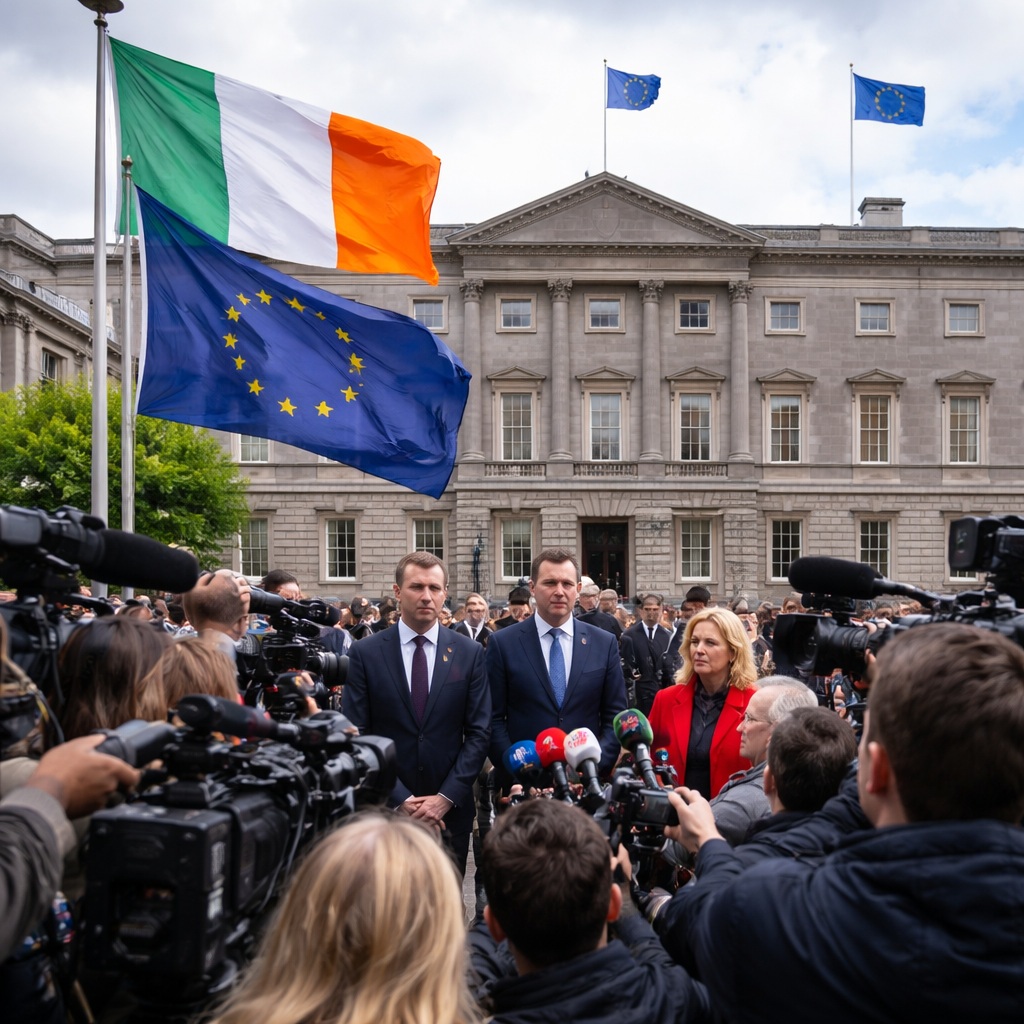
Coalition tensions, policy bottlenecks and looming by-elections are reshaping Irish politics just months before Dublin takes the helm of the European Union.
DUBLIN — Ireland is approaching a moment of unusual political intensity as it prepares to assume the rotating presidency of the European Union in mid-summer. Traditionally a period when national governments seek stability and diplomatic focus, the run-up to the presidency is instead exposing strains at the heart of Irish politics, with leadership under pressure and coalition unity increasingly fragile.
The government, a carefully balanced partnership forged to ensure continuity after years of fragmented electoral outcomes, is facing mounting scrutiny at home. While ministers are keen to project competence and calm abroad, domestic debates are becoming louder and more polarised, complicating efforts to present Ireland as a steady hand capable of brokering consensus among EU member states.
At the centre of the turbulence is a sense that the governing coalition is being pulled in several directions at once. Policy disagreements that were once managed quietly within cabinet have spilled into public view, particularly on housing, migration and the future of the health system. These issues have long defined Irish political debate, but their convergence at such a sensitive diplomatic moment has heightened their impact.
Housing remains the most emotive of the challenges. Years of undersupply, rising rents and frustrated younger voters have created a perception that government responses have been too slow and too cautious. Opposition parties have seized on this sentiment, framing housing not only as a social crisis but as evidence of a political class disconnected from everyday pressures. Within the coalition, differences persist over how far the state should intervene in the market, exposing ideological fault lines that complicate unified messaging.
Migration policy has become another flashpoint. Ireland’s role within the EU places it at the intersection of collective European commitments and domestic capacity constraints. As arrivals have increased and accommodation pressures mounted, local communities have voiced concerns that have quickly translated into national political debate. Ministers insist that Ireland must uphold humanitarian obligations while cooperating closely with European partners, yet disagreements over enforcement, integration and burden-sharing have strained coalition cohesion.
Health policy, meanwhile, continues to test public confidence in governance. Despite repeated reform initiatives, waiting lists and access to care remain persistent concerns. Senior figures acknowledge that progress has been uneven, but argue that structural change takes time. Critics counter that the pace of reform is out of step with public expectations, particularly at a time when the cost of living has sharpened demands for effective public services.
Overlaying these policy disputes is the looming prospect of by-elections, which many observers see as an informal referendum on the government’s performance. Although they will not alter the balance of power in parliament on their own, the contests are widely viewed as bellwethers for voter mood. A poor showing for coalition parties would intensify leadership pressure and embolden internal critics just as Ireland steps onto the European stage.
Political analysts note that the timing could hardly be more awkward. The EU presidency requires sustained attention to complex legislative files, patient diplomacy among member states and the ability to respond quickly to external shocks. Any perception of domestic instability risks weakening Ireland’s authority in chairing negotiations and setting agendas, even if the civil service machinery underpinning the presidency remains robust.
Government leaders have sought to reassure European partners that preparations are on track. Officials point to Ireland’s previous presidencies, which earned praise for efficiency and consensus-building, and stress that institutional memory remains strong. Behind the scenes, however, there is recognition that political distraction at home can limit the bandwidth of senior ministers expected to lead EU-level discussions.
Opposition parties are acutely aware of this vulnerability. While most avoid overtly undermining Ireland’s international role, they have intensified criticism of domestic policy failures, arguing that credibility abroad begins with performance at home. Some have called for clearer leadership signals and a reset of coalition priorities to restore public trust before the presidency formally begins.
Public opinion appears divided between pride in Ireland’s European role and frustration with unresolved domestic problems. Surveys and street-level sentiment suggest that voters expect the government to be able to manage both, rejecting the notion that international responsibilities should excuse domestic shortcomings. This dual expectation is shaping a political environment in which compromise is harder to sell and missteps carry amplified consequences.
For Ireland, the coming months represent a delicate balancing act. The government must demonstrate enough unity and decisiveness to navigate domestic debates while simultaneously projecting the neutrality and reliability expected of an EU presidency holder. Success would reinforce Ireland’s reputation as a constructive European actor. Failure, or even visible drift, could deepen cynicism at home and weaken influence abroad.
As winter gives way to a politically charged spring, the question facing Dublin is not whether challenges exist, but whether the current leadership can contain them. With coalition strains exposed and key policy battles unresolved, Ireland’s path to the EU presidency is shaping up to be as much a test of domestic governance as of diplomatic skill.
 The Tower Post