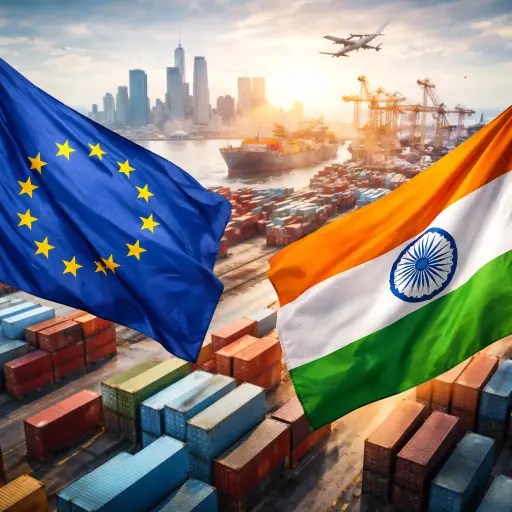
As transatlantic frictions persist and geopolitics shift, Brussels accelerates free-trade diplomacy to build resilience beyond traditional partners.

In early February, the European Union is moving decisively to redraw its global trade map. Against a backdrop of persistent transatlantic tensions and an increasingly fragmented geopolitical landscape, Brussels is accelerating efforts to secure broader trade partnerships that can cushion the bloc against economic shocks and strategic overdependence.
At the heart of this push is a renewed emphasis on diversification. For decades, the EU’s economic fortunes have been closely intertwined with a small number of major powers. While those relationships remain vital, policymakers in Brussels are now openly acknowledging the risks of relying too heavily on any single partner in a world marked by trade disputes, security crises, and rapid technological change.
Negotiations with India have become emblematic of this strategy. Talks toward a comprehensive free-trade agreement have gained fresh momentum, driven by complementary interests on both sides. For the EU, India represents not only a vast and growing market, but also a strategic counterweight in Asia. For New Delhi, closer trade ties with Europe promise greater access to advanced technologies, investment, and a stable export destination.
European officials frame the discussions as part of a broader effort to “de-risk” rather than disengage. The goal is not to sever existing economic ties, but to ensure that supply chains, energy flows, and critical industries are less vulnerable to political pressure or sudden disruptions. Recent years have underscored how quickly global trade can be weaponized, turning economic interdependence into a liability.
Beyond India, the EU is also revisiting or advancing trade talks with partners across the Indo-Pacific, Latin America, and Africa. Agreements with countries such as Australia and Mercosur members are seen as building blocks of a more balanced global network. Together, they would give European companies alternative markets and sourcing options, while reinforcing the EU’s role as a standard-setter on labor, environmental, and digital rules.
This outward push is unfolding as relations with the United States remain complex. While Washington and Brussels share deep economic ties and common values, recent disputes over industrial subsidies, green technologies, and regulatory approaches have highlighted structural differences. The EU’s trade diversification is therefore as much about strategic autonomy as it is about growth.
China, too, looms large in the background. Europe’s economic relationship with Beijing is significant, but increasingly fraught with concerns over market access, state subsidies, and security. By strengthening partnerships elsewhere, EU leaders hope to gain greater leverage and flexibility in managing this delicate balance.
Critics caution that free-trade agreements are no panacea. Negotiations are often lengthy and politically sensitive, particularly when they touch on agriculture, environmental standards, or data protection. Within Europe, domestic debates continue over how to reconcile openness with the protection of local industries and social models.
Still, there is a growing consensus in Brussels that standing still is not an option. The global trading system is under strain, multilateral rules are being tested, and geopolitical rivalries show little sign of easing. In this context, broadening the EU’s trade partnerships is increasingly viewed as a strategic necessity rather than a policy choice.
As winter turns toward spring, the message from European capitals is clear: the EU intends to be an active shaper of the emerging global order, not a passive bystander. By knitting together a wider web of trade relationships, Brussels hopes to secure economic resilience, political influence, and a measure of stability in an uncertain world.