Restructuring Drive Reflects Mounting Pressure on Europe’s Auto Sector as EV Competition Intensifies

Volkswagen is preparing to slash its costs by 20% by 2028 in a sweeping restructuring effort designed to reinforce its competitiveness in the global electric vehicle market, according to a Reuters report, marking one of the most significant efficiency drives in the company’s recent history as Europe’s automotive champions confront intensifying structural and competitive pressures.
The plan signals a decisive moment for the German automaker as it seeks to recalibrate its vast industrial network and administrative framework to adapt to an era defined by electrification, digitalization and aggressive price competition, particularly from fast-growing Chinese manufacturers that have rapidly expanded their global footprint with lower-cost electric models.
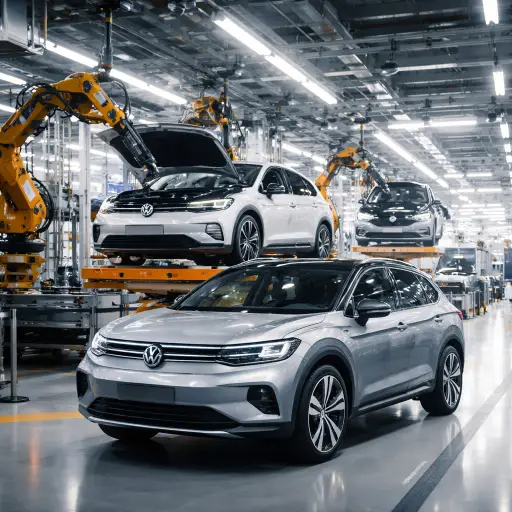
Executives are expected to pursue savings through streamlined procurement, leaner corporate structures, optimized production processes and expanded automation, while also reviewing overlapping functions across brands in an effort to simplify decision-making and improve operational agility within the group’s complex organizational architecture.
The cost-cutting initiative unfolds at a time when the broader European auto industry is grappling with weakening demand in key markets, volatile energy prices and the high capital expenditures required to transition from internal combustion engines to battery-electric platforms, creating a dual burden of funding legacy operations while investing heavily in future technologies.
Industry analysts say Volkswagen’s scale, once an unquestioned competitive advantage, has in recent years contributed to slower execution and higher fixed costs, prompting investor calls for sharper efficiency and more disciplined capital allocation as profit margins in the core passenger car division face mounting strain.
Electric vehicle adoption across Europe continues to expand, yet price sensitivity among consumers has intensified as government incentives become less predictable and new entrants push down average selling prices, forcing established manufacturers to reassess cost structures that were built around combustion-era economics.
Volkswagen’s leadership has framed the 20% reduction target not merely as a defensive response to market turbulence but as a proactive transformation aimed at unlocking resources for next-generation electric platforms, battery partnerships and software development capabilities that will underpin long-term competitiveness.
Central to the restructuring is the challenge of balancing efficiency gains with labor stability in Germany and other European markets where strong worker representation and social partnership traditions shape corporate decision-making, making productivity improvements a negotiated and politically sensitive process.
While no abrupt factory shutdowns have been formally announced as part of the plan, discussions are expected to focus on improving plant utilization rates, reducing complexity in model lineups and accelerating digital workflows to lower per-unit production costs without undermining industrial capacity.
The push for savings mirrors similar moves by other European automakers that are trimming overhead, consolidating research programs and seeking strategic alliances to share the immense costs associated with battery technology and advanced driver assistance systems.
Beyond competitive dynamics, Volkswagen’s restructuring also reflects geopolitical realities that have exposed vulnerabilities in global supply chains, prompting the company to explore greater localization of battery cell production and semiconductor sourcing in an effort to mitigate disruption risks.
Europe’s automotive sector remains a cornerstone of the region’s industrial base and export economy, supporting millions of jobs directly and indirectly, and the pressure on manufacturers to remain globally competitive has become a matter of strategic economic importance for policymakers.
In recent earnings discussions, company executives have acknowledged that sustaining profitability during the electric transition will depend not only on sales volumes but on structural cost discipline and faster product cycles, particularly as technological innovation accelerates across drivetrain and software systems.
Analysts caution that achieving a 20% reduction in expenses within a few years will require rigorous execution and cultural change inside an organization historically known for its engineering depth but sometimes criticized for bureaucratic inertia and slow adaptation to shifting market conditions.
At the same time, Volkswagen continues to expand its electric vehicle portfolio across multiple brands, betting that broader model availability combined with improved cost efficiency will allow it to defend market share in Europe while strengthening its presence in North America and other growth regions.
The company’s restructuring drive thus stands as both a corporate reset and a bellwether for the wider transformation sweeping Europe’s auto industry, where legacy manufacturers are racing to redefine themselves in the face of disruptive technological change and assertive global rivals.
Whether the savings program ultimately restores stronger margins in the electric era will hinge on disciplined implementation, stable demand conditions and the company’s ability to translate operational efficiencies into sustained innovation and customer appeal.
As the overhaul gathers momentum, investors, employees and policymakers alike will be watching closely to see whether Volkswagen can streamline its industrial model without sacrificing the engineering strength and brand equity that have long defined one of Europe’s most influential automotive groups.