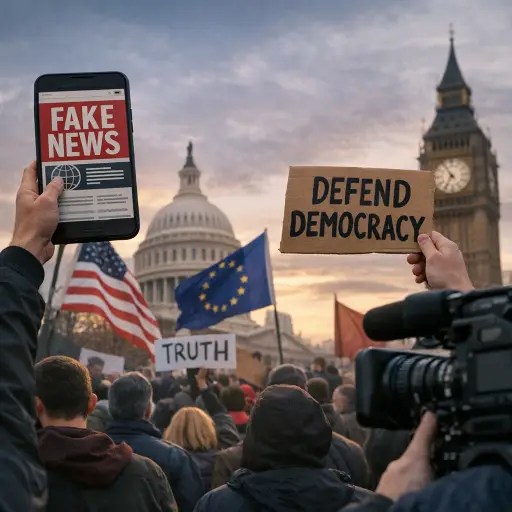
Transatlantic poll highlights fears of fake news, extremism, corruption, and weak accountability as defining threats to Western democratic systems
As winter political debates intensify across Western capitals, a sweeping transatlantic survey released this week finds that large majorities of citizens in Europe and the United States believe democracy is facing mounting internal pressure, with misinformation, extremism, corruption, and a lack of accountability cited as the most serious threats to the stability of democratic institutions.
The poll, conducted across multiple European Union member states, the United Kingdom, and the United States, reveals a striking convergence of concern among voters who differ politically but share a growing sense that the democratic model is being tested from within rather than from foreign adversaries alone.
Fake news and digital disinformation rank at the top of public anxieties, with respondents warning that the speed and scale of online manipulation have outpaced the ability of governments, regulators, and media organizations to respond effectively.
Participants describe an information environment saturated with misleading headlines, manipulated images, algorithm-driven echo chambers, and increasingly sophisticated synthetic media, all of which blur the line between verified reporting and manufactured narratives.
Many respondents say repeated exposure to questionable content has eroded trust not only in political leaders but also in traditional journalism, scientific institutions, and electoral processes, creating a feedback loop of suspicion that weakens democratic cohesion.
Closely following concerns about misinformation is the perceived rise of political extremism, with citizens on both the left and the right expressing alarm at hardened rhetoric, declining willingness to compromise, and the normalization of once-fringe ideological positions.
Survey participants across Europe point to growing polarization within national parliaments, while American respondents reference entrenched partisan divides that frequently result in legislative gridlock and public confrontations over fundamental democratic norms.
The sense that political leaders are not being held adequately accountable further deepens public unease, as large segments of respondents believe that oversight mechanisms exist on paper but are inconsistently enforced in practice.
Ethics investigations, lobbying controversies, opaque campaign financing structures, and the revolving door between public office and private industry are frequently cited as examples of a system perceived to favor insiders over ordinary voters.
Corruption, both perceived and proven, remains a powerful driver of democratic skepticism, particularly in parts of Southern and Eastern Europe, but also in the United States where respondents increasingly describe influence as something that can be legally purchased through campaign contributions and privileged access.
For many citizens surveyed, the distinction between illegal corruption and legal forms of influence is less important than the broader impression that wealth and proximity to power distort policymaking outcomes.
Despite these anxieties, the survey does not suggest a wholesale rejection of democratic governance, as clear majorities in every country polled still affirm that democracy remains preferable to any alternative system.
However, that support is increasingly described as conditional, with respondents emphasizing that democracy must deliver transparency, fairness, and institutional integrity in order to retain public confidence.
Younger respondents express some of the strongest concerns about the fragility of democratic systems, yet they also report higher levels of civic engagement and a stated willingness to participate in protests, voting initiatives, and digital activism aimed at defending democratic norms.
In both Europe and the United States, debates over social media regulation, election security, judicial independence, and media freedom have intensified, reflecting a broader recognition that democratic resilience depends on institutional adaptation to technological and political change.
Experts observing the findings note that anxiety itself can be destabilizing if left unaddressed, as persistent distrust may reduce voter participation, weaken compliance with public policy, and create openings for leaders who promise decisive action at the expense of checks and balances.
At the same time, analysts argue that widespread concern can also be interpreted as evidence of democratic vitality, since engaged citizens who identify problems are more likely to demand reform than those who have disengaged entirely.
Several European governments are advancing transparency measures aimed at curbing online disinformation and strengthening media oversight, while lawmakers in Washington continue to debate campaign finance reform and enhanced safeguards for electoral integrity.
Whether these initiatives will satisfy public expectations remains uncertain, but the survey makes clear that citizens are paying close attention and are increasingly willing to evaluate leaders based on their commitment to democratic repair.
The interconnected nature of the threats identified in the poll underscores the complexity of the challenge, as misinformation fuels extremism, extremism deepens polarization, polarization weakens accountability, and weakened accountability fosters corruption.
As Western democracies navigate a politically charged period marked by consequential elections, geopolitical tensions, and rapid technological evolution, the message from voters is neither fatalistic nor complacent but urgent.
Democracy, according to the citizens surveyed, is not collapsing, yet it is undeniably under strain, and its future will depend on whether leaders can rebuild trust in institutions that many believe have drifted too far from the people they are meant to serve.

 The Tower Post