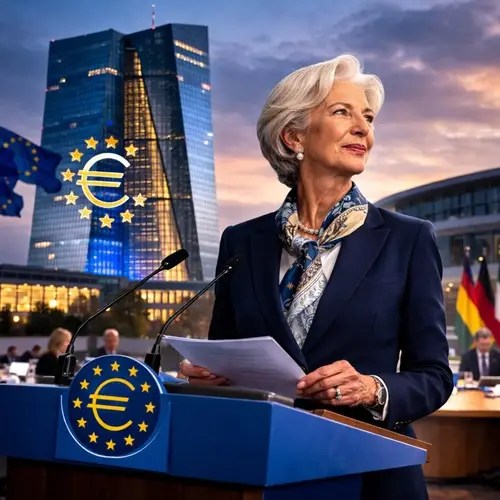
ECB President Signals Early Exit to Shape Europe’s Political Balance Ahead of France’s Electoral Season
A fresh wave of political speculation is sweeping across Europe’s financial centers as Christine Lagarde prepares to step down from the presidency of the European Central Bank before the official conclusion of her mandate, a move that could recalibrate influence inside the European Union just as France approaches a sensitive electoral season.
Senior officials in Frankfurt and Brussels confirm that internal discussions about succession have quietly accelerated, suggesting that the timing of Lagarde’s departure is designed to provide European leaders with greater flexibility in shaping the bloc’s monetary leadership before domestic political pressures intensify in Paris.
Lagarde, who previously served as France’s finance minister and later led the International Monetary Fund, has been one of the most recognizable figures in global economic governance, steering the euro area through pandemic emergency stimulus, energy-driven inflation shocks, tightening cycles, and geopolitical uncertainty that tested the cohesion of the currency union.
Her tenure at the ECB was defined by a delicate balancing act between hawkish policymakers demanding aggressive rate increases to combat inflation and more cautious voices concerned about recession risks and financial fragmentation within southern member states, a divide she managed through consensus-building and calibrated communication.
While the ECB’s institutional independence remains formally intact, leadership transitions at the top of the central bank have always reflected a broader equilibrium among member states, and an early vacancy would immediately trigger negotiations among eurozone capitals eager to secure strategic representation in Frankfurt.
In Paris, the implications are especially pronounced because Lagarde remains one of France’s most influential figures on the European stage, and her decision to leave early may offer EU leaders the opportunity to appoint a successor without the distortions of campaign politics overshadowing the process.
Financial markets have so far reacted with measured restraint, as bond spreads across southern Europe show no signs of acute stress, indicating that investors perceive continuity in policy direction despite the potential change in leadership at the ECB’s helm.
Analysts note that the central bank’s monetary framework is institutionally anchored and unlikely to shift abruptly, yet they also acknowledge that the personality and diplomatic style of its president can influence tone, communication strategy, and crisis management during periods of volatility.
The debate unfolding behind closed doors extends beyond economic management and touches on the broader question of how Europe’s supranational institutions interact with national political cycles, especially at a moment when populist movements and fiscal tensions continue to test the bloc’s unity.
Lagarde has remained publicly focused on inflation dynamics and financial stability, declining to address speculation directly, but those familiar with her thinking suggest she is determined to leave the institution on stable footing and to ensure a smooth handover that protects the ECB’s credibility.
Potential successors are already being mentioned in diplomatic circles, with names circulating from both northern and southern Europe, reflecting the perennial balancing act between economic orthodoxy and political compromise that characterizes high-level EU appointments.
For European leaders gathering this week for strategic consultations, the question is no longer whether succession planning must begin, but how to manage the process in a way that reinforces confidence in governance rather than exposing fractures within the euro area.
Lagarde’s anticipated early exit thus represents more than a personal decision; it signals a recalibration of power within Europe’s institutional architecture at a moment when economic resilience, political legitimacy, and electoral timing intersect with unusual intensity.
As winter meetings continue and negotiations quietly unfold, Europe finds itself once again reminded that even its most technocratic institutions operate within a political ecosystem where timing, influence, and perception carry weight equal to interest rates and balance sheets.


 The Tower Post