As security tensions ripple across Northern Europe, Swedish defense officials warn that Moscow’s hybrid tactics are intensifying, testing resilience from the Baltic Sea to the Arctic frontier.

Sweden’s military leadership has issued a renewed warning that hybrid threats linked to Russia are increasing in scale and complexity, sharpening anxiety across Northern Europe’s defense establishments as war dynamics continue to reshape the continent’s security order.
Senior figures within the Swedish Armed Forces describe a steady pattern of coordinated actions designed to probe vulnerabilities, unsettle public confidence, and complicate political decision-making, all while remaining deliberately below the threshold of open armed confrontation.
According to defense officials, these activities range from cyber intrusions targeting public agencies and private infrastructure to disinformation campaigns circulating across digital platforms, alongside episodes of GPS interference and suspicious movements near critical maritime assets in the Baltic Sea region.
Although Sweden’s integration into NATO has reinforced its formal security guarantees, military planners acknowledge that membership has also elevated the country’s strategic visibility, potentially increasing its exposure to influence operations aimed at testing Alliance cohesion and resolve.
Hybrid warfare, as Swedish analysts explain, is characterized by ambiguity and deniability, blending cyber tactics, psychological operations, economic pressure, and limited physical disruption in ways that complicate attribution and blur the boundary between peace and conflict.
Across the Nordic and Baltic region, governments have reported similar patterns of cyber reconnaissance against government networks, energy providers, and telecommunications systems, reinforcing a shared perception that the pressure is neither isolated nor accidental.
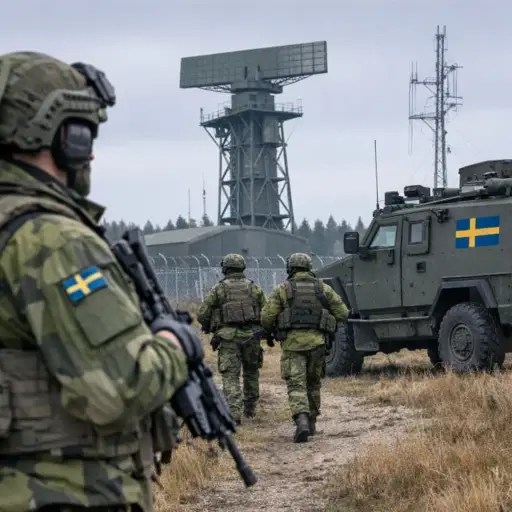
Sweden’s geographic position at the crossroads of the Nordic region and the Baltic Sea grants it strategic significance, with the island of Gotland once again central to defense planning as Stockholm strengthens its military footprint there to deter potential aggression and reassure allies.
Officials emphasize that resilience in this environment depends not solely on conventional military capabilities but on societal preparedness, prompting a revival of Sweden’s total defense concept that integrates civil authorities, private companies, and citizens into coordinated readiness efforts.
Public information initiatives now encourage vigilance against misinformation and advise households on contingency planning, reflecting a broader recognition that hybrid threats seek to exploit social fractures as much as technological vulnerabilities.
The continuing war in Ukraine forms the wider strategic backdrop to Sweden’s warning, as Stockholm maintains political, humanitarian, and military support for Kyiv, a posture that situates the country firmly within the geopolitical contest shaping Europe’s security trajectory.
Security experts note that hybrid pressure often intensifies when conventional fronts experience relative stalemate, allowing adversaries to seek leverage indirectly through disruption of supply chains, political discourse, or infrastructure reliability without triggering direct military retaliation.
Within NATO, Sweden’s assessments are closely examined, particularly regarding the protection of undersea cables, energy pipelines, and maritime corridors in the Baltic Sea, areas considered especially vulnerable following earlier incidents that heightened concern about sabotage risks.
Joint exercises and coordinated patrols in northern waters and airspace have increased in frequency, serving both operational and signaling purposes as allied forces aim to demonstrate readiness while maintaining transparency to reduce the risk of miscalculation.
Cybersecurity remains a focal point of Swedish defense strategy, with expanded cooperation between government agencies and technology firms to monitor malicious digital activity and harden critical systems against intrusion or manipulation.
At the same time, intelligence services are tracking influence networks that disseminate misleading narratives, seeking to counter coordinated manipulation while preserving the democratic freedoms that define Swedish society.
Political leaders across party lines have largely presented a unified stance on national security, underscoring public support for NATO membership and continued engagement in European defense initiatives despite heightened awareness of associated risks.
Analysts caution that hybrid tactics derive strength from ambiguity, enabling hostile actors to deny responsibility and exploit hesitation, which is why Swedish authorities stress early detection, rapid attribution, and transparent communication as core components of deterrence.
The broader European landscape remains fluid as diplomatic initiatives and battlefield developments evolve, and Swedish officials argue that sustained vigilance rather than episodic alarm is necessary to prevent openings for exploitation.
In Stockholm, the prevailing message is that security in Northern Europe must now be understood as multidimensional, extending beyond traditional military deterrence into cyberspace, information ecosystems, and the protection of critical infrastructure beneath sea and soil.
As Europe confronts an uncertain strategic horizon, Sweden’s response illustrates an effort to balance firmness with restraint, projecting steadiness in the face of hybrid pressure while reaffirming its commitment to sovereignty, democratic resilience, and collective defense.