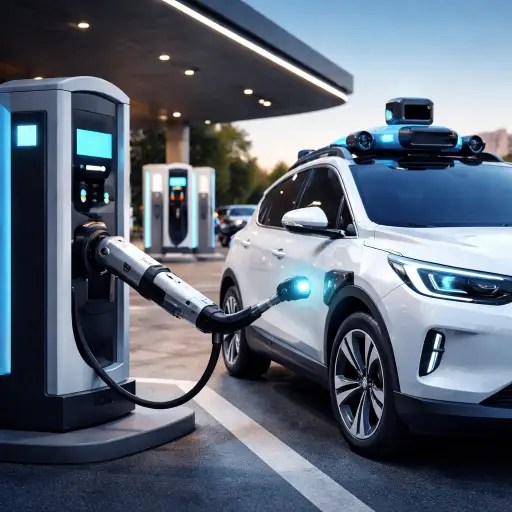
A $100M push into autonomous charging signals a pivotal shift in the race to power self-driving fleets

In a decisive move that underscores the accelerating transformation of urban mobility, Uber has unveiled plans to invest $100 million in building a dedicated autonomous vehicle charging network, marking one of the company’s most concrete infrastructure commitments as it deepens its ambitions in next-generation transport.
The announcement lands at a critical juncture for the mobility sector, as autonomous technology shifts from experimental pilots toward scaled deployment and long-term commercial viability across major metropolitan markets.
While public attention has largely focused on artificial intelligence systems, advanced sensors, and regulatory milestones, industry executives increasingly acknowledge that the less glamorous question of energy supply may determine who ultimately leads the race.
Uber’s planned charging infrastructure is designed specifically for autonomous fleets that operate nearly around the clock, demanding high-speed charging cycles, automated docking capabilities, predictive energy management, and minimal human intervention.
Company officials describe the investment as the foundation for an intelligent charging backbone that will allow vehicles to recharge seamlessly between trips while algorithms dynamically assign routes based on battery levels, traffic density, and demand forecasting.
The $100M autonomous charging network reflects a broader strategic shift within mobility technology companies, many of which are concluding that autonomy without scalable, reliable charging capacity risks creating operational bottlenecks that could undermine profitability.
Unlike traditional electric vehicle charging stations built for individual drivers, the envisioned hubs will prioritize fleet throughput, robotic connectors, real-time diagnostics, and direct communication with power grids to smooth electricity demand.
Analysts say controlling charging infrastructure could give Uber stronger leverage over operating costs, energy procurement, and fleet optimization, transforming what was once a backend utility expense into a competitive advantage.
The economic calculus is straightforward but consequential, because autonomous vehicles generate revenue only when moving, and every minute spent waiting for power represents lost income in a tightly margin-controlled business model.
By integrating energy management systems with dispatch software, Uber aims to reduce idle time to near zero while forecasting grid load patterns and negotiating more favorable electricity pricing agreements.
The move also positions the company as a participant in emerging urban energy ecosystems, where transportation electrification intersects with renewable integration, battery storage, and smart grid coordination.
Municipal governments are watching closely, as cities face mounting pressure to decarbonize transport networks while maintaining grid stability and safeguarding public space.
Centralized charging hubs could simplify regulatory oversight by consolidating fleet operations into predictable nodes rather than dispersing energy demand across fragmented private stations.
Critics caution that infrastructure investments represent a departure from Uber’s historically asset-light strategy, raising questions about capital intensity and long-term returns in a rapidly evolving technological landscape.
Company leaders counter that the rollout will be modular and aligned with autonomous fleet expansion, limiting exposure while ensuring that infrastructure capacity scales in tandem with vehicle deployment.
Competitive dynamics add urgency to the initiative, as rival ride-hailing platforms, automakers, and technology firms seek to secure charging access and lock in energy partnerships before autonomous services reach mass adoption.
Energy experts note that battery costs have stabilized and grid modernization efforts are accelerating, creating a more favorable environment for large-scale charging investments than in previous years.
For human drivers currently operating electric vehicles on the platform, the announcement underscores both opportunity and uncertainty, as electrification support continues even while automation advances.
Executives frame the investment as an evolution of the mobility ecosystem rather than an abrupt displacement of existing drivers, arguing that autonomous fleets will initially complement rather than replace human-operated vehicles in dense corridors.
Still, the symbolism is unmistakable, because building dedicated autonomous charging infrastructure signals confidence that self-driving fleets will form a central pillar of the company’s long-term growth strategy.
As cities adapt to electrified transport and data-driven traffic management, the success of autonomous services may hinge less on the sophistication of vehicle hardware and more on the intelligence of the networks that sustain them.
With this infrastructure commitment, Uber is staking its claim not only on the streets of future cities but also on the energy systems that will power them.