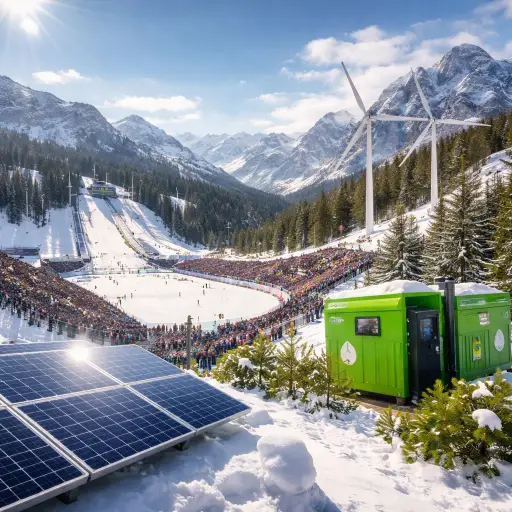
How the Milano-Cortina Winter Olympics turned renewable electricity and bio-based fuels into a test case for sustainable mega-events

As winter sport’s global spotlight settles on northern Italy, the Milano-Cortina Winter Olympics are drawing attention not only for medals and records but for an ambitious environmental pledge that has reshaped how the event is powered.
Organizers of the Games have made clean energy central to their operational strategy, committing to minimize the carbon footprint associated with electricity consumption across competition venues, training sites, media facilities, and temporary installations spread between Milan and the Dolomites.
At the heart of the plan is a guarantee that all electricity used for official venues has been sourced from certified renewable supplies, aligning projected demand with production from hydropower, solar, and wind facilities connected to the national grid.
The commitment required months of coordination with energy providers and certification bodies to secure guarantees of origin that match the scale and complexity of a multi-site Winter Olympics, where lighting, broadcasting, refrigeration, timing systems, and digital networks run continuously.
For winter sports in particular, the symbolism carries weight, as athletes compete against a backdrop of climate volatility that threatens snowfall reliability and reshapes alpine ecosystems, making the carbon intensity of the event itself a matter of scrutiny.
Beyond the grid connection, organizers turned their attention to one of the most carbon-intensive elements of past mega-events: temporary power generation, traditionally supplied by diesel generators stationed near venues and broadcast compounds.
In Milan-Cortina, diesel was largely replaced with bio-based fuel derived from renewable organic sources, reducing lifecycle greenhouse gas emissions while maintaining the reliability demanded by live global television and critical event infrastructure.
Technical teams conducted extensive pre-Games testing to ensure compatibility with existing generator fleets, storage safety in cold-weather conditions, and consistent performance under peak loads, seeking to avoid disruptions while lowering emissions.
The shift has resulted in a noticeably cleaner operational footprint, with reduced particulate emissions and lower net carbon output from the temporary energy systems that support hospitality areas, auxiliary buildings, and media operations.
Sustainability specialists observing the Games describe the integrated approach as a significant evolution from symbolic gestures toward structural change in energy procurement and management for international sporting events.
Rather than highlighting isolated renewable installations, the organizing committee embedded renewable sourcing and lower-carbon fuels into contractual frameworks and operational planning, setting a precedent for future hosts facing mounting environmental expectations.
The energy strategy also complements a broader emphasis on reusing and upgrading existing venues wherever possible, limiting new construction and the embodied carbon associated with building large-scale infrastructure from scratch.
Energy retrofits improved insulation and efficiency in legacy arenas, while widespread adoption of LED lighting reduced baseline electricity demand before renewable sourcing was even applied, amplifying the overall climate benefit.
Despite these advances, experts caution that the Games’ total carbon footprint extends well beyond venue electricity, with transportation representing the most stubborn and substantial source of emissions.
Thousands of athletes, officials, journalists, and spectators have traveled from across the globe, many relying on air transport, and even expanded rail links and public transport incentives cannot fully offset the emissions associated with international mobility.
Organizers have promoted integrated ticketing with regional trains, electric shuttle services, and low-emission vehicle fleets to reduce local transport impacts, yet analysts acknowledge that aviation remains the largest structural challenge for global sporting events.
To address residual emissions, the organizing committee has supported certified climate mitigation and ecosystem restoration projects, though environmental groups emphasize that such measures must complement direct reductions rather than substitute for them.
In the case of Milan-Cortina, observers note that the prioritization of renewable electricity and bio-based fuels signals an effort to cut emissions at source first, using offsets as a secondary mechanism rather than a primary solution.
Local authorities argue that investments in grid upgrades, renewable procurement agreements, and energy efficiency improvements will outlast the closing ceremony, accelerating the broader energy transition in regions that depend economically and environmentally on winter tourism.
Business leaders and event planners worldwide are watching closely, viewing the geographically dispersed Winter Olympics as a demanding test case that challenges assumptions about the feasibility of running complex international events on certified renewable power.
Questions remain about transparency, oversight of renewable certificates, and the sustainability of bio-based fuel supply chains, all of which will shape how the Games’ environmental claims are assessed in the months ahead.
Yet as competitions unfold under floodlights powered by renewable electricity, Milan-Cortina offers a visible demonstration that large-scale sport can meaningfully reduce its operational energy emissions without compromising performance or spectacle.
Whether this approach becomes the norm for future Olympics and other mega-events will depend on how thoroughly lessons learned here are embedded into procurement standards, host city agreements, and international sporting regulations.
For now, the Milano-Cortina Winter Olympics stand as a high-profile experiment in aligning elite sport with climate responsibility, presenting a model that seeks to reconcile global celebration with the urgent imperative of decarbonization.