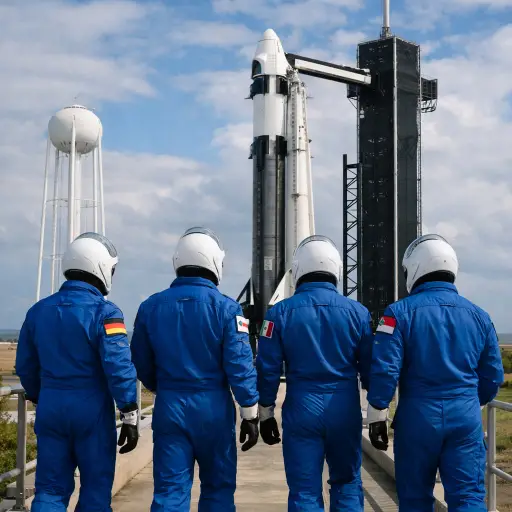
A Quiet Shift Toward Strategic Autonomy in Human Spaceflight

As the future of low Earth orbit enters a period of uncertainty, Europe is preparing to take a decisive step that signals a broader transformation in the global space landscape. The European Space Agency is advancing plans for a fully European-led astronaut mission to the International Space Station, relying on commercial launch capabilities while asserting independent operational control. The initiative, understated but highly strategic, reflects Europe’s determination to secure its place in the next era of human spaceflight.
For decades, Europe’s presence in orbit has been built on cooperation. European astronauts have flown aboard American and Russian spacecraft, contributing to scientific research and technological development on the International Space Station. This collaborative model has yielded significant achievements, but it has also left Europe without direct control over its access to space. As the station approaches the end of its operational life, that dependency is becoming a strategic concern.
The planned mission represents a turning point. By organizing and managing its own crewed flight, Europe is testing the framework for a future in which it can act not only as a partner, but as a principal actor. The use of a commercially available spacecraft underscores a pragmatic approach: rather than building a new human-rated launch system from scratch, Europe is leveraging existing infrastructure while focusing on mission leadership, training, and long-term planning.
At its core, the mission is about continuity. The retirement of the International Space Station will leave a gap in human presence in low Earth orbit, and multiple players are positioning themselves to shape what comes next. The United States is supporting the development of commercial space stations, while China is expanding its own orbital platform with increasing confidence. In this emerging environment, Europe faces a clear choice: remain dependent on external partners or develop the capacity to act independently.
European officials are framing the mission as a bridge. It allows the agency to maintain astronaut expertise, sustain scientific output, and refine operational capabilities during a transitional period. Just as importantly, it sends a signal to policymakers and industry leaders across the continent that human spaceflight is no longer a peripheral ambition, but a central component of Europe’s technological and geopolitical strategy.
The timing is significant. Global competition in space is intensifying, not only in exploration but in infrastructure, communications, and economic activity. Low Earth orbit is increasingly viewed as a domain of strategic importance, where presence translates into influence. By stepping forward with its own mission, Europe is acknowledging that access to space is not merely a scientific endeavor, but a matter of long-term sovereignty.
There are challenges ahead. Europe does not yet possess an independent crewed launch system, and the development of such a capability would require sustained political commitment and financial investment. The diversity of member states, while a strength in terms of collaboration, can complicate decision-making and slow progress. Yet the current initiative suggests a growing consensus that the status quo is no longer sufficient.
Industry is playing a crucial role in this shift. European aerospace companies are exploring new concepts for crew transport, orbital habitats, and in-space services. The mission serves as a catalyst, aligning public and private interests around a shared objective: ensuring that Europe remains an active participant in human spaceflight beyond the current generation of infrastructure.
The astronauts themselves will carry symbolic weight. A fully European crew, operating under European leadership, represents more than a technical milestone. It embodies a broader narrative of capability and ambition, reinforcing the idea that Europe can define its own path in space. For younger generations, it offers a tangible vision of participation in a field that is rapidly evolving.
International cooperation is unlikely to disappear. Space has long been a domain where collaboration transcends political boundaries, and Europe will continue to work with partners around the world. However, the balance is shifting. Autonomy and partnership are no longer mutually exclusive; instead, they are becoming complementary pillars of a more complex strategy.
As preparations move forward, the mission is being watched closely by other spacefaring nations. It is not a dramatic break from the past, but rather a subtle recalibration. Europe is not abandoning cooperation, nor is it seeking confrontation. Instead, it is positioning itself to engage on more equal terms, with the flexibility to pursue its own priorities when necessary.
In the broader context of global space activity, this development may appear incremental. Yet its implications are far-reaching. The ability to plan and execute an independent astronaut mission is a foundational step toward a more self-reliant space policy. It lays the groundwork for future decisions about infrastructure, exploration, and economic participation in orbit.
The coming years will determine whether Europe can build on this momentum. Success will depend on sustained investment, clear strategic direction, and the willingness to embrace new models of collaboration with industry. If those elements align, the mission now taking shape could mark the beginning of a new chapter—one in which Europe is not only present in space, but actively shaping its future.
In a domain defined by long timelines and high stakes, quiet moves can carry significant weight. Europe’s planned mission is one such move, signaling a shift that may only become fully apparent in hindsight. For now, it stands as a statement of intent: a commitment to remain in orbit, on its own terms.