Chancellor Friedrich Merz moves to stabilize a €100 billion defense program amid industrial tensions and rising calls for European strategic autonomy

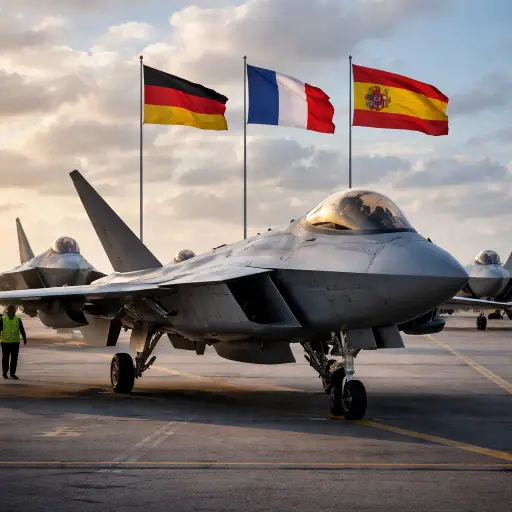
Germany has moved decisively to preserve one of Europe’s most ambitious defense projects, as Chancellor Friedrich Merz pledged to secure the future of a joint next-generation fighter jet program developed alongside France and Spain. The initiative, widely regarded as a cornerstone of Europe’s long-term military capability, has been under increasing strain due to disputes between industrial partners and diverging national priorities.
The project, valued at roughly €100 billion, aims to deliver a new generation of combat aircraft designed to replace existing fleets and ensure Europe’s competitiveness in advanced military aviation. It forms part of a broader system integrating drones, artificial intelligence, and networked warfare capabilities, reflecting a shift toward highly coordinated and technologically sophisticated defense platforms.
However, tensions between key industry players in Germany and France have cast uncertainty over the program’s trajectory. Disagreements have emerged over workshare distribution, intellectual property rights, and leadership roles within the consortium. These disputes, while not unusual in multinational projects of this scale, have grown increasingly visible and politically sensitive, threatening to delay critical development phases.
Berlin’s intervention signals a clear political determination to prevent the collapse or fragmentation of the program. Speaking with unusual directness, Merz emphasized that the project is not merely an industrial collaboration but a strategic imperative. His government views the fighter initiative as essential to maintaining Europe’s defense sovereignty at a time of shifting geopolitical realities.
The move comes against a backdrop of heightened security concerns across the continent. European governments have been reassessing their defense postures, driven by evolving global tensions and a renewed awareness of the need for independent capabilities. In this context, reliance on external suppliers, particularly in high-end military technology, is increasingly seen as a vulnerability.
Germany’s push to stabilize the fighter jet program reflects this broader shift. By committing political capital to the project, Berlin is attempting to ensure that Europe retains control over critical defense technologies and avoids fragmentation in its military-industrial base. Officials have framed the effort as a step toward greater strategic cohesion within the European Union.
France, for its part, has consistently advocated for strong European leadership in defense innovation. Yet differences in industrial philosophy and national interests have complicated cooperation. French stakeholders have sought a central role in design and development, while German partners have pushed for a more balanced distribution of responsibilities. Spain, the third partner in the program, has largely played a mediating role but remains invested in securing meaningful participation for its own aerospace sector.
Industry insiders suggest that the disagreements are as much about long-term influence as they are about immediate technical responsibilities. Control over key components of the project could shape Europe’s defense industry for decades, affecting jobs, exports, and technological leadership.
Despite these challenges, there is broad consensus among political leaders that abandoning the program is not an option. The scale of investment already committed, combined with the strategic importance of the project, has created strong incentives to find a compromise. Germany’s latest move appears designed to accelerate that process and prevent further delays.
Analysts note that the success or failure of this initiative will carry implications far beyond the defense sector. It is seen as a test case for Europe’s ability to execute large-scale collaborative projects in an increasingly competitive and uncertain global environment. A breakdown in cooperation could reinforce perceptions of fragmentation, while a successful outcome would demonstrate the viability of deeper integration.
The program also highlights the growing intersection between politics and industrial policy. Governments are no longer passive stakeholders but active participants shaping outcomes in strategic industries. In the case of the fighter jet project, political intervention is being used to bridge gaps that market forces alone have been unable to resolve.
At the same time, questions remain about timelines and costs. Large defense programs are notoriously prone to delays and budget overruns, and the added complexity of multinational coordination only increases these risks. Ensuring transparency and maintaining public support will be crucial as the project moves forward.
For Germany, the stakes are particularly high. As Europe’s largest economy, it faces expectations to lead not only in funding but also in aligning divergent interests among partners. Merz’s commitment signals a willingness to assume that role, even as it requires navigating delicate political and industrial negotiations.
The coming months are likely to be critical. Negotiations between companies and governments are expected to intensify, with a focus on resolving outstanding disputes and establishing a clear framework for cooperation. Observers will be watching closely for signs of progress or further friction.
Ultimately, the future of the fighter jet program will depend on whether the participating nations can reconcile their competing priorities in pursuit of a shared strategic vision. Germany’s intervention has bought time and injected momentum, but it has not eliminated the underlying challenges.
What is clear is that the project has become a symbol of Europe’s broader ambitions. In an era defined by geopolitical uncertainty and technological competition, the ability to act collectively in areas of strategic importance is increasingly seen as essential. The outcome of this effort will help define not only the future of European defense, but also the credibility of its aspirations for greater autonomy on the global stage.