A Strategic Push for Ethical Governance and Technological Balance

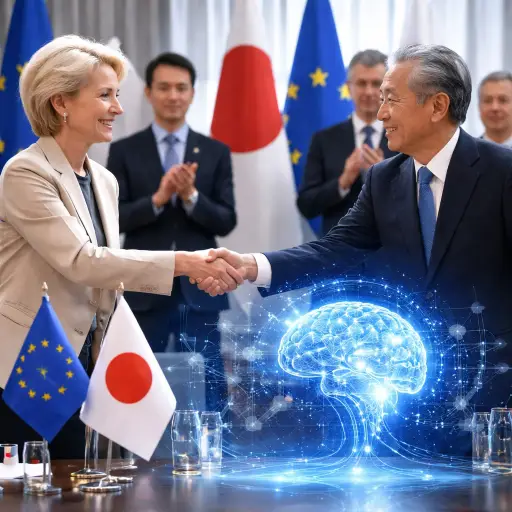
In a move set to reshape the global landscape of artificial intelligence, the European Union and Japan have unveiled a sweeping partnership aimed at establishing shared governance standards, enhancing data cooperation, and accelerating innovation. The agreement reflects a growing determination among advanced economies to assert influence over the rules governing AI, at a time when technological leadership is increasingly concentrated between the United States and China.
The initiative brings together two of the world’s most influential regulatory and industrial blocs, combining Europe’s assertive stance on digital regulation with Japan’s reputation for precision engineering and forward-looking technology policy. Officials on both sides describe the partnership as a natural alignment of values, grounded in a shared commitment to human-centric AI, transparency, and accountability.
At the heart of the agreement lies a coordinated effort to develop interoperable frameworks for AI governance. These frameworks are expected to address issues ranging from algorithmic transparency and bias mitigation to safety testing and certification. By harmonizing standards, the EU and Japan aim to reduce fragmentation in global AI regulation and offer an alternative model that prioritizes ethical safeguards without stifling innovation.
One of the central pillars of the partnership is the facilitation of trusted cross-border data flows. Recognizing that data is the lifeblood of modern AI systems, both parties have pledged to strengthen mechanisms that allow data to move securely and efficiently between jurisdictions. This includes aligning privacy protections, enhancing cybersecurity cooperation, and promoting the use of privacy-enhancing technologies. The goal is to create a digital corridor where innovation can thrive without compromising fundamental rights.
The collaboration also places a strong emphasis on joint research and development. European and Japanese institutions are expected to deepen cooperation in areas such as advanced robotics, generative AI, and smart infrastructure. By pooling expertise and resources, the partnership seeks to accelerate breakthroughs while ensuring that emerging technologies remain aligned with democratic values.
Industry leaders have welcomed the announcement, viewing it as a stabilizing force in an increasingly uncertain regulatory environment. For multinational companies, the prospect of aligned standards across major markets offers a clearer pathway for deployment and compliance. At the same time, startups and research organizations stand to benefit from expanded access to funding, talent exchanges, and collaborative platforms.
Geopolitically, the agreement carries significant weight. As the United States continues to rely on a more market-driven approach to AI development and China advances its state-led model, the EU-Japan alliance positions itself as a third force advocating for balanced governance. Analysts suggest that this alignment could influence international norms, particularly in multilateral forums where rules for emerging technologies are still being negotiated.
The partnership also signals a broader shift in how technological alliances are formed. Rather than focusing solely on competition, the EU and Japan are emphasizing cooperation as a means of maintaining strategic autonomy. By working together, they aim to reduce dependence on external technologies while strengthening their own ecosystems.
Critics caution that the success of the initiative will depend on its implementation. Aligning regulatory systems across different legal and cultural contexts is a complex undertaking, and there are concerns about potential delays or inconsistencies. However, proponents argue that the shared principles underpinning the agreement provide a strong foundation for progress.
Looking ahead, the partnership is expected to expand beyond governance into practical applications. Pilot projects in areas such as healthcare, climate modeling, and urban mobility are already being discussed, with the aim of demonstrating how ethical AI can deliver tangible benefits to society. These initiatives are likely to serve as test cases for the broader framework, offering insights into how standards can be applied in real-world scenarios.
The announcement comes at a pivotal moment, as governments worldwide grapple with the rapid advancement of AI technologies. Questions about regulation, accountability, and global coordination are becoming increasingly urgent, and the EU-Japan alliance represents one of the most comprehensive attempts to address them collaboratively.
By combining regulatory leadership with technological expertise, the European Union and Japan are seeking to shape the future of artificial intelligence on their own terms. Whether this partnership can effectively counterbalance the dominance of other global powers remains to be seen, but its ambition and scope mark a significant step toward a more coordinated and values-driven approach to AI governance.