Rising aerial activity signals widening security concerns as tensions linked to the Ukraine-Russia conflict edge closer to Northern Europe

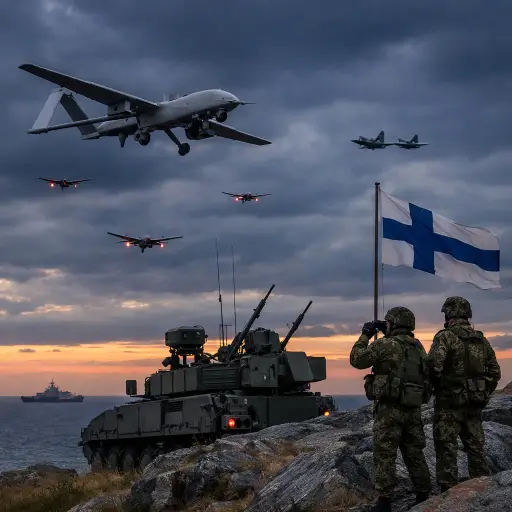
Finland has reported a series of suspected drone incursions along its Baltic frontier, prompting heightened alert levels among defense officials and raising fresh concerns about the geographic spread of instability tied to the ongoing war between Ukraine and Russia.
Authorities in Helsinki have described the incidents as unusual and persistent, involving unidentified unmanned aerial vehicles detected near sensitive maritime and coastal zones. While officials have stopped short of attributing the activity to any specific state actor, the pattern and timing have intensified speculation that the incursions may be connected to broader military signaling in the region.
The sightings come amid a period of escalating tensions across Eastern Europe, where the conflict in Ukraine continues to reshape security dynamics far beyond its immediate borders. Analysts note that Northern Europe, long considered relatively insulated from direct confrontation, is now increasingly exposed to indirect forms of pressure, including surveillance operations and airspace probing.
Finnish defense officials have confirmed that radar systems and coastal monitoring units registered multiple aerial anomalies over recent days. Some of these objects reportedly demonstrated advanced maneuverability and flight endurance, characteristics commonly associated with military-grade drones rather than civilian devices.
The Finnish government has responded by reinforcing surveillance measures and coordinating closely with regional partners. Military readiness has been quietly adjusted, with increased patrols along strategic waterways and enhanced cooperation with allied forces operating in the Baltic Sea.
Security experts suggest that such incursions may serve multiple purposes. Beyond intelligence gathering, they can test response times, identify vulnerabilities, and send calculated political messages without crossing into overt military confrontation. In this context, the incidents are being interpreted as part of a broader pattern of hybrid tactics that blur the line between peace and conflict.
The developments have also drawn attention from neighboring countries, many of which have reported similar episodes of unexplained aerial activity in recent months. This growing trend underscores a shift in how modern conflicts unfold, with unmanned systems playing an increasingly prominent role in strategic competition.
Public reaction within Finland has been measured but attentive. Officials have emphasized that there is no immediate threat to civilian safety, while also acknowledging the seriousness of the situation. The government has urged calm, even as it underscores the importance of vigilance in an evolving security environment.
Meanwhile, diplomatic channels remain active. Finnish representatives are engaging with European and transatlantic partners to share intelligence and coordinate responses. The aim is to ensure that any potential escalation is managed collectively, reducing the risk of miscalculation.
The Baltic region has long held strategic importance due to its proximity to key NATO members and its access to vital shipping routes. Recent events suggest that it may once again become a focal point in the broader geopolitical contest unfolding across Europe.
As the situation develops, analysts warn that these drone incursions could mark an early phase of a wider pattern of activity. While not constituting direct aggression, they reflect a growing willingness to operate in gray zones, where ambiguity can be leveraged to exert pressure without triggering immediate retaliation.
For Finland, a country that has historically balanced caution with preparedness, the challenge now lies in responding firmly while avoiding unnecessary escalation. The coming weeks are likely to be critical in determining whether these incidents remain isolated or evolve into a more sustained feature of regional security tensions.
In a landscape already shaped by uncertainty, the appearance of drones over the Baltic horizon serves as a stark reminder that the ripple effects of the Ukraine-Russia conflict continue to extend far beyond the battlefield, reaching into new territories and testing the resilience of Europe’s northern flank.