Leaked communications and mounting political outrage deepen divisions within the European Union, raising fears over unity and trust at a critical geopolitical moment

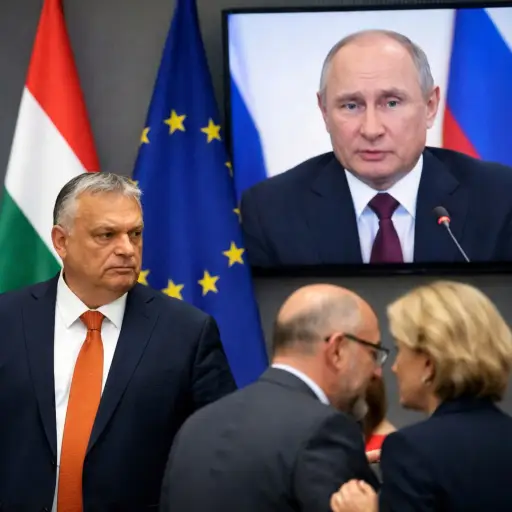
As the European Union grapples with ongoing geopolitical tensions and an increasingly fragile internal consensus, a new controversy has erupted at its heart. Hungary now finds itself under intense scrutiny following allegations that it has acted in alignment with Russian interests during key EU deliberations. The accusations, fueled by leaked communications and unusually sharp rhetoric from European leaders, have triggered one of the most serious internal disputes the bloc has faced in recent years.
According to multiple diplomatic sources, recently surfaced recordings of private discussions appear to suggest a pattern of coordination between Hungarian officials and representatives linked to Moscow. While the full authenticity and context of the leaks remain under review, their contents have sent shockwaves through European institutions. The recordings reportedly indicate that Hungary may have signaled its positions on sanctions and policy measures in ways that align closely with Russian strategic objectives.
The reaction from other EU member states has been swift and, in some cases, unusually blunt. Several senior officials have described the alleged behavior as “sinister” and “repulsive,” language that underscores the level of frustration and concern within the bloc. For many leaders, the issue extends beyond policy disagreements and into questions of trust, loyalty, and the fundamental cohesion of the union.
At the center of the controversy lies the EU’s sanctions regime against Russia, a cornerstone of its collective response to ongoing security challenges in Eastern Europe. These measures require unanimity among member states, giving each country significant leverage. Hungary has previously delayed or softened certain sanctions packages, citing national economic interests, particularly in the energy sector. However, the latest allegations suggest that these positions may not be purely domestic calculations but part of a broader alignment.
Hungarian officials have strongly rejected the accusations, describing them as politically motivated and lacking credible evidence. Government representatives insist that their actions are guided solely by national interest and a pragmatic approach to diplomacy. They argue that Hungary’s energy dependence and economic vulnerabilities necessitate a more cautious stance than that of some of its European partners.
Despite these denials, the political fallout continues to intensify. Diplomats across Brussels report a growing sense of unease, with some member states quietly discussing mechanisms to limit the ability of individual countries to block critical decisions. Proposals to reform voting procedures, including expanding qualified majority voting in foreign policy matters, are gaining renewed attention, though such changes would themselves require broad consensus.
The controversy also comes at a particularly sensitive time for the European Union. As it seeks to present a unified front on global issues, internal divisions risk undermining its credibility on the international stage. Analysts warn that perceived fractures within the bloc could be exploited by external actors, further complicating an already volatile geopolitical environment.
Beyond institutional concerns, the situation raises deeper questions about the nature of political alignment within the EU. The union has long prided itself on accommodating diverse perspectives while maintaining a shared commitment to common values. However, the current dispute highlights the limits of that balance, especially when strategic interests appear to diverge sharply.
Public opinion within Europe is also beginning to reflect the tension. In several member states, political leaders face increasing pressure to take a firmer stance, while others caution against escalating rhetoric that could further strain relations. The challenge lies in addressing the allegations without pushing the bloc toward deeper fragmentation.
For now, the European Commission and other key institutions are proceeding cautiously, emphasizing the need for verification and due process. At the same time, informal diplomatic channels are working to contain the fallout and prevent the dispute from derailing broader policy agendas.
As investigations continue and political positions harden, the controversy surrounding Hungary’s alleged role is likely to remain a defining issue in European politics. Whether it leads to meaningful reforms or further entrenches divisions will depend on how leaders navigate the delicate balance between accountability and unity.
What is clear, however, is that the episode has exposed vulnerabilities within the European project—vulnerabilities that may prove difficult to ignore in the months ahead.