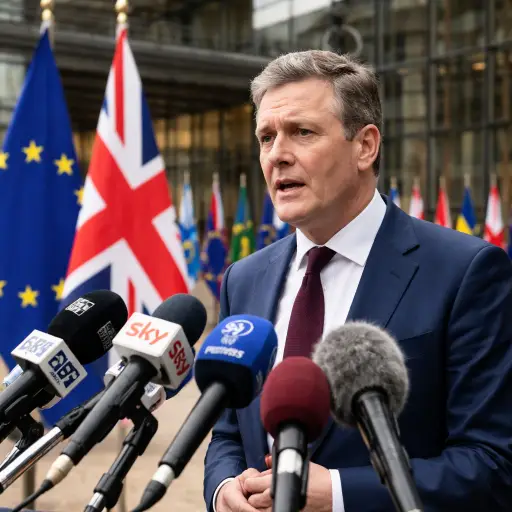
Keir Starmer seeks closer defense and trade ties with Europe as shifting geopolitics challenge NATO cohesion and reshape post-Brexit strategy

In a move that signals a significant shift in Britain’s foreign policy direction, Prime Minister Keir Starmer is actively pursuing a renewed alliance with the European Union, seeking deeper cooperation on defense and trade as global instability intensifies.
The initiative reflects growing concern within the UK government over the changing security landscape, particularly in light of escalating tensions involving Iran and broader uncertainties surrounding the long-term reliability of NATO commitments. Officials in London increasingly view closer alignment with European partners as a strategic necessity rather than a political choice.
Starmer’s outreach to EU leaders marks one of the clearest indications yet of a post-Brexit recalibration. While the United Kingdom formally left the bloc years ago, the evolving geopolitical environment has exposed the limits of operating independently in matters of continental security and economic resilience.
At the heart of the proposed partnership is defense cooperation. British officials are exploring frameworks that would allow for more coordinated military planning, intelligence sharing, and joint procurement initiatives with EU member states. The aim is to bolster Europe’s collective security architecture at a time when traditional alliances face mounting strain.
The urgency of the effort has been amplified by fears that NATO, long regarded as the cornerstone of Western defense, could face weakening political cohesion. Uncertainty over future commitments from key allies has prompted European governments to consider more autonomous security arrangements. In this context, the UK’s military capabilities and intelligence infrastructure are seen as valuable assets for a strengthened European defense posture.
Trade is the second pillar of Starmer’s strategy. Economic disruptions stemming from global conflicts and supply chain vulnerabilities have renewed interest in reducing barriers between the UK and the EU. While there is no indication of a return to full single market membership, discussions are reportedly focused on targeted agreements in critical sectors such as energy, technology, and manufacturing.
Diplomatic sources suggest that Starmer’s approach is deliberately pragmatic. Rather than reopening divisive debates over Brexit, the government is framing the initiative as a forward-looking partnership grounded in shared interests. This messaging is intended to appeal both to European counterparts and to a domestic audience wary of revisiting past political battles.
Reactions within the EU have been cautiously positive. Several member states, particularly those in Eastern and Northern Europe, have expressed openness to enhanced cooperation with the UK, especially in defense. However, officials in Brussels are expected to seek clear commitments and structured agreements before moving forward, mindful of the complexities that have defined UK-EU relations since Brexit.
The proposal also carries significant political implications at home. Starmer must balance the strategic benefits of closer EU ties with sensitivities among voters who remain divided over Britain’s relationship with the bloc. By emphasizing security and economic stability, the government hopes to build a consensus that transcends earlier divisions.
Analysts note that the initiative could mark the beginning of a broader realignment in European geopolitics. As global power dynamics shift and regional conflicts intensify, traditional alliances are being reassessed. The UK’s move to re-engage with the EU reflects a recognition that cooperation, rather than isolation, may offer the most effective path forward.
Whether this effort will lead to a formalized partnership remains uncertain. Negotiations are likely to be complex, and both sides will need to navigate legal, political, and institutional challenges. Nevertheless, the direction of travel is clear: Britain is seeking to redefine its role in Europe at a time when unity may prove essential.
As global instability continues to test existing frameworks, the UK’s push for a new EU alliance underscores a broader reality facing Western nations. In an increasingly unpredictable world, strategic partnerships are once again becoming the foundation of security and prosperity.