Scientists uncover thriving ecosystems fueled by bat guano deep inside Earth’s darkest caves

In the silent depths of the world’s caves, where sunlight has never reached and life was long assumed to be sparse, scientists are now uncovering a surprising reality: entire ecosystems flourishing in complete darkness. At the center of this discovery lies an unlikely driver of life—bat guano.
Recent research has revealed that bat droppings, long regarded simply as organic waste, form the foundation of intricate subterranean ecosystems. These findings are reshaping how scientists understand biodiversity in extreme environments and highlighting the profound ecological importance of bats beyond their role in pollination and insect control.
Deep within cave systems, colonies of bats gather in vast numbers, sometimes reaching into the millions. Over time, their droppings accumulate into large deposits, creating nutrient-rich mounds in otherwise barren environments. For decades, scientists knew that some organisms relied on guano as a food source. What they did not anticipate was the sheer complexity and scale of life it supports.
“When you look closely, it’s not just a few insects feeding on waste,” explained one researcher involved in the study. “It’s a fully functioning ecosystem with multiple trophic levels, interactions, and even specialized adaptations that allow species to survive in total darkness.”
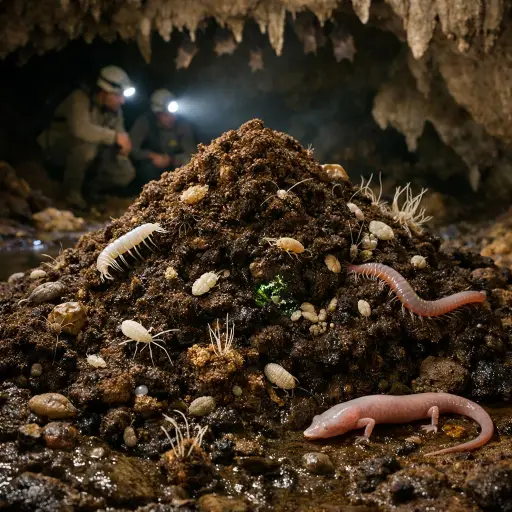
These guano-based ecosystems are composed of a wide array of organisms, including bacteria, fungi, insects, worms, and even small vertebrates. Microorganisms begin the process by breaking down the organic material, releasing nutrients that sustain higher life forms. Insects such as beetles and flies feed directly on the guano, while predatory species, including spiders and centipedes, prey on these primary consumers.
What makes these ecosystems particularly remarkable is their independence from sunlight. Unlike surface ecosystems, which rely on photosynthesis, cave ecosystems driven by guano depend entirely on organic input from bats. This makes them one of the clearest examples of ecosystems sustained by external nutrient sources rather than internal energy production.
The biodiversity within these systems is striking. Many of the species discovered are highly specialized and found nowhere else on Earth. Some have evolved to be completely blind, relying instead on heightened senses of touch or chemical detection to navigate their environment. Others exhibit pale or translucent bodies, having lost pigmentation over generations in the absence of light.
Scientists believe that these ecosystems may be far more widespread than previously thought. Similar environments have now been identified in caves across multiple continents, suggesting that guano-based ecosystems could represent a global phenomenon. Each cave, however, hosts its own unique community of organisms, shaped by local conditions such as temperature, humidity, and the species of bats present.
The discovery carries important implications for conservation. Bats are often misunderstood and, in some regions, threatened by habitat loss, disease, and human disturbance. The realization that entire ecosystems depend on their presence adds a new dimension to their ecological significance.
“If bat populations decline, these cave ecosystems could collapse,” researchers warn. “We’re not just talking about losing one species, but potentially dozens or even hundreds that depend on this delicate balance.”
There are also broader scientific implications. The ability of life to thrive in such extreme, lightless environments offers insights into the adaptability of organisms and the limits of life on Earth. Some scientists suggest that studying these systems could even inform the search for life beyond our planet, particularly in environments where sunlight is absent, such as subsurface oceans on icy moons.
At the same time, the discovery underscores how much remains unknown about Earth’s hidden environments. Despite centuries of exploration, caves continue to yield new species and reveal unexpected ecological dynamics. Advances in technology, including genetic sequencing and micro-sensing equipment, are allowing researchers to study these environments in unprecedented detail.
Yet, these fragile ecosystems face increasing threats. Human activity, including tourism, mining, and pollution, can disrupt the delicate balance within caves. Even small changes in temperature or humidity can have cascading effects on the organisms that depend on stable conditions.
Researchers emphasize the need for careful management and protection of cave environments. Limiting human disturbance, preserving bat populations, and monitoring environmental changes are all critical steps in safeguarding these newly recognized ecosystems.
As exploration continues, scientists expect more discoveries to emerge from beneath the surface. Each new finding adds to a growing understanding that life is far more resilient and adaptable than once believed.
In the darkness of bat caves, what was once dismissed as waste is now recognized as the foundation of life. These hidden ecosystems serve as a powerful reminder that even in the most unlikely places, nature finds a way to thrive.
And as researchers continue to uncover the secrets of these subterranean worlds, one thing is becoming increasingly clear: the story of life on Earth is still being written, often in places we have only just begun to explore.