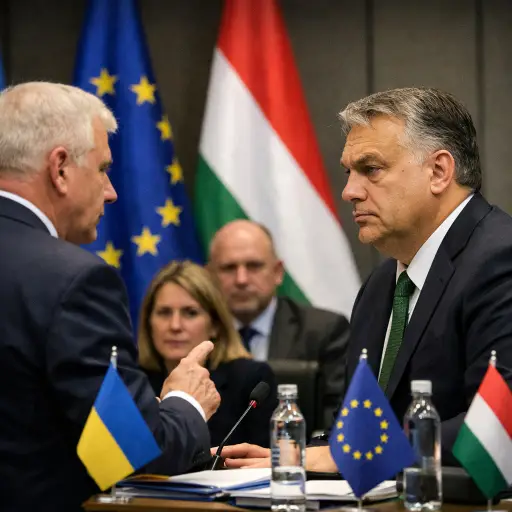
Brussels explores legal workarounds to unlock critical financing for Kyiv amid rising tensions over unity and sovereignty

In the heart of Brussels, a growing standoff between the European Union and Hungary is testing the bloc’s ability to act decisively in one of its most consequential geopolitical moments. As Ukraine continues to rely heavily on Western support for its defence and economic stability, EU officials are intensifying efforts to circumvent Budapest’s persistent veto over a major financial assistance package.
The proposed €90bn loan, designed to provide long-term macro-financial support to Ukraine, has become a focal point of both urgency and division. For many EU leaders, the package is not only a financial instrument but a strategic necessity, aimed at sustaining Ukraine’s war effort and preventing broader instability on the continent. Yet Hungary’s refusal to endorse the plan has forced Brussels into uncharted legal and political territory.
Hungarian Prime Minister Viktor Orbán has repeatedly voiced concerns over the scale and structure of the aid, arguing that such commitments risk overextending EU resources and infringing on national sovereignty. His government has also linked its opposition to broader disputes with Brussels over rule-of-law conditions and frozen EU funds, adding another layer of complexity to the impasse.
Behind closed doors, EU officials are now examining alternative mechanisms that could allow the majority of member states to move forward without unanimous consent. These options include intergovernmental agreements outside the formal EU framework or the use of enhanced cooperation procedures, both of which would mark a significant departure from the bloc’s traditional consensus-driven approach.
Diplomats describe the situation as a delicate balancing act. On one hand, there is a pressing need to deliver timely support to Ukraine, whose financial and military resilience remains closely tied to external assistance. On the other, bypassing a member state risks setting a precedent that could reshape the internal dynamics of the union.
The debate has reignited longstanding questions about the limits of unanimity within the EU, particularly in areas of foreign policy and financial solidarity. Several member states have expressed frustration with what they see as the disproportionate influence of a single country over decisions with continent-wide implications. At the same time, there is caution about eroding mechanisms designed to protect national interests.
As discussions intensify, the political temperature across Europe is rising. Some governments are openly advocating for treaty reforms that would reduce the scope of veto powers, while others warn against hastily altering the institutional balance. The outcome of this standoff may therefore have implications far beyond the immediate issue of Ukraine aid.
For Kyiv, the stakes could hardly be higher. The funding is expected to support essential government functions, infrastructure repairs, and defence-related expenditures at a time when domestic revenues remain under severe strain. Delays or uncertainty in EU assistance risk complicating Ukraine’s broader financial planning and undermining confidence among international partners.
Meanwhile, public opinion across the EU remains largely supportive of Ukraine, though signs of fatigue are beginning to emerge in some countries. This shifting mood adds further pressure on policymakers to demonstrate both effectiveness and unity, even as internal disagreements persist.
Whether through compromise, legal innovation, or political recalibration, the EU faces a critical test of its capacity to respond collectively to external crises while managing internal dissent.
In the corridors of power, one reality is increasingly clear: the question is no longer whether the EU can act, but how far it is willing to go to ensure that action is not held hostage by division.