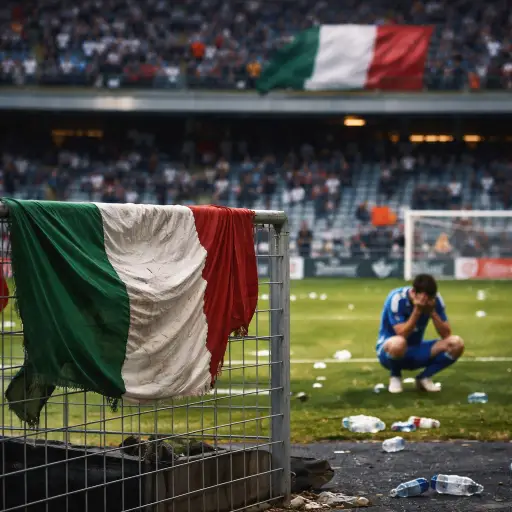
A proud game faces institutional collapse, fading competitiveness, and a race against time to save its fut

Italian football, once a global standard-bearer of tactical excellence and institutional strength, now finds itself navigating one of the most turbulent periods in its modern history. A cascade of failures—on the pitch, in governance, and across infrastructure—has exposed deep structural weaknesses that many insiders argue have been ignored for far too long.
The most symbolic moment of this crisis arrived with the resignation of the national federation’s president, a move that followed yet another disappointing international campaign. The departure, long anticipated by critics, has left a leadership vacuum at a time when decisive direction is urgently needed. What was framed as an act of accountability has instead underscored the absence of a coherent long-term vision for the sport in the country.
At the heart of the turmoil lies the national team’s ongoing struggle to reclaim its competitive identity. Once synonymous with discipline and resilience, Italy’s recent performances have been marked by inconsistency, tactical confusion, and an inability to nurture a new generation capable of sustaining its historic legacy. The failure to meet expectations on the global stage has not only bruised national pride but has also intensified scrutiny on the federation’s development systems.
Observers point to a fragmented youth pipeline as a critical weakness. While other European nations have invested heavily in modern academies and data-driven scouting, Italy’s system remains uneven, often dependent on traditional methods that struggle to adapt to the evolving demands of the modern game. Promising talents exist, but the pathway from grassroots to elite competition appears increasingly disjointed.
Compounding the sporting decline is a mounting crisis in infrastructure. Stadiums across the country, many of them relics of past decades, have become emblematic of broader stagnation. Outdated facilities, bureaucratic delays, and a lack of coordinated investment have hindered efforts to modernize the football environment. This issue has taken on new urgency as Italy faces growing uncertainty over its role as host of a major upcoming European tournament.
Concerns from governing bodies about the readiness of key venues have sparked fears that hosting rights could be reconsidered. Such a scenario would represent not only a logistical setback but also a significant blow to the country’s international standing in football. The tournament had been seen as an opportunity to catalyze long-overdue reforms; instead, it now risks becoming another symbol of missed potential.
Financial instability within domestic clubs adds another layer of complexity. While Italy’s top league retains global appeal, many teams continue to grapple with debt, inconsistent revenue streams, and reliance on short-term solutions. The gap between ambition and sustainability has widened, raising questions about the long-term viability of the current model.
Amid this backdrop, calls for reform have grown louder. Former players, coaches, and analysts have urged a comprehensive overhaul that goes beyond superficial changes. Proposals range from restructuring the federation’s governance framework to implementing nationwide standards for youth development and accelerating stadium redevelopment projects. Yet translating these ideas into action has proven difficult, often hindered by political inertia and competing interests.
Despite the bleak outlook, there remains a sense that the crisis could serve as a turning point. Italian football has demonstrated resilience in the past, emerging from scandals and setbacks with renewed purpose. The current moment, however, demands a level of unity and strategic clarity that has so far been elusive.
For supporters, the situation evokes a mixture of frustration and cautious hope. The passion for the game remains undiminished, filling stadiums and sustaining one of the richest football cultures in the world. But passion alone will not be enough to reverse the decline.
As the federation searches for new leadership and the country confronts the possibility of losing its place on a major European stage, the stakes could hardly be higher. The decisions made in the coming months will shape not only the immediate future of Italian football but also its identity for generations to come.
Whether this period will be remembered as the beginning of a long descent or the catalyst for meaningful renewal remains uncertain. What is clear is that Italian football stands at a crossroads, with little margin left for delay.