Google’s quiet rollout of free AI video tools signals a turning point where anyone can become a filmmaker overnight

For years, the promise of AI-generated video hovered just out of reach—impressive demos, closed beta tests, and expensive tools reserved for studios and specialists. That barrier has now fallen. In a move that feels less like an announcement and more like a sudden shift in gravity, Google has begun rolling out AI video and music generation directly into everyday apps, making creation not just easier, but effectively universal.
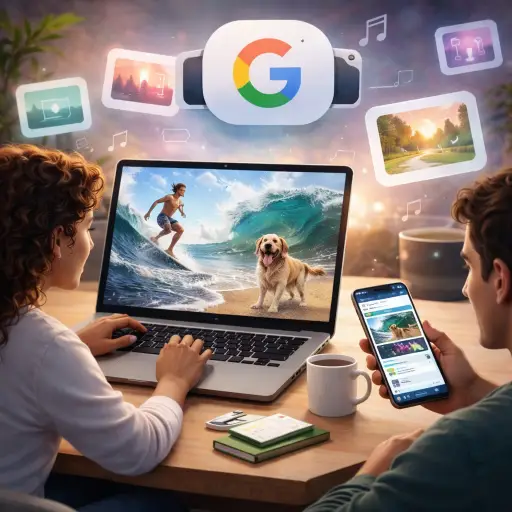
At the center of this shift is its Veo 3.1 model, a system capable of turning simple prompts into fully realized video sequences. What makes this moment different is not just the technology itself, but where it lives. No longer confined to niche platforms or professional software, these tools are being embedded into familiar environments—places where billions of people already work, communicate, and create.
The result is immediate: the distance between an idea and a finished video has collapsed.
Until now, video production has been defined by friction. Cameras, editing software, timelines, rendering pipelines—each step required time, skill, and often money. Even the rise of smartphones and social platforms, while democratizing distribution, did not eliminate the complexity of production. Creating something polished still demanded effort.
AI video changes that equation entirely. With Veo 3.1, a user can describe a scene—a sunset over a futuristic city, a documentary-style narration, a product demo—and receive a coherent, stylized video in return. Add music, adjust tone, refine pacing, all through natural language. The interface disappears. The tool becomes conversational.
This is not an incremental improvement. It is a redefinition of authorship.
The timing matters. The rollout arrives in a moment already saturated with short-form content, where attention is fragmented and visual storytelling dominates communication. By lowering the barrier to entry even further, Google is not just competing in the AI race; it is reshaping the supply side of media itself.
Every user becomes a potential creator. Every message can become a video.
There is an almost playful irony to the release. Coming at a moment often associated with pranks and surprises, the shift feels deceptively light at first glance. A new feature. A clever tool. But beneath that surface lies something far more consequential: the industrialization of creativity.
If anyone can generate high-quality video on demand, the scarcity that once defined the medium disappears. The value of production decreases, while the value of ideas—and perhaps authenticity—rises.
This raises immediate questions for industries built around content creation. Advertising, filmmaking, education, journalism—each relies, in different ways, on the cost and expertise required to produce video. When those constraints vanish, the competitive landscape shifts.
Small businesses can produce cinematic ads without agencies. Teachers can generate custom visual lessons in minutes. Independent creators can compete with studios not just in reach, but in production quality. The gatekeepers of visual media begin to lose their leverage.
At the same time, the floodgates open.
An explosion of content is inevitable. The internet, already dense with images and videos, will become exponentially more saturated. Discovery becomes harder. Trust becomes more fragile. The line between what is captured and what is generated blurs further.
Google, aware of these tensions, is embedding safeguards and provenance signals into its systems. But the broader cultural impact will not be determined by technology alone. It will depend on how people choose to use it.
There is also a deeper shift taking place beneath the surface: the evolution of creativity itself.
For decades, creative work has been tied to craft—the mastery of tools, the accumulation of technical skill. AI challenges that foundation. When execution becomes trivial, creativity moves upstream. The focus shifts from how something is made to what is imagined.
In this new landscape, prompting becomes a form of direction. Iteration becomes instantaneous. The creative process accelerates, becoming more fluid, more experimental, and, in some ways, more accessible.
But accessibility does not automatically mean equality.
Those who understand how to guide these systems—how to frame ideas, refine outputs, and shape narratives—will have an advantage. A new kind of literacy emerges, one that blends storytelling with system thinking.
The question is no longer who can make a video, but who can make one that matters.
There is also the human factor. As AI-generated media becomes indistinguishable from traditional production, audiences may begin to seek signals of authenticity more actively. Imperfection, once seen as a limitation, could become a marker of trust.
Ironically, the rise of synthetic media may increase the value of the real.
For Google, the strategy is clear. By integrating AI video into widely used platforms, it ensures rapid adoption. The tools do not need to be downloaded or learned in isolation. They appear where users already are, turning everyday interactions into creative opportunities.
This is how technologies become infrastructure—quietly, pervasively, and irreversibly.
What comes next is less predictable. Will this lead to a renaissance of creativity, with millions of new voices entering the visual conversation? Or will it result in a homogenized landscape, shaped by the underlying biases and patterns of AI systems?
The answer is likely both.
What is certain is that the future of video is no longer a distant concept. It has arrived, embedded in the tools people use every day, waiting to be explored.
The camera is no longer the gatekeeper. The editor is no longer the bottleneck. The studio is no longer a place.
It is a prompt.
And for the first time, it belongs to everyone.