From sculptural silhouettes to scarf reinventions, a season of expressive dressing turns the runway into a stage

The mood in fashion right now is unmistakably bold. As the new season unfolds, designers are no longer flirting with experimentation—they are fully immersed in it. What was once considered eccentric has become the new baseline, and what was once wearable has been pushed toward something more theatrical, more emotional, and far less predictable.
Across major runways, the message is clear: subtlety is taking a back seat. In its place comes a kind of visual storytelling that feels closer to performance than presentation. Silhouettes have grown sharper, stranger, and more sculptural. Shoulders rise and curve in exaggerated arcs, waists cinch dramatically, and skirts flare into shapes that feel architectural rather than purely functional. Clothing is no longer just worn—it is staged.
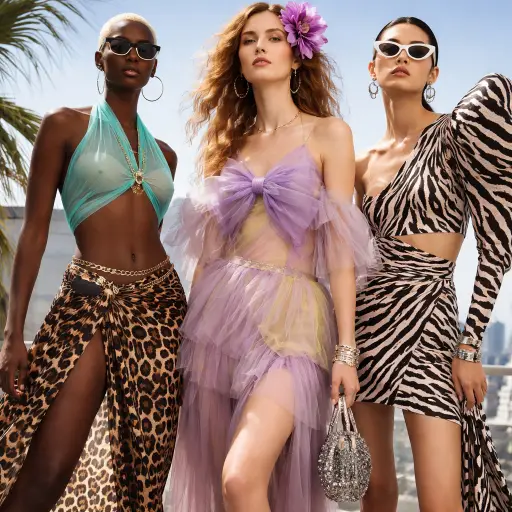
One of the most striking developments is the return of animal prints, but not in their traditional, predictable forms. Leopard, zebra, and reptilian patterns have been reimagined in oversized proportions, clashing palettes, and unexpected placements. Instead of serving as accents, they dominate entire looks. A full zebra-print ensemble paired with metallic accessories, or a leopard motif layered over sheer fabrics, signals a shift away from classic styling toward something more daring and layered.
At the same time, a contrasting aesthetic has emerged: what some insiders are calling “poetic whimsy.” This softer, dreamlike approach leans heavily on translucent fabrics, pastel tones, and fluid movement. Tulle, organza, and chiffon appear in cascading layers, often styled with an almost improvisational feel. Bows are oversized, flowers are exaggerated, and garments seem to float rather than sit on the body. It’s a deliberate embrace of fantasy—one that stands in tension with the sharper, more aggressive silhouettes seen elsewhere.
Perhaps the most talked-about transformation this season, however, is the reinvention of the scarf. Once a simple accessory, it has become one of the most versatile—and symbolic—pieces in contemporary wardrobes. Designers have turned scarves into skirts, tops, dresses, and even hybrid garments that defy easy categorization. A silk scarf tied asymmetrically can now function as a statement top, while layered scarves can create movement and texture in place of traditional tailoring.
This shift speaks to a broader trend: adaptability. In a fashion landscape increasingly shaped by individuality, garments are expected to do more than serve a single purpose. The scarf, with its inherent flexibility, has become the perfect canvas for this idea. It allows wearers to experiment, to personalize, and to engage directly with the act of styling.
Underlying all of these trends is a deeper cultural shift toward expressive dressing. There is a growing sense that clothing should communicate something beyond taste or status—it should reflect mood, identity, and even narrative. This has led to looks that feel almost theatrical in their execution. Outfits are being composed with the same intentionality as costumes, with each element contributing to a larger visual story.
Street style is already echoing this movement. In urban centers, it is no longer unusual to see individuals mixing dramatically oversized pieces with delicate, whimsical details, or pairing bold prints with unexpected textures. The result is a kind of controlled chaos—an aesthetic that feels spontaneous but is, in fact, carefully constructed.
Critics might argue that such experimentation risks alienating those who prefer practicality. Yet even within this wave of maximalism, there are entry points. A single statement piece—a sculptural jacket, a scarf worn as a top, or a boldly patterned skirt—can transform an otherwise simple outfit. The emphasis is not on abandoning wearability altogether, but on expanding its definition.
Retailers, too, are beginning to adapt. Collections are increasingly designed with modularity in mind, allowing consumers to reinterpret pieces in multiple ways. This reflects an understanding that modern fashion is as much about participation as it is about consumption. The wearer is no longer a passive recipient of trends, but an active collaborator.
As the season continues, one thing is certain: the boundaries of fashion are being redrawn in real time. The interplay between structure and softness, between boldness and whimsy, suggests a moment of creative freedom that feels both refreshing and unpredictable.
In this landscape, the most important rule may be that there are no rules left to follow. Instead, there is only the invitation to experiment—to take risks, to play with form, and to embrace the idea that fashion, at its most compelling, is not just about how we look, but about how we choose to express ourselves.