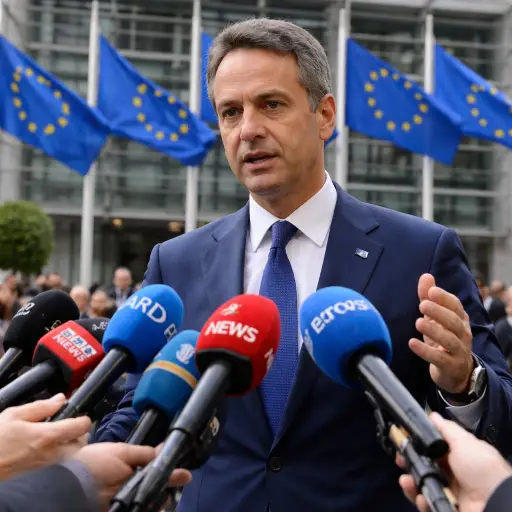
Mounting pressure on European prosecutors as allegations involving lawmakers shake political confidence and test institutional credibility

The Greek government has stepped up calls for a faster and more decisive response from European authorities investigating an expanding corruption scandal that has begun to cast a shadow over the country’s political landscape. Prime Minister Kyriakos Mitsotakis is urging European prosecutors to accelerate their inquiry into allegations involving members of parliament, warning that delays risk undermining both public trust and political stability.
Speaking with increasing urgency, Mitsotakis framed the issue not only as a national concern but as a broader test of European accountability mechanisms. According to officials familiar with the government’s position, Athens believes the pace of the investigation has failed to match the seriousness of the allegations, which include claims of financial misconduct, misuse of public funds, and improper influence over state contracts.
The case has grown steadily in scope, with investigators examining links between political figures and private entities that allegedly benefited from preferential treatment. While no final conclusions have been reached, the mere existence of the probe has intensified scrutiny on the ruling party and raised questions about internal oversight.
Government aides say Mitsotakis is keenly aware of the political risks. With public frustration already heightened by economic pressures and lingering institutional distrust, the perception of inaction could prove damaging. By pressing European prosecutors to move faster, the prime minister appears to be attempting to demonstrate transparency while distancing his administration from any wrongdoing.
At the European level, the investigation falls under the remit of the European Public Prosecutor’s Office, which has jurisdiction over crimes affecting the EU’s financial interests. However, the complexity of cross-border financial flows and the need to coordinate with national authorities have slowed progress. Legal experts note that such cases often require extensive documentation and careful procedural steps, making rapid conclusions difficult.
Still, critics argue that the current pace risks eroding confidence in the very institutions designed to safeguard integrity. Opposition parties in Greece have seized on the issue, calling for greater accountability and suggesting that delays could allow potential misconduct to go unpunished. Some lawmakers have demanded parliamentary inquiries alongside the European investigation, further intensifying political pressure.
Within the ruling party, the scandal has exposed underlying tensions. While party leadership has publicly supported the investigation, there are concerns that prolonged uncertainty could weaken cohesion. Several members have called for a clearer communication strategy, emphasizing the need to reassure voters that the government remains committed to ethical governance.
Analysts say the situation reflects a broader challenge facing European institutions: balancing thorough legal processes with the need for timely action. “There is always a tension between due diligence and urgency,” one policy expert noted. “But in politically sensitive cases, delays can carry significant costs.”
For Mitsotakis, the stakes are both immediate and long-term. A swift resolution could help contain political fallout and reinforce his government’s reform agenda. Conversely, a prolonged investigation—especially one that yields damaging findings—could reshape the political landscape and embolden opposition forces.
Public sentiment remains fluid. While many citizens support a comprehensive investigation, there is growing impatience with what some perceive as bureaucratic inertia. Civil society groups have called for greater transparency from both national and European authorities, arguing that regular updates could help maintain public confidence.
European prosecutors, for their part, have acknowledged the sensitivity of the case while reiterating their commitment to independence and legal rigor. Officials have indicated that the investigation is ongoing and that all necessary steps are being taken to ensure its integrity. However, they have stopped short of providing a clear timeline, citing the complexity of the evidence.
As the situation unfolds, the intersection of national politics and European oversight is becoming increasingly apparent. The outcome of the investigation could have implications beyond Greece, potentially influencing how similar cases are handled across the EU.
For now, Mitsotakis’s call for urgency underscores a broader message: that accountability must not only be pursued, but seen to be pursued. In a climate where public trust is fragile, the speed and transparency of the response may prove just as important as the findings themselves.