Washington signals readiness for rapid action as tensions over the Strait of Hormuz and regional security reach a volatile new peak

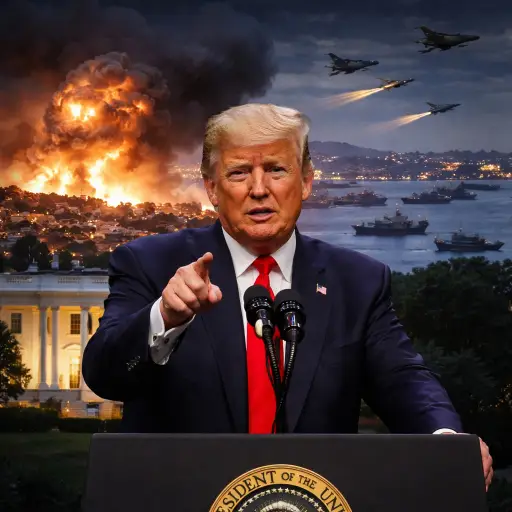
As global attention shifts once again to the fragile balance of power in the Middle East, U.S. President Donald Trump has sharply intensified his rhetoric toward Iran, warning that the United States could “destroy” the Islamic Republic in a single night. His remarks, delivered with characteristic bluntness, have sparked renewed concern among diplomats, military analysts, and international observers who fear that the window for de-escalation may be narrowing rapidly.
Speaking in a forceful tone, Trump suggested that a decisive military operation could be imminent if Iran fails to meet U.S. demands. Chief among these is the reopening of the Strait of Hormuz, a strategic maritime corridor through which a significant portion of the world’s oil supply flows. The president also reiterated threats of targeted strikes against critical Iranian infrastructure, including power plants and bridges, framing such actions as necessary leverage to compel compliance.
The comments mark a notable escalation in an already tense standoff. For months, relations between Washington and Tehran have deteriorated amid accusations of regional destabilization, maritime disruptions, and proxy conflicts. However, Trump’s latest statements go further, introducing a sense of immediacy that has unsettled allies and adversaries alike.
Security experts warn that such rhetoric carries real risks. While the United States maintains overwhelming military superiority, a rapid strike against Iran could trigger a broader regional conflict with unpredictable consequences. Iran, for its part, has repeatedly signaled that it would respond to any attack with force, potentially targeting U.S. assets and allies across the region.
The Strait of Hormuz remains a central flashpoint in the dispute. Any prolonged closure or disruption could have immediate repercussions for global energy markets, driving up oil prices and straining economies far beyond the Middle East. Shipping companies and insurers are already assessing heightened risks, while governments are quietly reviewing contingency plans.
Within Washington, reactions have been mixed. Some officials view Trump’s hardline stance as a strategic effort to pressure Iran into negotiations, arguing that credible threats are essential to achieving diplomatic breakthroughs. Others, however, caution that the language being used may limit diplomatic flexibility and increase the likelihood of miscalculation.
Internationally, calls for restraint have grown louder. European leaders, as well as key actors in Asia and the Gulf, have urged both sides to return to dialogue. Behind the scenes, diplomatic channels remain active, though progress appears limited. Analysts note that the current environment is shaped not only by geopolitical rivalry but also by domestic political pressures in both countries.
In Tehran, officials have dismissed Trump’s threats as provocative and destabilizing, while emphasizing their readiness to defend national sovereignty. State media has framed the situation as part of a broader pattern of Western aggression, reinforcing a narrative that resonates with domestic audiences.
Despite the heated rhetoric, some experts believe that both sides may still seek to avoid open conflict. Military confrontation, they argue, would carry immense costs and risks for all involved. Yet the combination of strong language, military posturing, and high-stakes demands has created a volatile atmosphere in which a single misstep could escalate rapidly.
As the situation evolves, the international community watches closely. The coming days are widely seen as critical in determining whether tensions will ease through diplomacy or intensify toward confrontation. For now, uncertainty prevails, with the prospect of sudden escalation casting a long shadow over the region and beyond.