Tennis prodigy embraces the spotlight—but warns the sport may be crossing a line

As the clay season gathers momentum on the Mediterranean coast, all eyes turn once again to Carlos Alcaraz, the young star whose rise has redefined the pace and personality of modern tennis. Yet ahead of his highly anticipated appearance in Monte Carlo, the Spaniard is making headlines for reasons that go beyond forehands and footwork.
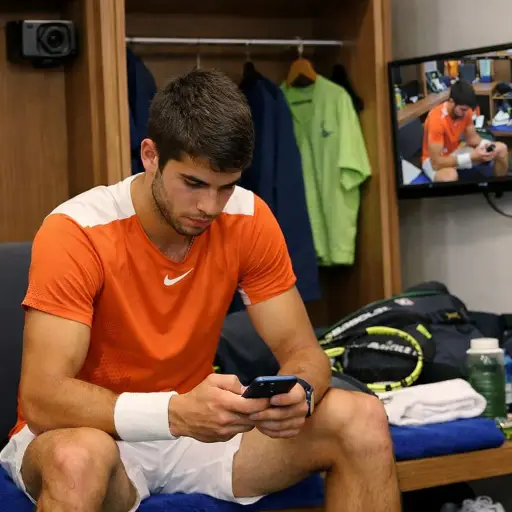
In a candid moment with reporters, Alcaraz revealed the extent to which his life—both on and off the court—is now under constant observation. Cameras, once confined to match play and press duties, have increasingly found their way into spaces traditionally considered private. The locker room, he suggested with a mix of humor and unease, is no longer exempt.
“You can probably see what I’m doing on my phone,” he joked, a remark delivered lightly but carrying a more serious undertone. The comment, while playful, underscores a growing tension between the demands of global sports entertainment and the personal boundaries of its biggest stars.
The expansion of behind-the-scenes access is not new. Over the past few seasons, tennis—like many global sports—has embraced a more immersive media approach. Streaming platforms, social media teams, and tournament organizers are all vying to bring fans closer to the action, offering unprecedented glimpses into players’ routines, emotions, and preparation.
For audiences, the appeal is undeniable. Fans are no longer limited to televised matches; they can now witness pre-match rituals, recovery sessions, and candid interactions that humanize even the most elite competitors. In many ways, this access has helped broaden tennis’s reach, particularly among younger viewers who crave authenticity and constant engagement.
But for players, the line between access and intrusion is becoming increasingly blurred.
Alcaraz, widely regarded as one of the sport’s most grounded and media-savvy figures, is not calling for a rollback of innovation. Instead, his remarks suggest a need for recalibration. The issue, he implies, is not the presence of cameras, but their placement—and the expectation that nothing remains off-limits.
Those close to the tour note that the pressure extends beyond visibility. Continuous monitoring can affect how athletes relax, communicate, and mentally prepare. The locker room, historically a sanctuary for focus and recovery, risks losing its function if players feel they are perpetually on display.
There is also a broader cultural shift at play. In an era defined by digital transparency, the boundaries between public and private life have eroded—not just for athletes, but for public figures across industries. Tennis, with its global appeal and individual-centric narratives, sits at the forefront of this transformation.
Yet Alcaraz’s voice carries particular weight. Still early in his career, he represents a generation that has grown up alongside social media but is now confronting its unintended consequences. His willingness to speak openly—without confrontation, but with clarity—signals a maturing perspective on what it means to be a modern sports icon.
Tournament organizers and governing bodies are likely to take note. While fan engagement remains a priority, there is increasing recognition that athlete well-being must be preserved. Finding that balance will be crucial, especially as tennis continues to evolve in an increasingly competitive entertainment landscape.
For now, Alcaraz remains focused on the court, where expectations remain as high as ever. Monte Carlo marks another chapter in his development on clay, a surface that demands patience, resilience, and tactical precision—qualities he has shown in abundance.
But as he prepares to compete, his off-court message lingers.
In a sport built on tradition yet driven by innovation, the question is no longer whether fans should be brought closer to the game. It is how close is too close—and who gets to decide.