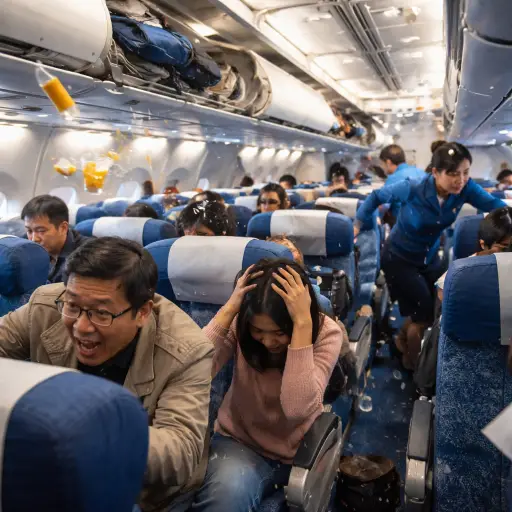
A series of violent in-flight incidents over China during the Easter travel period is renewing concerns about passenger safety, crew preparedness, and the growing impact of atmospheric instability on aviation

For many travelers, turbulence remains an invisible threat—an unpredictable force that turns routine flights into moments of intense anxiety. High above the earth, where aircraft cruise in seemingly calm skies, sudden jolts can transform a quiet cabin into a scene of fear within seconds. Over the recent Easter travel period, that fear became reality for passengers aboard a domestic flight operated by China Southern Airlines, as well as several other aircraft crossing Chinese airspace.
Passengers on the China Southern flight, expecting a standard journey, instead found themselves gripping armrests as the aircraft was struck by severe turbulence. According to accounts shared after landing, the cabin experienced abrupt vertical drops and violent shaking that sent unsecured items flying. Overhead compartments reportedly opened under pressure, and drinks spilled across aisles as startled passengers struggled to remain seated.
“I thought the plane was falling,” one passenger said, describing the sensation of weightlessness followed by sudden impact. Others recounted screams echoing through the cabin, while flight attendants attempted to maintain order despite the instability.
The incident was not isolated. Aviation authorities and tracking data suggest that multiple flights across different regions of China encountered strong turbulence during the same period. Meteorologists point to shifting atmospheric conditions, including unstable air masses and jet stream irregularities, as contributing factors.
Turbulence itself is not uncommon, nor is it inherently dangerous in most cases. Modern aircraft are engineered to withstand far greater stress than what typical turbulence produces. However, the experience can be deeply unsettling for passengers, particularly when it occurs without warning. Injuries, though relatively rare, often result from passengers or crew not being properly secured at the moment of impact.
What made this series of events notable was both the intensity reported and the concentration of incidents within a short timeframe. Aviation analysts note that such clustering raises questions about forecasting accuracy and whether current systems adequately capture rapidly evolving atmospheric patterns.
Clear-air turbulence, one of the most dangerous forms, is especially difficult to detect. Unlike turbulence associated with visible storm systems, it occurs in cloudless regions and often without prior visual cues. Pilots rely on weather data, radar, and reports from other aircraft, but even these tools can fail to provide sufficient warning.
The psychological impact on passengers should not be underestimated. Fear of turbulence is one of the most common forms of flight anxiety, and incidents like these can reinforce that fear, even among frequent travelers. Aviation psychologists emphasize that while the sensation can be alarming, the structural integrity of modern aircraft remains highly reliable.
Airlines, including China Southern, are expected to review the events and assess whether additional measures could improve passenger safety and communication. These may include stricter enforcement of seatbelt use during cruising, enhanced crew training for severe turbulence scenarios, and more proactive announcements when unstable conditions are anticipated.
Experts also highlight a broader trend: climate change may be contributing to an increase in turbulence intensity and frequency. Warmer atmospheric conditions can amplify wind shear and disrupt established air currents, creating more volatile flying environments. While research is ongoing, early findings suggest that turbulence encounters could become more common in the coming years.
For now, aviation authorities continue to stress that flying remains one of the safest modes of transportation. Still, the recent experiences over China serve as a stark reminder that even in an age of advanced technology, the skies retain an element of unpredictability.
As passengers disembarked from the affected flights, many carried with them not just their luggage, but the lingering memory of moments when control seemed uncertain. For some, it may fade with time. For others, it will reshape how they view every future journey above the clouds.