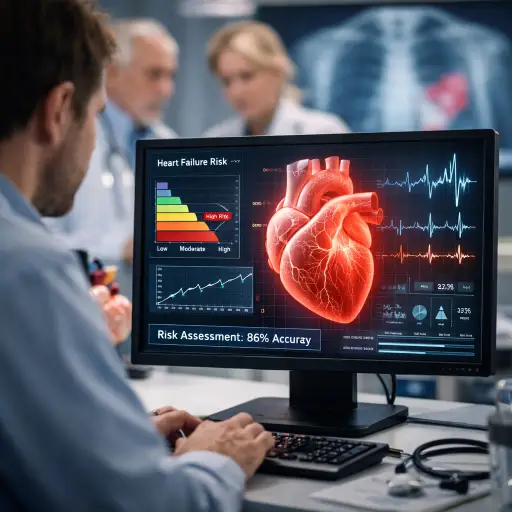
Oxford scientists unveil a simple tool capable of predicting cardiac risk years in advance, opening new frontiers in preventive medicine

AI Breakthrough Offers Early Warning for Heart Failure
A quiet but potentially transformative breakthrough has emerged from one of the world’s leading research centers, where scientists have developed a new artificial intelligence tool capable of predicting the risk of heart failure years before symptoms appear. The innovation, created by a research team in Oxford, could mark a turning point in how cardiovascular disease is detected, monitored, and ultimately prevented.
Heart failure remains one of the most pressing global health challenges, affecting tens of millions of people worldwide. Often developing silently over years, the condition is typically diagnosed only after irreversible damage has occurred. By that point, treatment focuses less on prevention and more on management. The newly developed AI tool seeks to change that paradigm entirely.
At the core of the system is a machine learning model trained on vast datasets of patient health records, imaging results, and routine clinical measurements. By analyzing subtle patterns that may escape even experienced clinicians, the tool can identify early warning signs of cardiac dysfunction long before traditional diagnostic methods would detect them.
In testing, the system demonstrated an accuracy rate of 86 percent in predicting the likelihood of heart failure within a five-year window. Researchers say this level of precision is not only statistically significant but clinically meaningful, offering physicians a powerful new instrument in the fight against cardiovascular disease.
Unlike many advanced diagnostic technologies, the Oxford tool is designed to be simple and accessible. It does not require expensive equipment or highly specialized procedures. Instead, it can work with data already collected during standard medical check-ups, such as blood tests, blood pressure readings, and basic imaging scans. This ease of integration could allow the tool to be deployed widely, including in healthcare systems with limited resources.
The implications for patient care are profound. Early identification of risk creates an opportunity for intervention at a stage when the heart is still relatively healthy. Lifestyle modifications, medication adjustments, and closer monitoring could significantly reduce the likelihood of progression to full-blown heart failure.
Researchers involved in the project emphasize that the goal is not to replace doctors, but to enhance their decision-making capabilities. Artificial intelligence, they argue, is best used as a supportive tool, augmenting human expertise rather than substituting it. By flagging high-risk individuals early, clinicians can focus their attention where it is needed most.
The development also reflects a broader trend in medicine, where predictive analytics is becoming an increasingly important component of healthcare. Rather than reacting to disease after it emerges, healthcare systems are gradually shifting toward proactive strategies that aim to anticipate and prevent illness.
However, as with any new technology, challenges remain. Questions around data privacy, algorithm transparency, and clinical validation will need to be addressed before widespread adoption can occur. Ensuring that the system performs equally well across diverse populations is another critical consideration, as biases in training data could impact accuracy.
Despite these hurdles, the early results have generated considerable optimism within the medical community. Experts suggest that tools like this could eventually become a standard part of routine care, much like blood pressure monitors or cholesterol tests.
For patients, the promise is simple but powerful: more time. Time to act, to adapt, and to avoid a life-altering diagnosis. For healthcare providers, it offers a new level of insight into one of the most complex and consequential conditions they face.
As artificial intelligence continues to evolve, its role in medicine is likely to expand rapidly. The Oxford team’s work stands as a compelling example of how technology can be harnessed not just to treat disease, but to foresee it—and perhaps, in some cases, prevent it altogether.